Bian Wenjie, Xin Yue, Bao Jing, Gong Pihua, Li Ran, Wang Keqiang, Xi Wen, Chen Yanwen, Ni Wentao, Gao Zhancheng
Department of Respiratory and Critical Care Medicine, Peking University People's Hospital, Beijing, People's Republic of China.
Risk Manag Healthc Policy. 2024 Dec 4;17:2971-2980. doi: 10.2147/RMHP.S476812. eCollection 2024.
Pneumocystis Pneumonia (PCP), primarily affecting individuals with weakened immune systems, is a severe respiratory infection caused by pneumocystis jirovecii and can lead to acute respiratory failure (ARF). In this article, we explore the risk factors of ARF and propose a prognostic model of ARF for PCP patients.
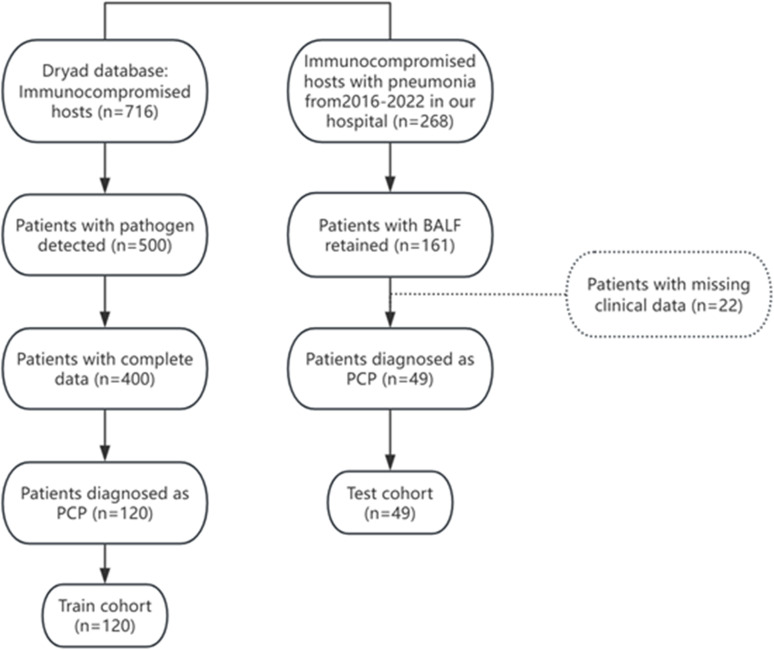
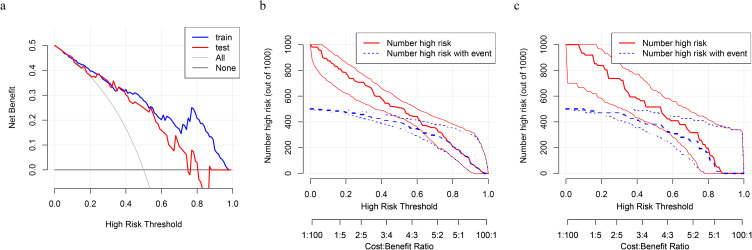
In this multi-center, retrospective study in 6 secondary or tertiary academic hospitals in China, 120 PCP patients were screened from the Dryad database for the development of a predictive model. A total of 49 patients from Peking University People's Hospital were collected for external validation. Crucial clinical features of these patients are selected applying univariate and multivariate logistic regression analysis. We established an intuitive nomogram. Receiver operating characteristic (ROC) curve, calibration curve, decision curve analysis (DCA) and clinical impact curve (CIC) were plotted to evaluate the model's performance.
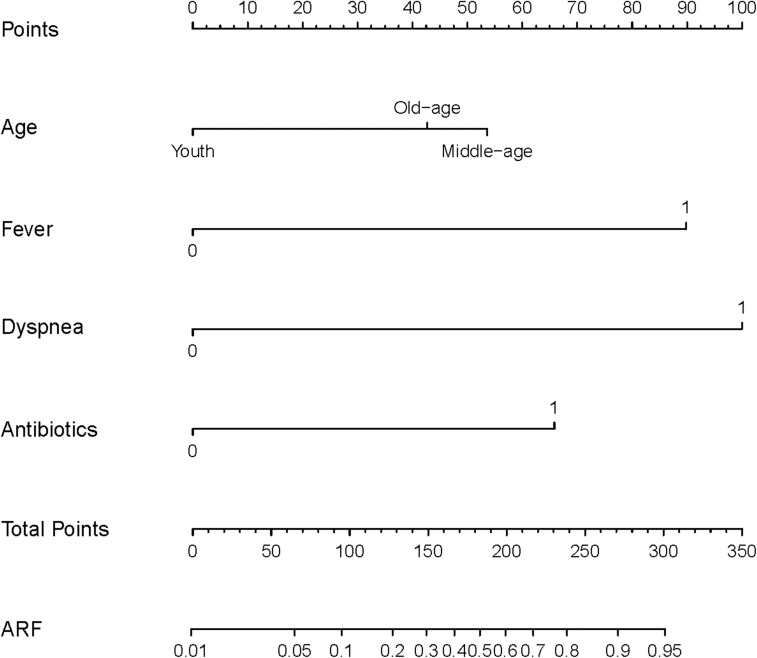
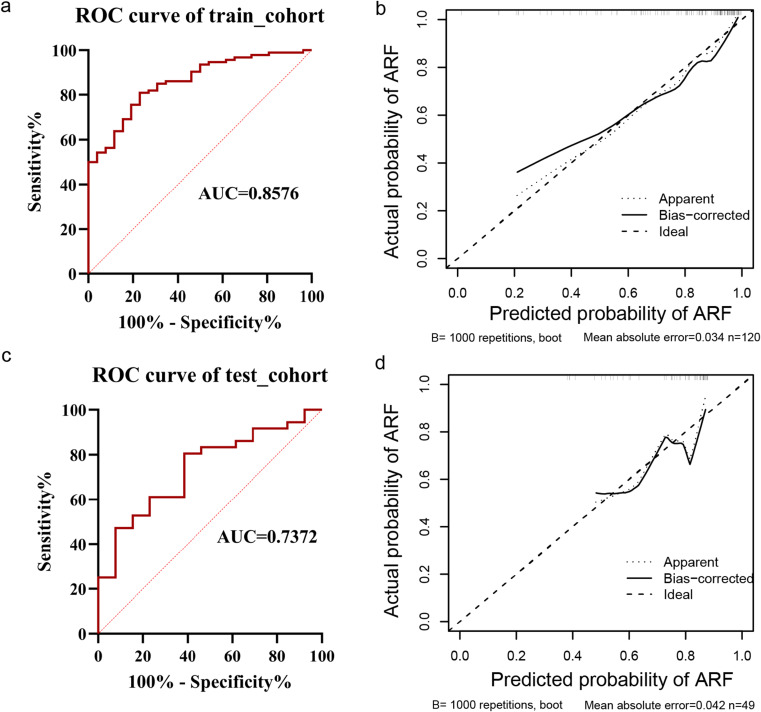
A cohort of 120 patients formed the training cohort for the development of the model, with 49 patients constituting the test cohort. Univariate and multivariate logistic regression analysis identified five risk factors associated with ARF, which are age, fever, dyspnea, high neutrophil count and use of antibiotics. A nomogram was then proposed based on these factors. The area under the ROC curve (AUROC) in the development group has reached 0.8576, while the validation group has an AUROC of 0.7372, indicating commendable ability for predicting ARF. In addition, results for Hosmer-Lemeshow test indicate the effectiveness of our model. Furthermore, DCA and CIC curves demonstrate excellent clinical benefit.
We present a nomogram for predicting ARF in non-HIV related PCP patients. The prognostic model may provide references in clinical medicine, promote timely treatment and improve therapeutic outcomes of PCP patients.
肺孢子菌肺炎(PCP)主要影响免疫系统较弱的个体,是由耶氏肺孢子菌引起的严重呼吸道感染,可导致急性呼吸衰竭(ARF)。在本文中,我们探讨了ARF的危险因素,并为PCP患者提出了ARF的预后模型。
在这项对中国6家二级或三级学术医院进行的多中心回顾性研究中,从Dryad数据库中筛选出120例PCP患者用于建立预测模型。北京大学人民医院共收集了49例患者进行外部验证。应用单因素和多因素逻辑回归分析选择这些患者的关键临床特征。我们建立了一个直观的列线图。绘制受试者工作特征(ROC)曲线、校准曲线、决策曲线分析(DCA)和临床影响曲线(CIC)以评估模型的性能。
一组120例患者组成了模型开发的训练队列,49例患者组成了测试队列。单因素和多因素逻辑回归分析确定了与ARF相关的五个危险因素,即年龄、发热、呼吸困难、中性粒细胞计数高和使用抗生素。然后基于这些因素提出了一个列线图。开发组的ROC曲线下面积(AUROC)达到0.8576,而验证组的AUROC为0.7372,表明对ARF具有良好的预测能力。此外,Hosmer-Lemeshow检验结果表明我们的模型是有效的。此外,DCA和CIC曲线显示出优异的临床效益。
我们提出了一个用于预测非HIV相关PCP患者ARF的列线图。该预后模型可为临床医学提供参考,促进及时治疗并改善PCP患者的治疗效果。