Saadat Seyed Hossein, Goodarzi Rakhshaneh, Elahi Zeynab, Ameri Aref
Department of Neonatology, Clinical Research Development Center of Children's Hospital, Hormozgan University of Medical Sciences, Bandar Abbas, Iran.
Department of Pediatrics, Clinical Research Development Center of Children's Hospital, Hormozgan University of Medical Sciences, Bandar Abbas, Iran.
J Clin Transl Sci. 2024 Oct 31;8(1):e183. doi: 10.1017/cts.2024.611. eCollection 2024.
Essential trace elements and micronutrients are critical in eliciting an effective immune response to combat sepsis, with selenium being particularly noteworthy. The objective of this investigation is to analyze and the levels of serum selenium in neonates within sepsis and control groups.
In 2023, a case-control study was carried out involving 66 hospitalized infants - 33 diagnosed with sepsis forming the case group and 33 free from sepsis constituting the control group - along with their mothers, at Children's and Shariati Hospitals in Bandar Abbas. The serum selenium concentrations (expressed in micrograms per deciliter) were quantified utilizing atomic absorption spectrometry. Subsequently, the data were processed and analyzed using IBM SPSS statistical software, version 22.
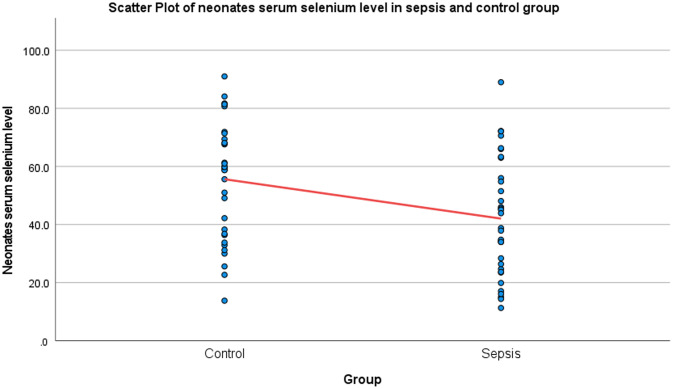
The average serum selenium level in neonates with sepsis (42.06 ± 20.40 µg/dL) was notably lower compared to the control group (55.61 ± 20.33 µg/dL), a difference that was statistically significant (-value = 0.009). The levels of serum selenium were comparable between neonates and mothers across both study groups.
The findings of this research indicate that selenium levels in the sepsis group were reduced compared to the control group, despite similar selenium levels in the mothers and neonates in both groups, suggesting that sepsis could be associated with a decrease in selenium levels.
必需微量元素和微量营养素对于引发有效的免疫反应以对抗败血症至关重要,其中硒尤为值得关注。本研究的目的是分析败血症组和对照组新生儿的血清硒水平。
2023年,在阿巴斯港的儿童医院和沙里亚蒂医院开展了一项病例对照研究,涉及66名住院婴儿——33名被诊断为败血症的婴儿组成病例组,33名无败血症的婴儿组成对照组——以及他们的母亲。血清硒浓度(以微克每分升表示)采用原子吸收光谱法进行定量。随后,使用IBM SPSS统计软件22版对数据进行处理和分析。
败血症新生儿的平均血清硒水平(42.06±20.40微克/分升)明显低于对照组(55.61±20.33微克/分升),差异具有统计学意义(P值=0.009)。两个研究组中新生儿和母亲的血清硒水平相当。
本研究结果表明,败血症组的硒水平低于对照组,尽管两组中母亲和新生儿的硒水平相似,这表明败血症可能与硒水平降低有关。