Baldridge Abigail S, Bellinger Grace C, Fleming Oriana M, Rasmussen Luke V, Whitley Eric W, Welty Leah J
Feinberg School of Medicine, Northwestern University, Chicago, IL, USA.
J Clin Transl Sci. 2024 May 17;8(1):e110. doi: 10.1017/cts.2024.533. eCollection 2024.
To better understand and prevent research errors, we conducted a first-of-its-kind scoping review of clinical and translational research articles that were retracted because of problems in data capture, management, and/or analysis.
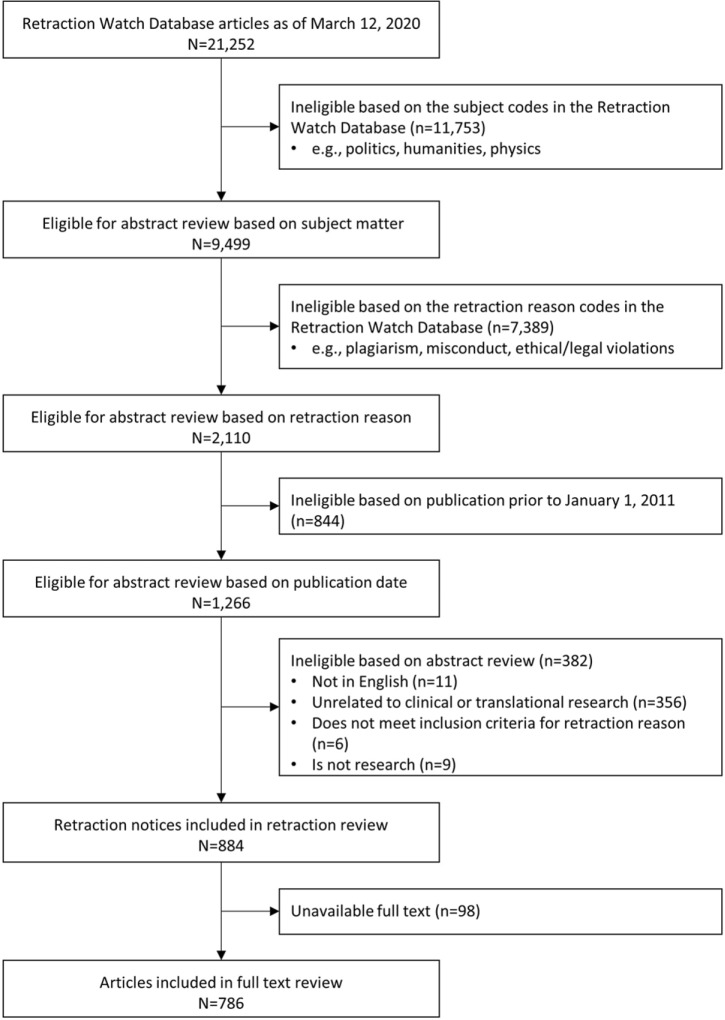
The scoping review followed a preregistered protocol and used retraction notices from the Retraction Watch Database in relevant subject areas, excluding gross misconduct. Abstracts of original articles published between January 1, 2011 and January 31, 2020 were reviewed to determine if articles were related to clinical and translational research. We reviewed retraction notices and associated full texts to obtain information on who retracted the article, types of errors, authors, data types, study design, software, and data availability.
After reviewing 1,266 abstracts, we reviewed 884 associated retraction notices and 786 full-text articles. Authors initiated the retraction over half the time (58%). Nearly half of retraction notices (42%) described problems generating or acquiring data, and 28% described problems with preparing or analyzing data. Among the full texts that we reviewed: 77% were human research; 29% were animal research; and 6% were systematic reviews or meta-analyses. Most articles collected data (77%), but only 5% described the methods used for data capture and management, and only 11% described data availability. Over one-third of articles (38%) did not specify the statistical software used.
Authors may improve scientific research by reporting methods for data capture and statistical software. Journals, editors, and reviewers should advocate for this documentation. Journals may help the scientific record self-correct by requiring detailed, transparent retraction notices.
为了更好地理解和预防研究错误,我们对因数据采集、管理和/或分析问题而被撤回的临床和转化研究文章进行了首次此类范围审查。
范围审查遵循预先注册的方案,并使用来自相关主题领域的Retraction Watch数据库的撤回通知,不包括严重不当行为。对2011年1月1日至2020年1月31日期间发表的原始文章摘要进行审查,以确定文章是否与临床和转化研究相关。我们审查了撤回通知和相关全文,以获取关于谁撤回了文章、错误类型、作者、数据类型、研究设计、软件和数据可用性的信息。
在审查了1266篇摘要后,我们审查了884份相关撤回通知和786篇全文文章。超过一半的时间(58%)是作者发起撤回。近一半的撤回通知(42%)描述了数据生成或获取方面的问题,28%描述了数据准备或分析方面的问题。在我们审查的全文中:77%是人体研究;29%是动物研究;6%是系统评价或荟萃分析。大多数文章收集了数据(77%),但只有5%描述了用于数据采集和管理的方法,只有11%描述了数据可用性。超过三分之一的文章(38%)未指定使用的统计软件。
作者可以通过报告数据采集方法和统计软件来改进科学研究。期刊、编辑和审稿人应提倡这种记录。期刊可以通过要求详细、透明的撤回通知来帮助科学记录自我纠正。