School of Information, University of Michigan, Ann Arbor, MI 48109.
Center for the Study of Complex Systems, University of Michigan, Ann Arbor, MI 48109.
Proc Natl Acad Sci U S A. 2022 Jun 21;119(25):e2119086119. doi: 10.1073/pnas.2119086119. Epub 2022 Jun 14.
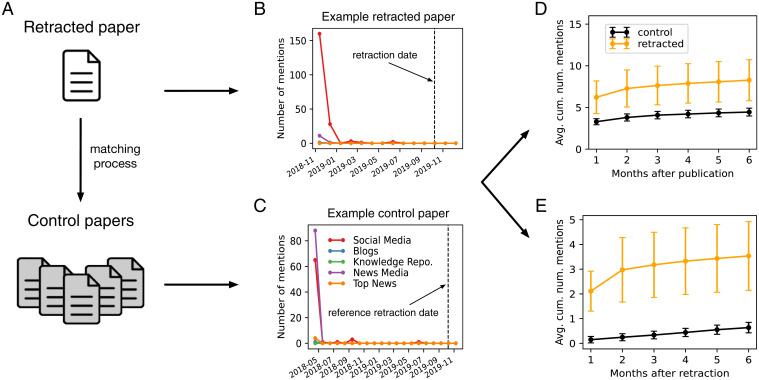
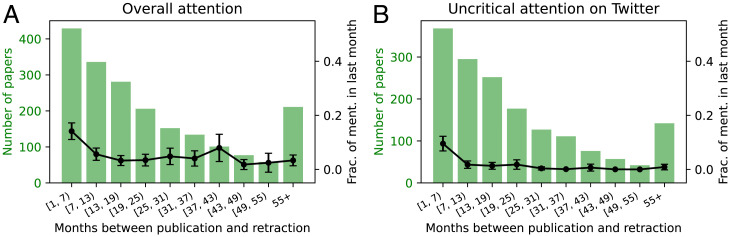
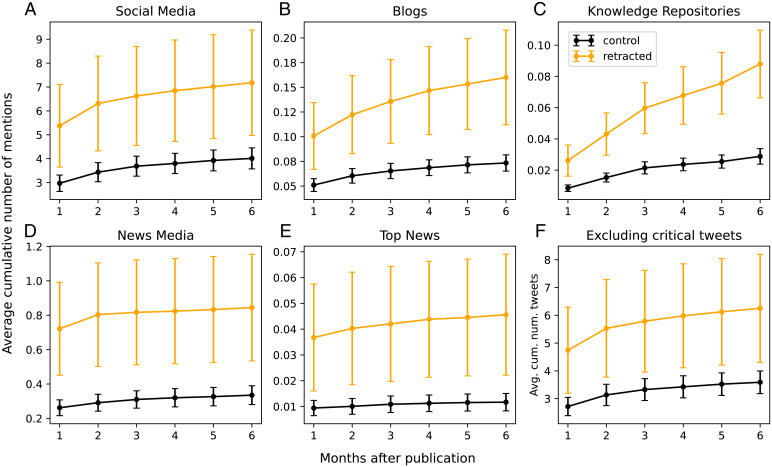
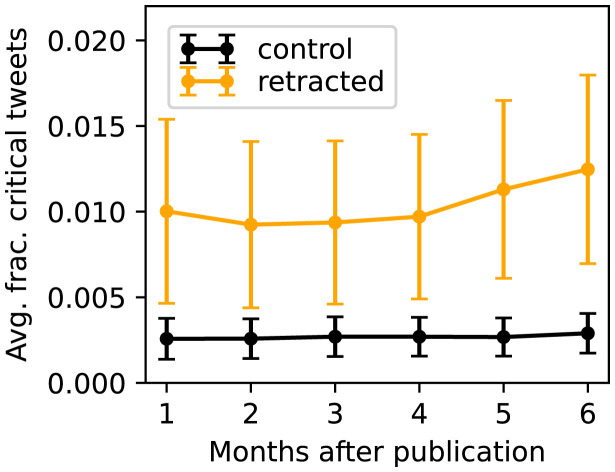
Retracted papers often circulate widely on social media, digital news, and other websites before their official retraction. The spread of potentially inaccurate or misleading results from retracted papers can harm the scientific community and the public. Here, we quantify the amount and type of attention 3,851 retracted papers received over time in different online platforms. Comparing with a set of nonretracted control papers from the same journals with similar publication year, number of coauthors, and author impact, we show that retracted papers receive more attention after publication not only on social media but also, on heavily curated platforms, such as news outlets and knowledge repositories, amplifying the negative impact on the public. At the same time, we find that posts on Twitter tend to express more criticism about retracted than about control papers, suggesting that criticism-expressing tweets could contain factual information about problematic papers. Most importantly, around the time they are retracted, papers generate discussions that are primarily about the retraction incident rather than about research findings, showing that by this point, papers have exhausted attention to their results and highlighting the limited effect of retractions. Our findings reveal the extent to which retracted papers are discussed on different online platforms and identify at scale audience criticism toward them. In this context, we show that retraction is not an effective tool to reduce online attention to problematic papers.
撤稿论文在正式撤稿前,经常在社交媒体、数字新闻和其他网站上广泛传播。撤稿论文中潜在不准确或误导性的结果传播可能会损害科学界和公众的利益。在这里,我们定量分析了 3851 篇撤稿论文在不同在线平台上随时间推移所受到的关注的数量和类型。与来自同一期刊的一组具有相似出版年份、作者数量和作者影响力的非撤稿对照论文相比,我们表明,撤稿论文不仅在社交媒体上,而且在新闻媒体和知识库等精心策划的平台上,发表后获得的关注更多,从而放大了对公众的负面影响。与此同时,我们发现,Twitter 上的帖子往往对撤稿论文的批评比对对照论文的批评更多,这表明表达批评的推文可能包含有关有问题论文的真实信息。最重要的是,在撤稿的同时,论文引发的讨论主要是撤稿事件本身,而不是研究结果,这表明此时论文已经耗尽了对其结果的关注,并突出了撤稿的有限效果。我们的研究结果揭示了撤稿论文在不同在线平台上讨论的程度,并确定了对它们的大规模受众批评。在这种情况下,我们表明,撤稿并不是减少对有问题论文的在线关注的有效工具。