Harney Brendan L, Sacks-Davis Rachel, van Santen Daniela K, Stewart Ashleigh C, Matthews Gail V, Carson Joanne M, Klein Marina B, Lacombe Karine, Wittkop Linda, Salmon Dominque, Leleux Olivier, Merchadou Laurence, van der Valk Marc, Smit Colette, Prins Maria, Boyd Anders, Berenguer Juan, Jarrin Inmaculada, Rauch Andri, Hellard Margaret E, Doyle Joseph S
Disease Elimination Program, Burnet Institute, Melbourne, Australia.
School of Public Health and Preventive Medicine, Monash University, Melbourne, Australia.
Liver Int. 2025 Jan;45(1):1-13. doi: 10.1111/liv.16203.
Historically, hepatitis C virus (HCV) was difficult to treat among people with HIV. However, treatment with direct-acting antivirals (DAAs) results in 90%-95% of people being cured. There is a need to understand why a proportion of people are not cured. We aimed to examine characteristics that may indicate an increased probability of unsuccessful DAA HCV treatment.
Data were from the International Collaboration on Hepatitis C Elimination in HIV Cohorts. People who commenced DAA HCV treatment between 2014 and 2019 were included. Unsuccessful treatment was defined as a positive HCV RNA test at a person's first RNA test at least 4 weeks (SVR4+) following the end of treatment. Multivariable mixed-effects logistic regression was used to examine characteristics associated with unsuccessful treatment.
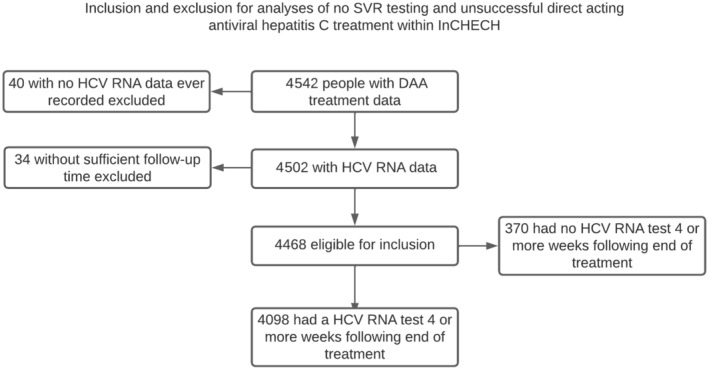
Of 4468 people who commenced DAA treatment, 4098 (91.7%) had an SVR test 4+ weeks following the end of treatment, 207 (5%) of whom were unsuccessfully treated. Compared to a CD4+ cell count > 500 cells/mm, cell counts < 200 (aOR 1.81, 95%CI 1.00-3.29) and between 200 and 349 (aOR 1.95, 95%CI 1.30-2.93) were associated with increased odds of unsuccessful treatment. Among 1921 people with data on injection drug use in the 12 months prior to treatment, there was some evidence that recent injection drug use was associated with increased odds of unsuccessful treatment; however, this was not statistically significant (aOR 1.67, 95%CI 0.99-2.82).
The overwhelming majority of people were successfully treated for HCV. Overall, 5% of those with an SVR4+ test were unsuccessfully treated; this was more likely among people with evidence of immunodeficiency and those who reported recently injecting drugs.
历史上,丙型肝炎病毒(HCV)在HIV感染者中难以治疗。然而,使用直接抗病毒药物(DAA)进行治疗能使90%-95%的患者治愈。有必要了解为什么一部分人没有治愈。我们旨在研究可能表明DAA治疗HCV失败概率增加的特征。
数据来自HIV队列丙型肝炎消除国际协作组。纳入2014年至2019年间开始接受DAA治疗HCV的患者。治疗失败定义为在治疗结束后至少4周(SVR4+)进行的首次RNA检测中HCV RNA检测呈阳性。使用多变量混合效应逻辑回归来研究与治疗失败相关的特征。
在4468例开始DAA治疗的患者中,4098例(91.7%)在治疗结束后4周以上进行了SVR检测,其中207例(5%)治疗失败。与CD4+细胞计数>500个/mm相比,细胞计数<200(调整后比值比1.81,95%置信区间1.00-3.29)以及200至349之间(调整后比值比1.95,95%置信区间1.30-2.93)与治疗失败几率增加相关。在1921例治疗前12个月有注射吸毒数据的患者中,有一些证据表明近期注射吸毒与治疗失败几率增加有关;然而,这在统计学上并不显著(调整后比值比1.67,95%置信区间0.99-2.82)。
绝大多数人HCV治疗成功。总体而言,SVR4+检测的患者中有5%治疗失败;在有免疫缺陷证据的人和报告近期注射毒品的人中,这种情况更有可能发生。