Tiede Anja, Stockhoff Lena, Ehrenbauer Alena F, Rieland Hannah, Cornberg Markus, Meyer Bernhard C, Gabriel Maria M, Wedemeyer Heiner, Hinrichs Jan B, Weissenborn Karin, Falk Christine S, Maasoumy Benjamin
Department of Gastroenterology, Hepatology, Infectious Diseases and Endocrinology, Hannover Medical School, Hannover, Germany.
German Center for Infection Research (DZIF), Hannover-Braunschweig, Germany.
Metab Brain Dis. 2024 Dec 10;40(1):58. doi: 10.1007/s11011-024-01436-2.
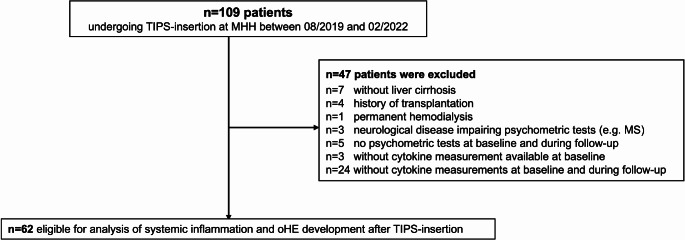
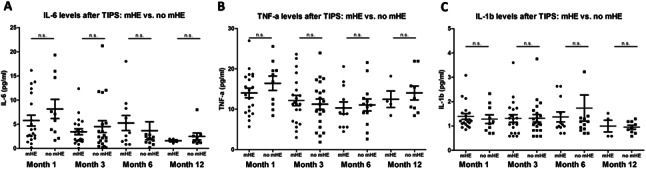
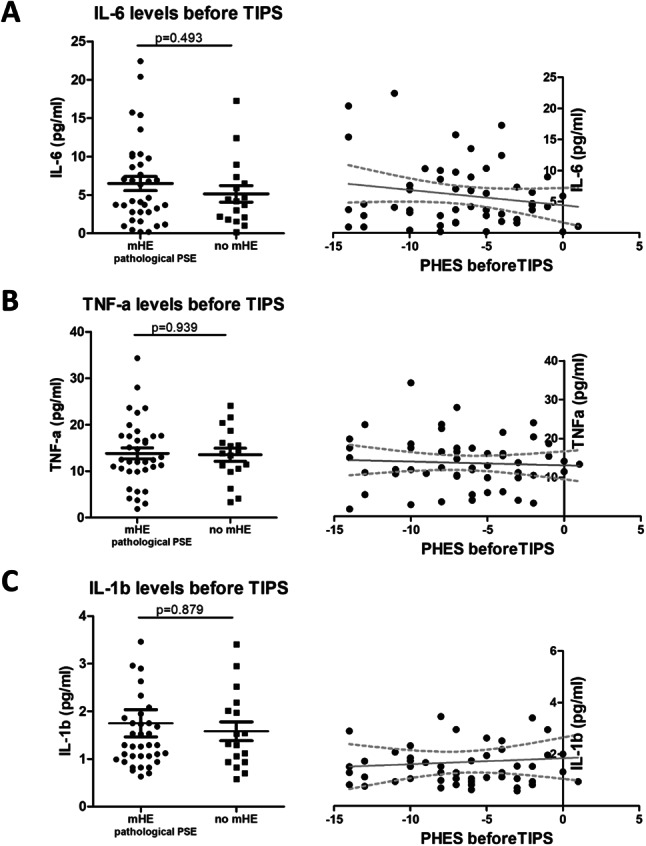
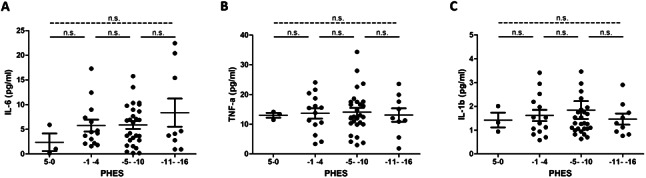
Development of overt hepatic encephalopathy (oHE) is a particularly feared complication when considering treatment with transjugular intrahepatic portosystemic shunt (TIPS). However, the pathophysiology of HE, in particular after TIPS-insertion, is complex and valid predictors remain scarce. We aimed to investigate whether systemic inflammation markers (SIM) are linked to minimal (mHE) and overt HE (oHE) development before and after TIPS. 62 prospectively recruited patients undergoing TIPS-insertion were included and monitored for oHE occurrence two years thereafter. Patients underwent psychometric testing including the portosystemic encephalopathy syndrome test (PSE), yielding the psychometric hepatic encephalopathy score (PHES), and Animal Naming Test (ANT) before TIPS (baseline) and during structured follow-up 1, 3, 6 and 12 months afterwards. SIM (IL-6, TNF-α and IL-1β) were measured at corresponding timepoints. Patients were predominantly male (64.5%) with a median age of 58 years and MELD of 11. The majority (75.8%) received a TIPS for treatment of refractory ascites. 67.9% presented with mHE before TIPS. No link between the investigated SIM and PHES or ANT at baseline or during any follow-up was documented. 19 (30.6%) patients developed oHE during follow-up. Neither baseline SIM levels nor test results were significantly associated with risk for oHE. We demonstrated a significant decline of all SIM during follow-up, which did not translate to an ameliorated risk for oHE. In patients undergoing TIPS-insertion, the selected SIM have neither a strong link to post-TIPS-oHE development nor to subclinical changes in psychometric tests for mHE.
在考虑经颈静脉肝内门体分流术(TIPS)治疗时,显性肝性脑病(oHE)的发生是一种特别令人担忧的并发症。然而,肝性脑病的病理生理学,尤其是在插入TIPS之后,是复杂的,有效的预测指标仍然很少。我们旨在研究全身炎症标志物(SIM)是否与TIPS前后最小肝性脑病(mHE)和显性肝性脑病(oHE)的发生有关。纳入了62例前瞻性招募的接受TIPS插入术的患者,并在术后两年监测oHE的发生情况。患者在TIPS术前(基线)以及术后1、3、6和12个月的结构化随访期间接受了心理测量测试,包括门体性脑病综合征测试(PSE),得出心理测量肝性脑病评分(PHES)和动物命名测试(ANT)。在相应时间点测量SIM(IL-6、TNF-α和IL-1β)。患者以男性为主(64.5%),中位年龄为58岁,终末期肝病模型(MELD)评分为11。大多数(75.8%)接受TIPS治疗难治性腹水。67.9%的患者在TIPS术前存在mHE。在基线或任何随访期间,未发现所研究的SIM与PHES或ANT之间存在关联。19例(30.6%)患者在随访期间发生oHE。基线SIM水平和测试结果均与oHE风险无显著相关性。我们证明在随访期间所有SIM均显著下降,但这并未转化为oHE风险的改善。在接受TIPS插入术的患者中,所选的SIM与TIPS术后oHE的发生以及mHE心理测量测试中的亚临床变化均无紧密联系。