Steensels Mieke, Soldan Colas, Rauw Fabienne, Roupie Virginie, Lambrecht Bénédicte
Avian Virology and Immunology, Sciensano, Rue Groeselenberg 99, Uccle, Brussels 1180, Belgium.
Avian Virology and Immunology, Sciensano, Rue Groeselenberg 99, Uccle, Brussels 1180, Belgium; Laboratory of Virology, Faculty of Veterinary Medicine, Ghent University, Merelbeke, Belgium.
Poult Sci. 2025 Jan;104(1):104604. doi: 10.1016/j.psj.2024.104604. Epub 2024 Nov 27.
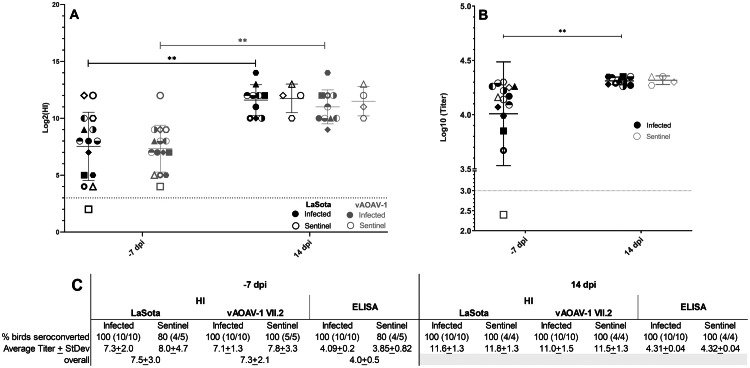
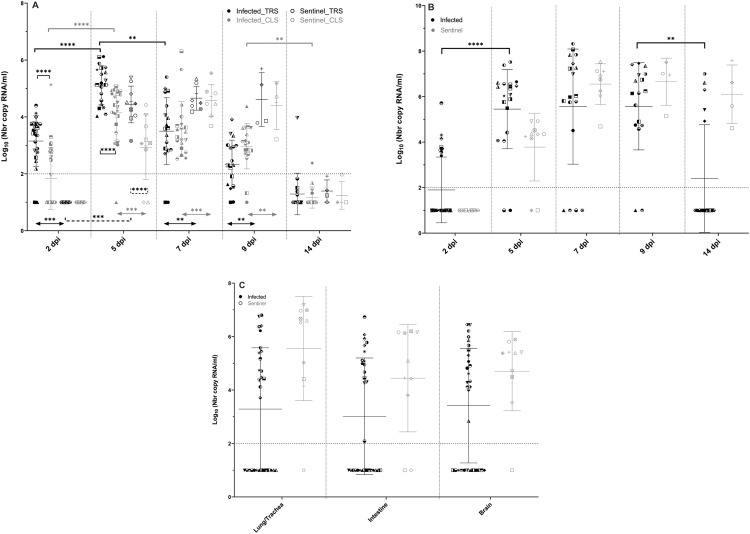
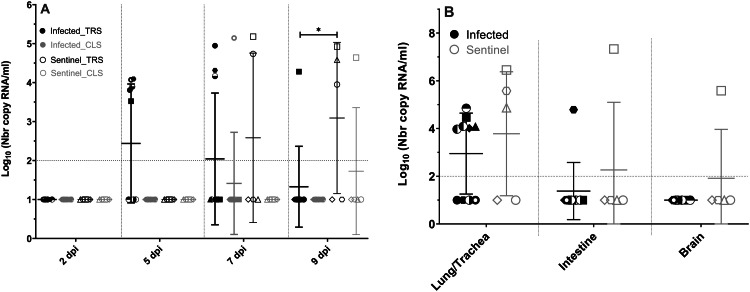
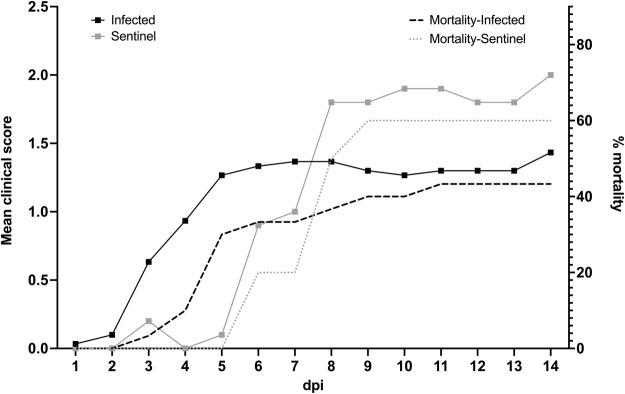
Vaccination against Newcastle disease (ND) has been routinely implemented in the Belgian professional poultry sector since 1993, using genotype I and II vaccines. Despite this, an outbreak of genotype VII.2 avian paramyx-ovirus 1 (APMV-1) occurred in 2018, with 20 reported cases over the course of 3 months. Although the economic impact on the professional poultry sector was limited, this epizootic raised questions regarding the efficacy of implemented classical genotype I and II vaccines against phylogenetically distant exotic velogenic strains. The present study provides insights into the protective efficacy of standard vaccination programs applied in layer and broiler flocks against the introduction and transmission of this velogenic APMV-1 VII.2 strain. For fully field-vaccinated 26-week-old layer chickens, high levels of specific antibodies were measured at the time of the velogenic APMV-1 challenge, resulting in good clinical protection. However, despite the observed humoral immunity, viral excretion was not prevented, leading to transmission of the virus to non-infected sentinel birds. In fully field-vaccinated 4-week-old broiler chickens, assessment of vaccine uptake and coverage revealed low levels of ND specific antibodies despite double vaccination at day 1 and day 14. Consequently, poor protection against velogenic APMV-1 infection was observed, with both clinical signs and viral excretion occurring in both infected and sentinel birds. This study demonstrates that the introduction of velogenic APMV-1 VII.2 can lead to its dissemination among the Belgian avian poultry population despite the implementation of standard vaccination.
自1993年以来,比利时专业家禽业一直常规使用I型和II型疫苗对新城疫(ND)进行免疫接种。尽管如此,2018年仍发生了VII.2型禽副粘病毒1型(APMV-1)疫情,在3个月内报告了20起病例。虽然对专业家禽业的经济影响有限,但这次 epizootic 引发了关于已实施的经典I型和II型疫苗对系统发育上遥远的外来速发型毒株的效力的问题。本研究深入探讨了应用于蛋鸡和肉鸡群的标准疫苗接种计划对这种速发型APMV-1 VII.2毒株的引入和传播的保护效力。对于完全在田间接种疫苗的26周龄蛋鸡,在速发型APMV-1攻毒时检测到高水平的特异性抗体,从而获得了良好的临床保护。然而,尽管观察到了体液免疫,但并未阻止病毒排泄,导致病毒传播给未感染的哨兵鸡。在完全在田间接种疫苗的4周龄肉鸡中,对疫苗摄取和覆盖率的评估显示,尽管在第1天和第14天进行了两次接种,但ND特异性抗体水平较低。因此,观察到对速发型APMV-1感染的保护较差,感染鸡和哨兵鸡均出现临床症状和病毒排泄。这项研究表明,尽管实施了标准疫苗接种,但速发型APMV-1 VII.2的引入仍可导致其在比利时禽群中传播。