Widhalm Klaus, Maul Lukas, Durstberger Sebastian, Putz Peter, Klupper Carissa, Werner Franz
Physiotherapy, FH Campus Wien, University of Applied Sciences, Vienna, Austria.
Institute for Biomechanics, Paracelsus Medical University, Salzburg, Austria.
JMIR Serious Games. 2024 Dec 10;12:e51771. doi: 10.2196/51771.
Osteoarthritis is one of the most common degenerative diseases of the musculoskeletal system and can ultimately lead to the need for surgery, such as total knee or hip arthroplasty. Functional movement deficits can be a prognostic factor for osteoarthritis in the lower extremities. Thus, training physiological movement patterns may help in the treatment of such functional deficits. Motivation to exercise frequently is of utmost importance and can be promoted by using digital real-time feedback.
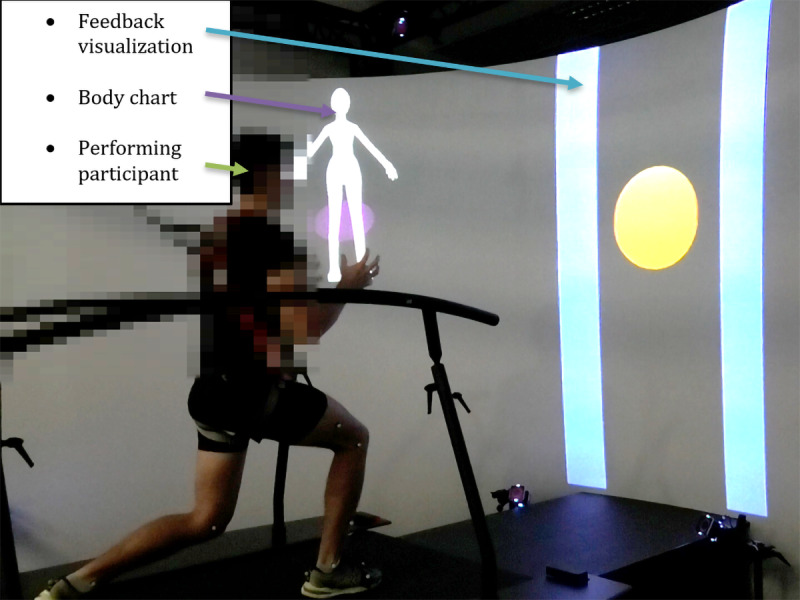
This qualitative study aims to gather user recommendations for prototype feedback visualizations in a real-time exercise-feedback system called homeSETT for the treatment of functional deficits. The system provides real-time feedback to participants while performing exercises that focus on functional deficits, such as lateral trunk lean, pelvic drop, and valgus thrust. The findings of this study should help to optimize the prototype feedback visualizations. Thus, the main research questions were how patients, physiotherapists, and physicians evaluate the presented, current state of prototype feedback visualizations for selected functional exercises, and what improvements and variations would be recommended.
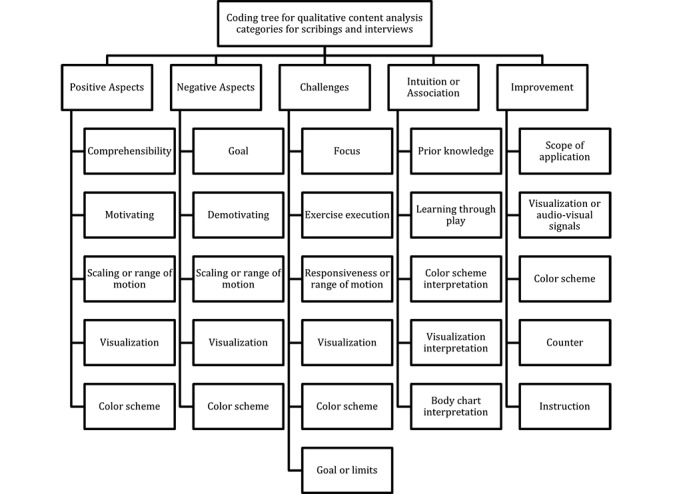
Testing of the prototype feedback visualizations took place at a movement laboratory using a 3D optoelectronic movement analysis system. Data on usability factors were acquired using the thinking aloud method during and semistructured interviews after prototype testing. Transcribed audio recordings of semistructured interviews as well as scribing logs of the thinking aloud method were examined using qualitative content analysis.
Data were analyzed from 9 participants, comprising 2 (22%) patients, 2 (22%) physicians, and 5 (56%) physiotherapists. The mean age of the participants was 45 (SD 9) years and the mean work experience among the participating physiotherapists and physicians was 22 (SD 5) years. Each participant tested 11 different exercise-feedback combinations. Overall, results indicated that participants enjoyed the prototype feedback visualizations and believed that they could be used in therapeutic settings. Participants appreciated the simplicity, clarity, and self-explanatory nature of the feedback visualizations. While most participants quickly familiarized themselves, some struggled to recognize the feedback goals and connect the visualizations to their movements. Recommendations for improvement included optimizing color schemes, sensitivity, and difficulty adjustments. Adding instructional information and game design elements, such as repetition counting and reward systems, was deemed useful. The main study limitations were the small sample size and the use of feedback on performance as the sole feedback modality.
The prototype feedback visualizations were positively perceived by the participants and were considered applicable in therapy settings. Insights were gathered on improving the color scheme, sensitivity, and recognizability of the feedback visualizations. The implementation of additional gamification and instructional elements was emphasized. Future work will optimize the prototype feedback visualizations based on study results and evaluate the homeSETT system's efficacy in eligible patient populations.
骨关节炎是肌肉骨骼系统最常见的退行性疾病之一,最终可能需要进行手术,如全膝关节或髋关节置换术。功能运动缺陷可能是下肢骨关节炎的一个预后因素。因此,训练生理运动模式可能有助于治疗此类功能缺陷。经常锻炼的动力至关重要,使用数字实时反馈可以促进这种动力。
本定性研究旨在收集用户对一种名为homeSETT的实时运动反馈系统中原型反馈可视化的建议,该系统用于治疗功能缺陷。该系统在参与者进行针对功能缺陷(如侧躯干倾斜、骨盆下降和外翻推力)的锻炼时提供实时反馈。本研究的结果应有助于优化原型反馈可视化。因此,主要研究问题是患者、物理治疗师和医生如何评估所选功能锻炼的原型反馈可视化的当前呈现状态,以及会推荐哪些改进和变化。
在运动实验室使用3D光电运动分析系统对原型反馈可视化进行测试。在原型测试期间使用出声思考法,并在测试后进行半结构化访谈,获取关于可用性因素的数据。使用定性内容分析法检查半结构化访谈的转录音频记录以及出声思考法的记录日志。
对9名参与者的数据进行了分析,其中包括2名(22%)患者、2名(22%)医生和5名(56%)物理治疗师。参与者的平均年龄为45(标准差9)岁,参与的物理治疗师和医生的平均工作经验为22(标准差5)年。每位参与者测试了11种不同的运动反馈组合。总体而言,结果表明参与者喜欢原型反馈可视化,并认为它们可用于治疗环境。参与者赞赏反馈可视化的简单性、清晰度和自解释性。虽然大多数参与者很快就熟悉了,但一些人难以识别反馈目标并将可视化与他们的动作联系起来。改进建议包括优化配色方案、灵敏度和难度调整。添加教学信息和游戏设计元素,如重复计数和奖励系统,被认为是有用的。主要研究局限性是样本量小以及仅将表现反馈作为唯一的反馈方式。
参与者对原型反馈可视化给予了积极评价,并认为其适用于治疗环境。收集了关于改进反馈可视化的配色方案、灵敏度和可识别性的见解。强调了实施额外的游戏化和教学元素。未来的工作将根据研究结果优化原型反馈可视化,并评估homeSETT系统在符合条件的患者群体中的疗效。