Ge Xiaogai, Mao Yilian, Zhou Benzhi, Wang Xiaoming, Li Mai-He
Research Institute of Subtropical Forestry, Chinese Academy of Forestry, Hangzhou, Zhejiang, China.
Qianjiangyuan Forest Ecosystem Research Station, National Forestry and Grassland Administration, Hangzhou, Zhejiang, China.
Front Plant Sci. 2024 Nov 26;15:1474671. doi: 10.3389/fpls.2024.1474671. eCollection 2024.
The variety of organs carbon concentration may be important for tree survival rate, drought resistance and tree subsequent recovery. However, it remains unclear how drought affect structural carbohydrate (SC) and non-structural carbohydrate (NSC) export and transport on clonal plant, which can be correlated with sustain physiological metabolism and group drought resistance by resource sharing. To better understand the adaption ability of clone plants to drought and the linkage of organ carbon with soil organic carbon (SOC) fractions, we assessed how long-term drought affects organ carbon and its impact on SOC fractions among moso bamboo () ramets.
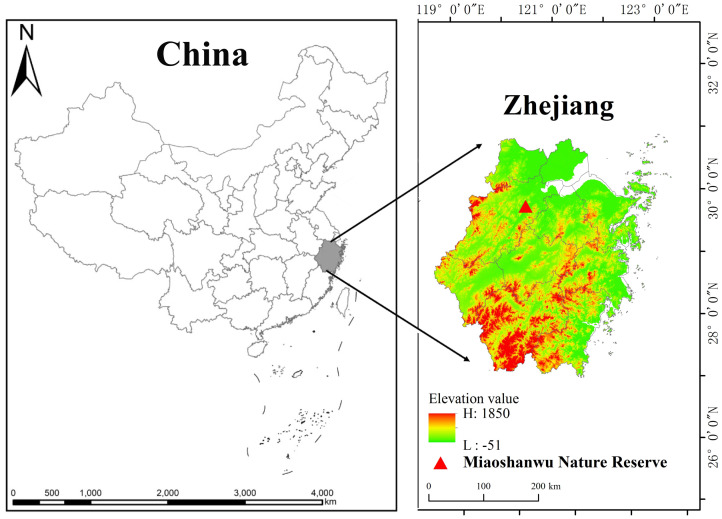
Throughfall exclusion included two treatments with simulated drought (TE) and control sample (CK, natural rainfall) by waterproofing panels, which excluded 70-80% of the precipitation. We measured the SC and NSC of leaves, branches and roots as well as soil organic carbon components on three ramets, which emerged in 2017 (grandma, GB), ramets that appeared in 2018 (mother bamboo, MB) and ramets emerging in 2019 (current-year bamboo, CB).
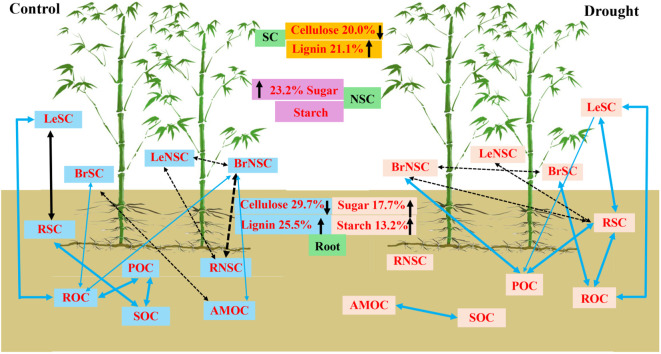
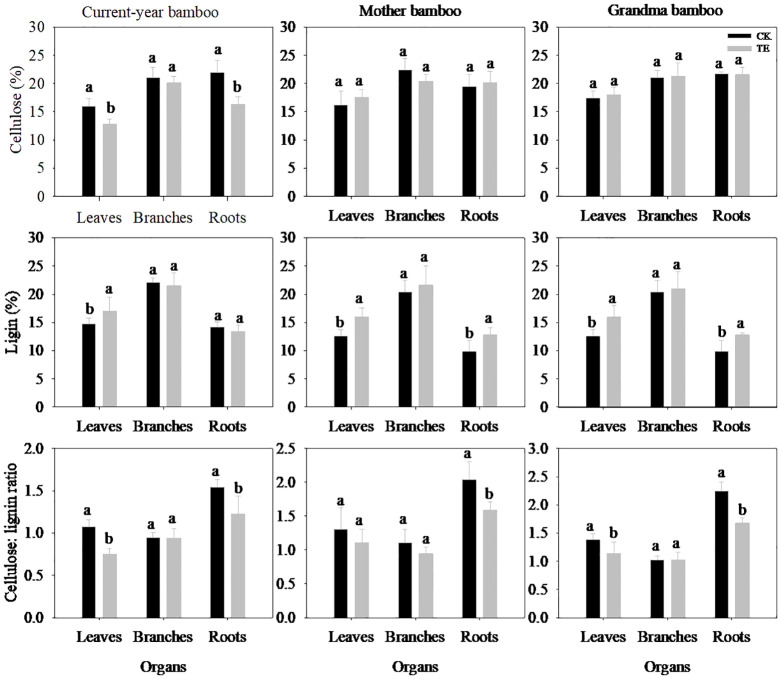
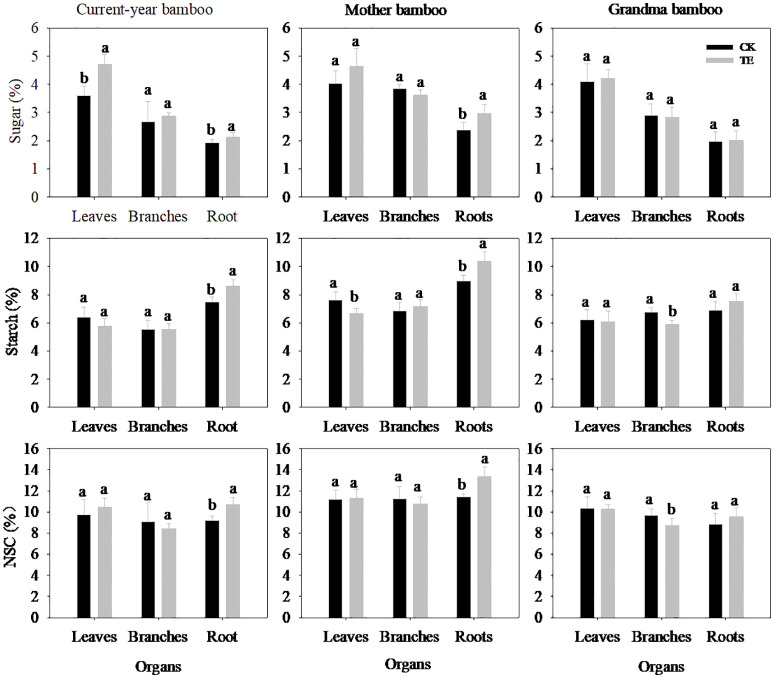
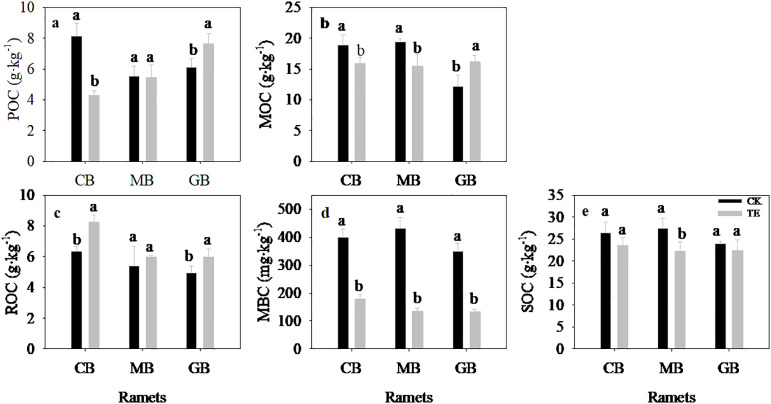
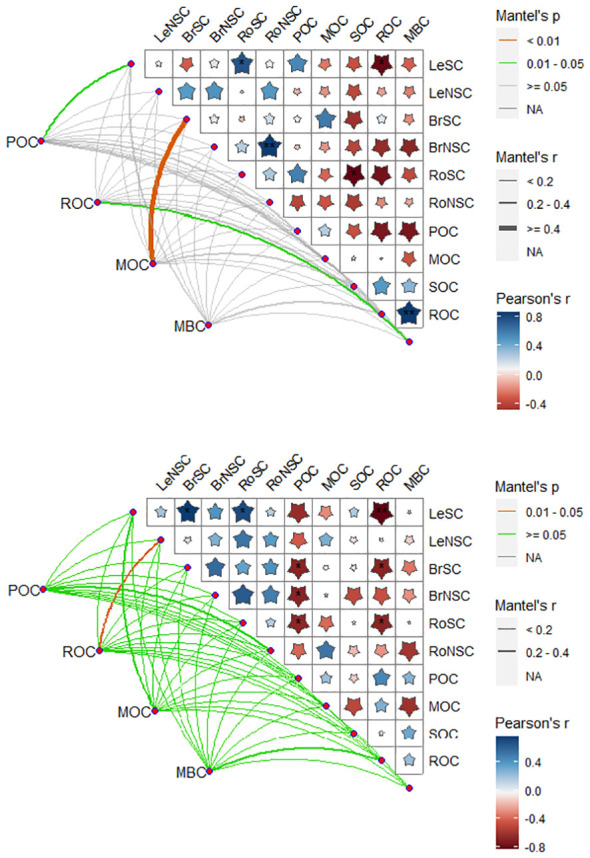
The results showed that there was significant difference on lignin, cellulose: lignin ratio and soluble sugar in leaves and roots (<0.05) instead of branches (>0.05). Effect of drought on SC and NSC varied with different organs and ramet age. Drought significantly increased soluble sugar concentration of leaves and roots by 15.5-31.0% and 10.6-24.8% for current-year bamboo. Compared with CK, drought decreased SOC by 6.7-19.1%, microbial biomass carbon (MBC) by 55.3-68.7%, readily oxidizable carbon (ROC) by 11.2-29.8%, particulate organic carbon (POC) by 25.1-47.4% but no effect on mineral-associated organic carbon (MOC). Drought changed the relationships of carbon components between plant organs and soil. In the control treatments, SC of leaves were significantly positively correlated with ROC, NSC of branches were positively correlated with ROC and MBC, NSC of roots were significantly positively correlated with SOC.
Overall, our results suggest that drought strengthened the linkage of plant organ carbon and soil carbon cycling among moso bamboo ramets in ecosystem studies, which are critical for predicting tree resistance and management in subtropical forest under drought.
器官碳浓度的差异可能对树木存活率、抗旱性及后续恢复至关重要。然而,干旱如何影响克隆植物中结构性碳水化合物(SC)和非结构性碳水化合物(NSC)的输出与运输仍不清楚,而这可能与通过资源共享维持生理代谢及群体抗旱性相关。为了更好地理解克隆植物对干旱的适应能力以及器官碳与土壤有机碳(SOC)组分的联系,我们评估了长期干旱对毛竹分株中器官碳的影响及其对SOC组分的作用。
通过防雨板进行降雨排除处理,包括模拟干旱(TE)和对照样本(CK,自然降雨)两种处理,排除了70 - 80%的降水量。我们测量了2017年出现的三个分株(老竹,GB)、2018年出现的分株(母竹,MB)和2019年出现的分株(当年生竹,CB)的叶片、枝条和根系中的SC和NSC以及土壤有机碳成分。
结果表明,叶片和根系中的木质素、纤维素:木质素比值和可溶性糖存在显著差异(<0.05),而枝条中无显著差异(>0.05)。干旱对SC和NSC的影响因器官和分株年龄而异。干旱使当年生竹的叶片和根系可溶性糖浓度显著增加,分别增加了15.5 - 31.0%和10.6 - 24.8%。与CK相比,干旱使SOC降低了6.7 - 19.1%,微生物量碳(MBC)降低了55.3 - 68.7%,易氧化碳(ROC)降低了11.2 - 29.8%,颗粒有机碳(POC)降低了25.1 - 47. / 4%,但对矿物结合有机碳(MOC)无影响。干旱改变了植物器官与土壤之间碳组分的关系。在对照处理中,叶片的SC与ROC显著正相关,枝条的NSC与ROC和MBC正相关,根系的NSC与SOC显著正相关。
总体而言,我们的结果表明,在生态系统研究中,干旱加强了毛竹分株中植物器官碳与土壤碳循环的联系,这对于预测干旱条件下亚热带森林树木的抗性和管理至关重要。