Lehky Michael, Moonian Tashveen, Michel Tanja, Junker Daniel, Müsken Mathias, Strömpl Julia, Nübling Patrick, Neumann Franziska, Krumbholz Andi, Krause Gérard, Schneiderhan-Marra Nicole, van den Heuvel Joop, Strengert Monika
Department of Structure and Function of Proteins, Helmholtz Centre for Infection Research, Braunschweig, Germany.
Department of Epidemiology, Helmholtz Centre for Infection Research, Braunschweig, Germany.
Protein Sci. 2025 Jan;34(1):e5251. doi: 10.1002/pro.5251.
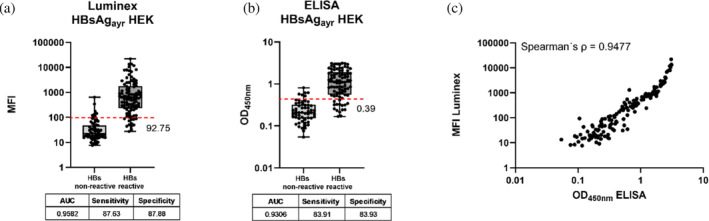
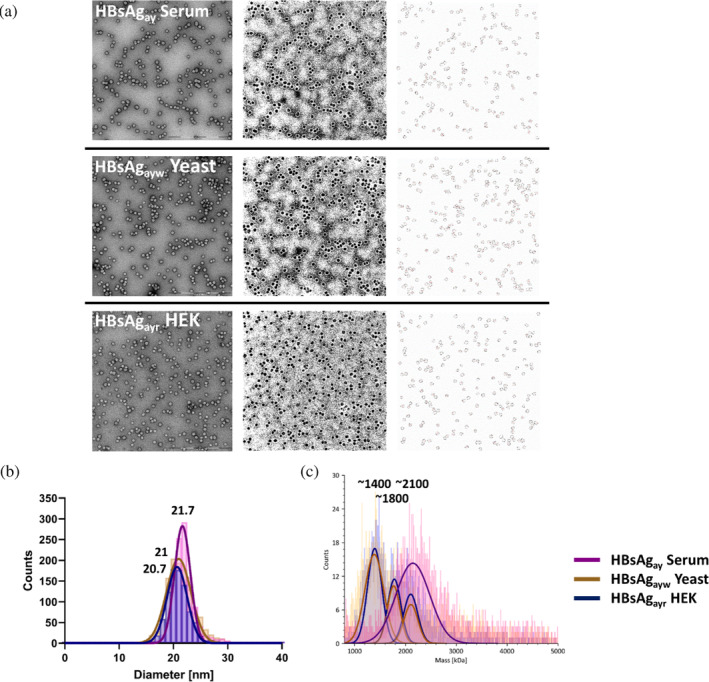
The Hepatitis B surface antigen (HBsAg) as the only lipid-associated envelope protein of the Hepatitis B virus (HBV) acts as cellular attachment and entry mediator of HBV making it the main target of neutralizing antibodies to provide HBV immunity after infection or vaccination. Despite its central role in inducing protective immunity, there is however a surprising lack of comparative studies examining different HBsAgs and their ability to detect anti-HBs antibodies. On the contrary, various time-consuming complex HBsAg production protocols have been established, which result in structurally and functionally insufficiently characterized HBsAg. Here, we present an easy-to-perform, streamlined and robust method for recombinant S-HBsAg virus-like particle (VLP) production by transient expression in mammalian cells and purification from the cell lysate with the aim of displaying uniform antigenic epitopes on the surface to improve serological detection of anti-HBs antibodies. We not only compare assembly status and particle composition by transmission electron microscopy and mass photometry of our S-HBsAg and of commonly used HBsAg reference samples, but also assess their antigenic quality and functional suitability for anti-HBs antibody detection to identify the best performing sample for serological screenings. While we found that serum-isolated and recombinant HBsAg VLPs are assembled differently, our S-HBsAg VLPs detected anti-HBs antibodies with the highest sensitivity and specificity in multiplex serology when compared to yeast or serum HBsAg making it the most suitable antigen for analysis of HBV immunity through anti-HBs serostatus.
乙肝表面抗原(HBsAg)作为乙肝病毒(HBV)唯一的脂质相关包膜蛋白,是HBV的细胞附着和进入介质,使其成为中和抗体的主要靶点,在感染或接种疫苗后提供HBV免疫力。尽管其在诱导保护性免疫中起核心作用,但令人惊讶的是,缺乏对不同HBsAg及其检测抗-HBs抗体能力的比较研究。相反,已经建立了各种耗时的复杂HBsAg生产方案,这些方案导致HBsAg在结构和功能上的表征不足。在此,我们提出一种易于操作、简化且稳健的方法,通过在哺乳动物细胞中瞬时表达并从细胞裂解物中纯化来生产重组S-HBsAg病毒样颗粒(VLP),目的是在表面展示均匀的抗原表位,以改善抗-HBs抗体的血清学检测。我们不仅通过透射电子显微镜和质量光度法比较了我们的S-HBsAg和常用HBsAg参考样品的组装状态和颗粒组成,还评估了它们的抗原质量和用于抗-HBs抗体检测的功能适用性,以确定用于血清学筛查的最佳性能样品。虽然我们发现血清分离的和重组的HBsAg VLPs组装方式不同,但与酵母或血清HBsAg相比,我们的S-HBsAg VLPs在多重血清学中检测抗-HBs抗体时具有最高的灵敏度和特异性,使其成为通过抗-HBs血清状态分析HBV免疫力的最合适抗原。