Moffa Eduardo Buozi, Malheiros Samuel Santana, Silva Larissa Tavares Sampaio, Branco Delcio Ildefonso, Grassia Junior Regis Cléo Fernandes, Brandt William Cunha, Goncalves Flavia, Barao Valentim Adelino Ricardo, Boaro Letícia Cristina Cidreira
University of Saskatchewan, College of Dentistry, Saskatchewan, Canada.
Universidade Estadual de Campinas - Unicamp, Piracicaba Dental School, Department of Prosthodontics and Periodontology, Piracicaba, SP, Brazil.
Braz Oral Res. 2024 Dec 9;38:e110. doi: 10.1590/1807-3107bor-2024.vol38.0110. eCollection 2024.
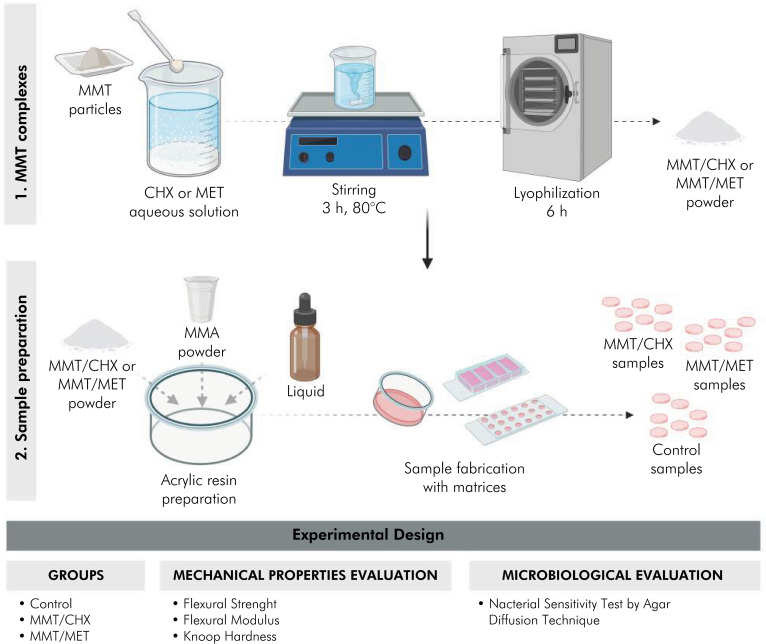
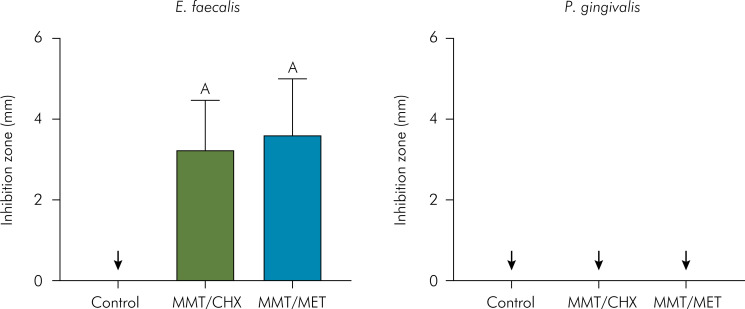
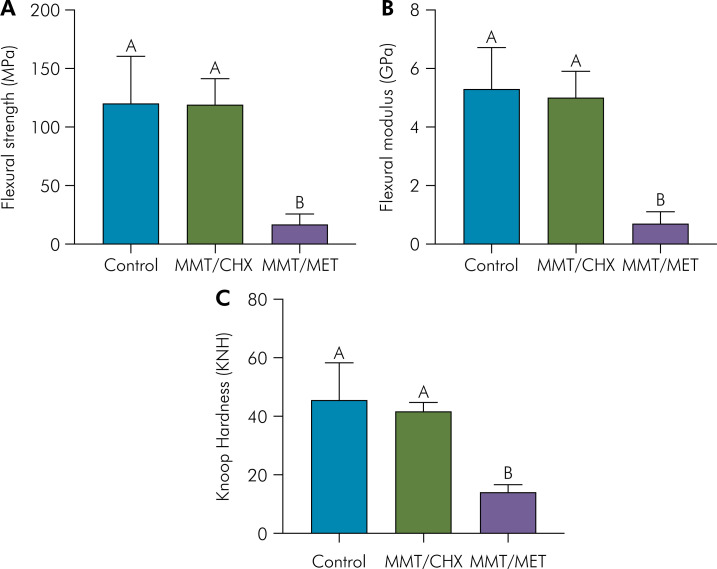
Poly(methyl methacrylate) (PMMA) materials are highly susceptible to microbial colonization, predisposing patients to oral infections. To address this concern, we loaded PMMA samples with montmorillonite clay (MMT), a crystalline nanoparticle, in combination with chlorhexidine (CHX) or metronidazole (MET) targeting improved antimicrobial action. PMMA samples were prepared with or without MMT loaded with either CHX or MET, establishing the following groups: control (acrylic resin without the addition of nanoparticles), MMT/CHX (acrylic resin with 5% by weight of MMT loaded with CHX), and MMT/MET (acrylic resin with 5% by weight of MMT loaded with MET). Mechanical properties such flexural strength, flexural modulus, and Knoop hardness were evaluated using a universal testing machine. Antimicrobial efficacy was assessed via agar diffusion tests against Enterococcus faecalis and Porphyromonas gingivalis. The addition of MMT loaded with CHX did not affect the flexural strength and flexural modulus of PMMA compared to the control group (p > 0.05). However, MMT/MET reduced all mechanical properties of PMMA (p < 0.05). Both loaded-PMMA materials demonstrated antibacterial activity against E. faecalis but not against P. gingivalis. In conclusion, the incorporation of MMT/CHX into acrylic resin appears to be the most promising approach to combat microbial colonization while preserving PMMA mechanical properties. Future research should focus on optimizing material characteristics to enhance antimicrobial properties, paving the way for clinical applicability.
聚甲基丙烯酸甲酯(PMMA)材料极易受到微生物定植,使患者易患口腔感染。为了解决这一问题,我们将聚甲基丙烯酸甲酯样品与蒙脱石粘土(MMT,一种结晶纳米颗粒)结合,并负载洗必泰(CHX)或甲硝唑(MET),以提高抗菌作用。制备了负载或未负载MMT且分别负载CHX或MET的PMMA样品,设立了以下几组:对照组(不添加纳米颗粒的丙烯酸树脂)、MMT/CHX组(含5%重量比负载CHX的MMT的丙烯酸树脂)和MMT/MET组(含5%重量比负载MET的MMT的丙烯酸树脂)。使用万能试验机评估弯曲强度、弯曲模量和努氏硬度等力学性能。通过琼脂扩散试验评估对粪肠球菌和牙龈卟啉单胞菌的抗菌效果。与对照组相比,添加负载CHX的MMT对PMMA的弯曲强度和弯曲模量没有影响(p>0.05)。然而,MMT/MET降低了PMMA的所有力学性能(p<0.05)。两种负载PMMA材料均对粪肠球菌表现出抗菌活性,但对牙龈卟啉单胞菌无抗菌活性。总之,将MMT/CHX掺入丙烯酸树脂似乎是在保留PMMA力学性能的同时对抗微生物定植的最有前景的方法。未来的研究应专注于优化材料特性以增强抗菌性能,为临床应用铺平道路。