Ware Lisa J, Kubheka Delisile, Mdladlamba Thato, Mabetha Khuthala, Hanson Mark, Godfrey Keith M, Woods-Townsend Kathryn, Norris Shane
Wits Health Hubb, Wits Health Consortium, Johannesburg, South Africa.
SA MRC-Wits Developmental Pathways for Health Research Unit, Department of Paediatrics, Faculty of Health Sciences, School of Clinical Medicine, University of the Witwatersrand, Johannesburg, South Africa.
Health Expect. 2024 Dec;27(6):e70121. doi: 10.1111/hex.70121.
Low health literacy levels during adolescence and young adulthood (AYA) may impact acute healthcare access and longer-term health outcomes. Previous research in South African AYA suggests that health literacy levels are typically suboptimal but few interventions exist. This study aimed to test the acceptability and feasibility of a co-created, interactive health literacy intervention (LifeLab-Soweto) with AYA in Soweto, South Africa.
Participants (18-24 years, n = 107) were recruited (September-October 2022) from a youth development centre database by telephone and through snowball sampling. AYA involved in the co-creation process were excluded. Pre-intervention data on participant age, gender identity and ability to correctly identify a normal blood pressure (BP) reading were captured via survey. Post-intervention, participants repeated the BP question and completed a satisfaction survey. Additionally, n = 31 AYA agreed to an in-depth interview about their LifeLab-Soweto experience. Interview transcripts were analysed using inductive thematic analysis.
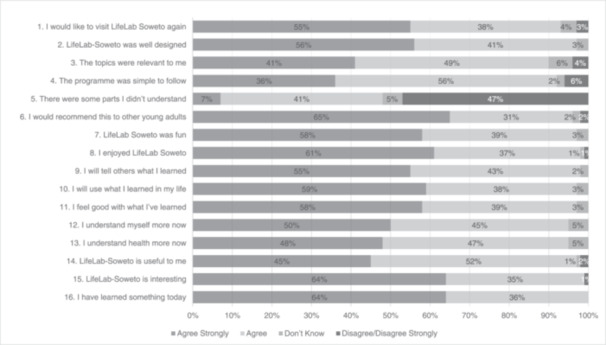
Participants (mean age 21 ± 2.4 years; 59% female, 39% male, 2% nonbinary) generally viewed LifeLab-Soweto as well-designed, relevant, simple to follow, fun, useful, and interesting, with most reporting an increased understanding of health and that they would use this new knowledge. Comparing pre- and post-intervention BP question accuracy, males showed the greatest improvement in scores. Interviews showed that, while LifeLab-Soweto was not what AYA were expecting, gains in health knowledge led AYA to consider changes in health behaviours including accessing health services.
Life-Soweto presents an acceptable, feasible and relevant health literacy intervention for South African youth with potential to improve health literacy and health behaviours.
To ensure the health literacy intervention was contextually relevant, age appropriate, and gender inclusive, a group of 40 adolescents (aged 18-24 years, male, female and non-binary) were recruited from Soweto to firstly identify the health topics that were most pressing in their daily lives. This youth advisory group identified stress as a major challenge impacting physical and mental health, health behaviour and daily functioning. Together with the youth group, researchers from South Africa and the UK worked to co-develop the health literacy intervention that delivers self-directed exploration and learning of how stress impacts health, behaviour and well-being. This manuscript describes how this cocreated intervention was received by a broader range of South African youth who were not involved in the cocreation process.
青少年和青年期(AYA)的健康素养水平较低可能会影响急性医疗服务的获取以及长期健康结果。此前对南非青少年和青年的研究表明,健康素养水平通常不尽人意,但相关干预措施却很少。本研究旨在测试一种与南非索韦托的青少年和青年共同创建的互动式健康素养干预措施(索韦托生活实验室)的可接受性和可行性。
通过电话和滚雪球抽样从一个青年发展中心数据库招募参与者(18 - 24岁,n = 107)(2022年9月至10月)。参与共同创建过程的青少年和青年被排除在外。通过调查收集干预前关于参与者年龄、性别认同以及正确识别正常血压(BP)读数能力的数据。干预后,参与者重复血压问题并完成满意度调查。此外,31名青少年和青年同意就他们在索韦托生活实验室的经历进行深入访谈。使用归纳主题分析法对访谈记录进行分析。
参与者(平均年龄21 ± 2.4岁;59%为女性,39%为男性,2%为非二元性别)普遍认为索韦托生活实验室设计良好、相关、易于遵循、有趣、有用且有意思,大多数人表示对健康的理解有所增加,并且会运用这些新知识。比较干预前后血压问题的回答准确性,男性得分提高最为显著。访谈表明,虽然索韦托生活实验室并非青少年和青年所期望的那样,但健康知识的增加促使他们考虑改变健康行为,包括获取医疗服务。
索韦托生活实验室为南非青年提供了一种可接受、可行且相关的健康素养干预措施,具有提高健康素养和健康行为的潜力。
为确保健康素养干预措施与实际情况相关、年龄适宜且具有性别包容性,从索韦托招募了一组40名青少年(年龄在18 - 24岁之间,包括男性、女性和非二元性别),首先确定他们日常生活中最紧迫的健康主题。这个青年咨询小组将压力确定为影响身心健康、健康行为和日常功能的主要挑战。南非和英国的研究人员与青年小组共同努力,共同开发了这种健康素养干预措施,该措施提供了关于压力如何影响健康、行为和幸福感的自主探索和学习。本手稿描述了这种共同创建的干预措施在未参与共同创建过程的更广泛南非青年中的接受情况。