van Dorth Daniëlle, Alafandi Ahmad, Soloukey Sadaf, Kruizinga Pieter, Venugopal Krishnapriya, Delphin Aurélien, Poot Dirk H J, Christen Thomas, Smits Marion, de Bresser Jeroen, Hernandez-Tamames Juan A, van Osch Matthias J P
C. J. Gorter MRI Center, Department of Radiology, Leiden University Medical Center, Leiden, The Netherlands.
Department of Radiology and Nuclear Medicine, Erasmus MC, University Medical Center Rotterdam, Rotterdam, The Netherlands.
NMR Biomed. 2025 Jan;38(1):e5308. doi: 10.1002/nbm.5308.
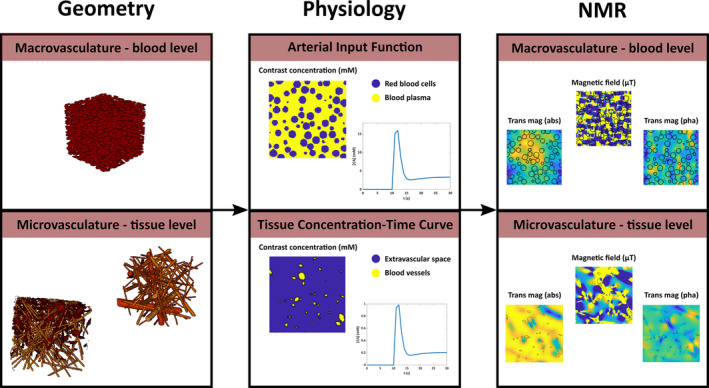
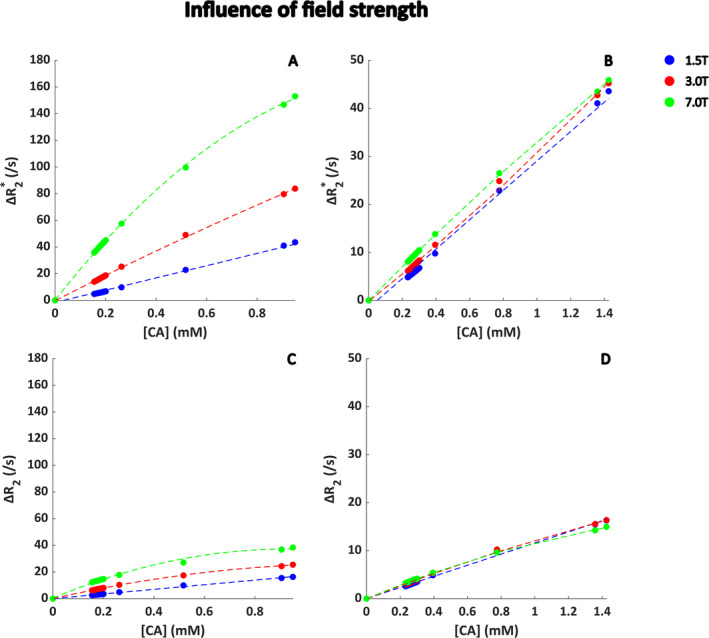
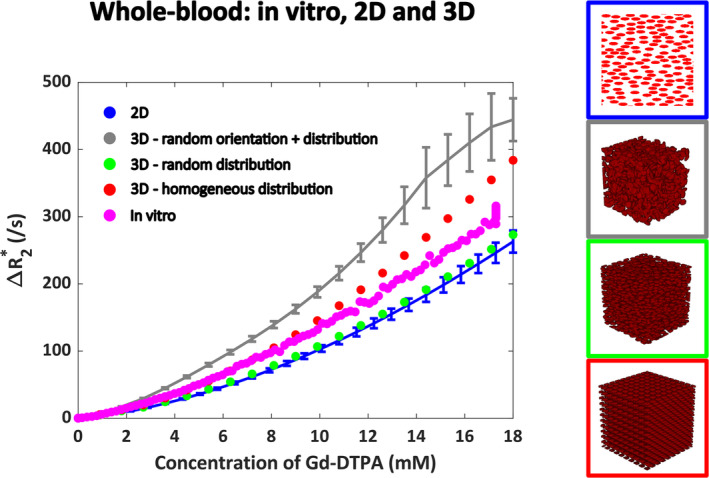
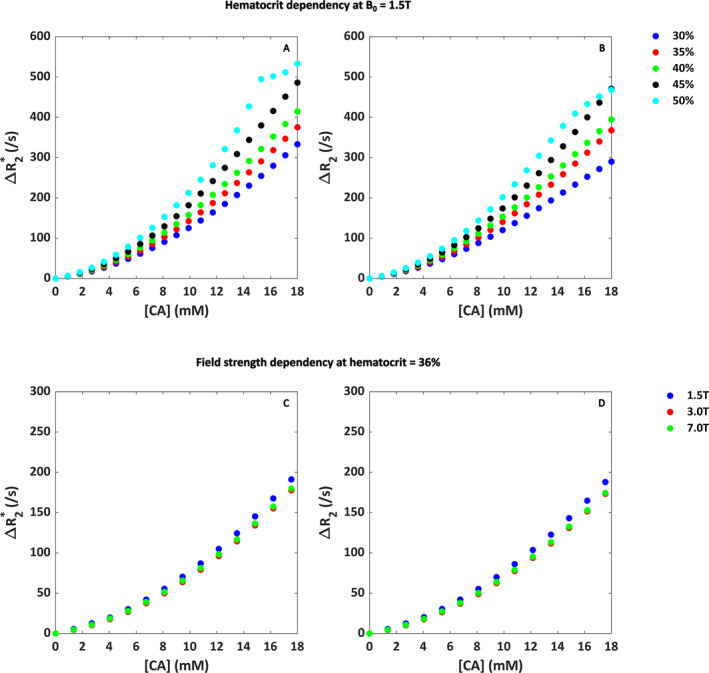
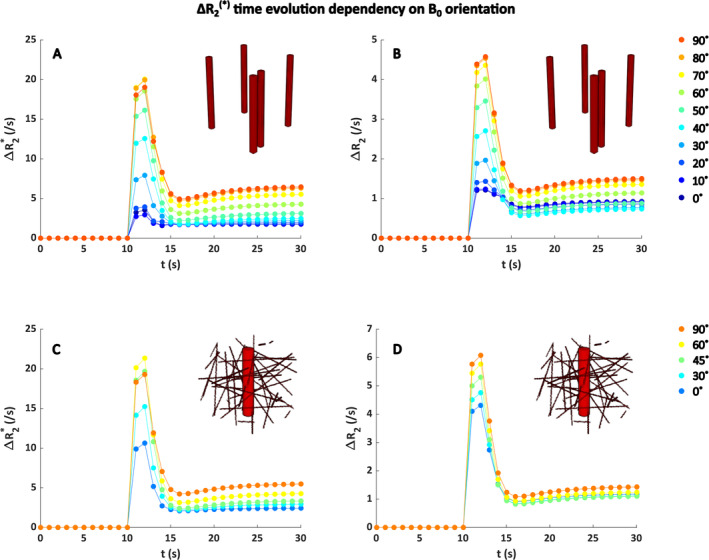
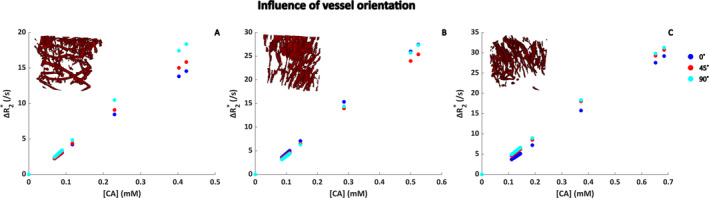
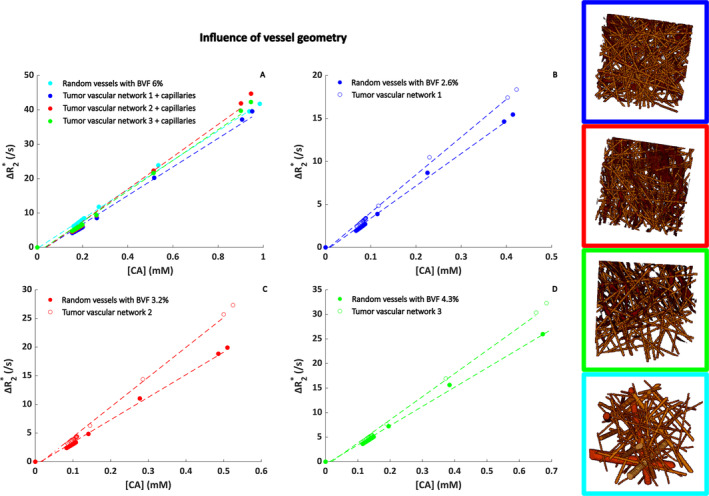
Dynamic susceptibility contrast (DSC) MRI is commonly part of brain tumor imaging. For quantitative analysis, measurement of the arterial input function and tissue concentration time curve is required. Usually, a linear relationship between the MR signal changes and contrast agent concentration ([Gd]) is assumed, even though this is a known simplification. The aim of this study was to develop a realistic 3D simulation model as an efficient method to assess the relationship between ΔR and [Gd] both in whole blood and brain tissue. We modified an open-source 3D simulation model to study different red blood cell configurations for assessing whole-blood ΔR versus [Gd]. The results were validated against previously obtained 2D data and in vitro data. Furthermore, hematocrit levels (30%-50%) and field strengths (1.5-3.0-7.0 T) were varied. Subsequently, realistic tumor vascular networks were derived from intraoperative high framerate Doppler ultrasound data to study the influence of vascular structure and orientation with respect to the main magnetic field (1.5-3.0-7.0 T) for the calculation of ΔR versus [Gd] in brain tissue. For whole blood, good agreement of the 3D model was found with in vitro and 2D simulation data when red blood cells were aligned with the blood flow. For brain tissue, minor differences were found between the vascular networks. The effect of vessel direction with respect to B was apparent in case of clear directionality of the main vessels. The dependency on field strength agreed with previous reports. In conclusion, we have shown that the relationship between ΔR and [Gd] is affected by the organization of red blood cells and orientation of blood vessels with respect to the main magnetic field, as well as the field strength. These findings are important for further optimization of the realistic 3D model that could eventually be used to improve the estimation of hemodynamic parameters from DSC-MRI.
动态磁敏感对比(DSC)磁共振成像通常是脑肿瘤成像的一部分。对于定量分析,需要测量动脉输入函数和组织浓度-时间曲线。通常,尽管这是一种已知的简化方法,但仍假定磁共振信号变化与造影剂浓度([Gd])之间存在线性关系。本研究的目的是开发一个逼真的三维模拟模型,作为评估全血和脑组织中ΔR与[Gd]之间关系的有效方法。我们修改了一个开源三维模拟模型,以研究不同红细胞配置对评估全血ΔR与[Gd]的影响。结果与先前获得的二维数据和体外数据进行了验证。此外,还改变了血细胞比容水平(30%-50%)和场强(1.5-3.0-7.0 T)。随后,从术中高帧率多普勒超声数据中得出逼真的肿瘤血管网络,以研究血管结构和相对于主磁场(1.5-3.0-7.0 T)的方向对脑组织中ΔR与[Gd]计算的影响。对于全血,当红细胞与血流方向一致时,三维模型与体外和二维模拟数据具有良好的一致性。对于脑组织,在血管网络之间发现了微小差异。在主血管具有明显方向性的情况下,血管方向相对于B的影响是明显的。对场强的依赖性与先前的报道一致。总之,我们已经表明,ΔR与[Gd]之间的关系受红细胞的组织、血管相对于主磁场的方向以及场强的影响。这些发现对于进一步优化逼真的三维模型很重要,该模型最终可用于改善从DSC-MRI估计血流动力学参数。