Shen Peixuan, Hu Dan, Shen Meiyue, Du Tingwei, Zhao Longzhu, Han Miaomiao, Song Ruihan, Guo Rongrong, Lu Xiaochuan, Liu Shengnan, Shen Xiaoli
Department of Epidemiology and Health Statistics, School of Public Health, Qingdao University, Qingdao, China.
Licang District Center for Disease Control and Prevention, Qingdao, China.
Front Public Health. 2024 Nov 27;12:1410601. doi: 10.3389/fpubh.2024.1410601. eCollection 2024.
Studies on the effects of polycyclic aromatic hydrocarbons (PAHs) on hearing loss (HL) are limited and often focus on individual PAH compounds. The present study aimed to explore the individual and combined effects of PAH exposure on hearing loss, with a focus on the mediating role of inflammatory blood cell markers.
This cross-sectional study included 1,409 participants from 3 cycles of the National Health and Nutrition Examination Survey (2001-2002, 2003-2004, and 2011-2012). Seven monohydroxylated PAH metabolites (OH-PAHs) in the urine were measured. Multivariable logistic regression, weighted quantile sum (WQS) regression, and Bayesian kernel machine regression (BKMR) were applied to assess both the individual and combined effects of OH-PAHs on hearing loss. Moreover, mediation analysis was employed to examine the mediating role of inflammatory blood cell markers in these associations.
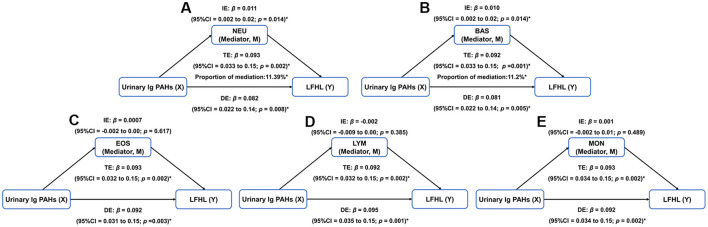
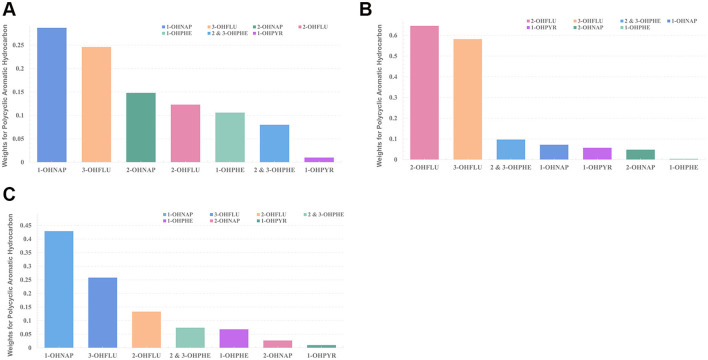
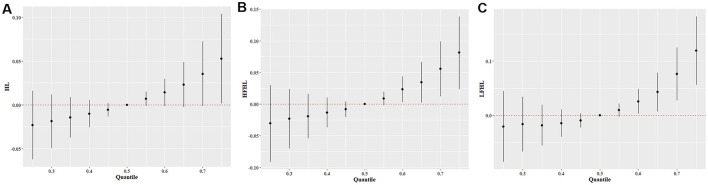
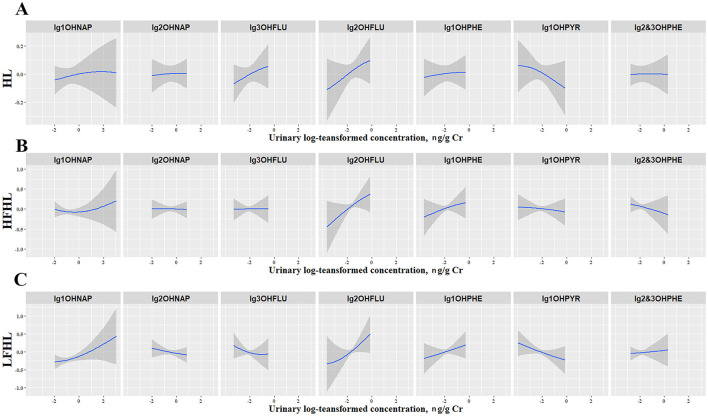
Among the 1,409 participants, 59.1% had hearing loss. The WQS model revealed a positive association between PAH mixtures and HL (OR: 1.290; 95% CI: 1.042, 1.597), LFHL (OR: 1.363; 95% CI: 1.130, 1.644), and HFHL (OR: 1.299; 95% CI: 1.022, 1.626). Additionally, the WQS model identified hydroxynaphthalene (1-OHNAP) primarily contributed to HL and LFHL, while 2-hydroxyfluorene (2-OHFLU) was the primary contributor to HFHL. BKMR analysis demonstrated positive associations between PAH mixtures and all three types of hearing loss. Mediation analysis revealed that the association between OH-PAHs and LFHL was mediated by neutrophil (NEU) and basophil (BAS) counts.
These results confirmed that exposure to PAH mixtures was positively associated with the odds of hearing loss and that inflammatory blood cell markers mediated this association.
关于多环芳烃(PAHs)对听力损失(HL)影响的研究有限,且通常聚焦于单个PAH化合物。本研究旨在探讨PAH暴露对听力损失的单独及联合影响,重点关注炎症血细胞标志物的中介作用。
这项横断面研究纳入了来自国家健康与营养检查调查(2001 - 2002年、2003 - 2004年和2011 - 2012年)3个周期的1409名参与者。测量了尿液中7种单羟基化PAH代谢物(OH - PAHs)。应用多变量逻辑回归、加权分位数和(WQS)回归以及贝叶斯核机器回归(BKMR)来评估OH - PAHs对听力损失的单独及联合影响。此外,采用中介分析来检验炎症血细胞标志物在这些关联中的中介作用。
在1409名参与者中,59.1%有听力损失。WQS模型显示PAH混合物与HL(比值比:1.290;95%置信区间:1.042,1.597)、低频听力损失(LFHL,比值比:1.363;95%置信区间:1.130,1.644)和高频听力损失(HFHL,比值比:1.299;95%置信区间:1.022,1.626)之间呈正相关。此外,WQS模型确定羟基萘(1 - OHNAP)主要导致HL和LFHL,而2 - 羟基芴(2 - OHFLU)是HFHL的主要促成因素。BKMR分析表明PAH混合物与所有三种类型的听力损失之间存在正相关。中介分析显示OH - PAHs与LFHL之间的关联由中性粒细胞(NEU)和嗜碱性粒细胞(BAS)计数介导。
这些结果证实,PAH混合物暴露与听力损失几率呈正相关,且炎症血细胞标志物介导了这种关联。