Niu Xiaokang, Zhang Qi, Liu Julong, Zhao Yuyang, Shang Nan, Li Shusen, Liu Yinghua, Xiong Wei, Sun Erna, Zhang Yong, Zhao Hongfeng, Li Yixuan, Wang Pengjie, Fang Bing, Zhao Liang, Chen Juan, Wang Fuqing, Pang Guofang, Wang Chenyuan, He Jingjing, Wang Ran
Key Laboratory of Functional Dairy, Co-Constructed by Ministry of Education and Beijing Government, Department of Nutrition and Health, China Agricultural University, Beijing, China.
Research Center for Probiotics, China Agricultural University, Beijing, China.
Front Nutr. 2024 Nov 27;11:1510318. doi: 10.3389/fnut.2024.1510318. eCollection 2024.
Synbiotics, combining specific probiotics and selected prebiotics, may benefit health issues like obesity, but evidence remains inconsistent.
This study aimed to verify the effect of a pre-screened synbiotics combination [containing subsp. MN-Gup (MN-Gup), galacto-oligosaccharides (GOS) and xylo-oligosaccharides (XOS)] on obesity in the population.
In a randomized, double-blind, placebo-controlled trial, 80 individuals with obesity consumed daily synbiotics (containing MN-Gup 1 × 10 CFU/day, GOS 0.7 g/day, and XOS 0.7 g/day) or placebo for 12 weeks. Body composition, blood lipids, serum hormone, bile acids, and gut microbiota were measured pre-and post-intervention.
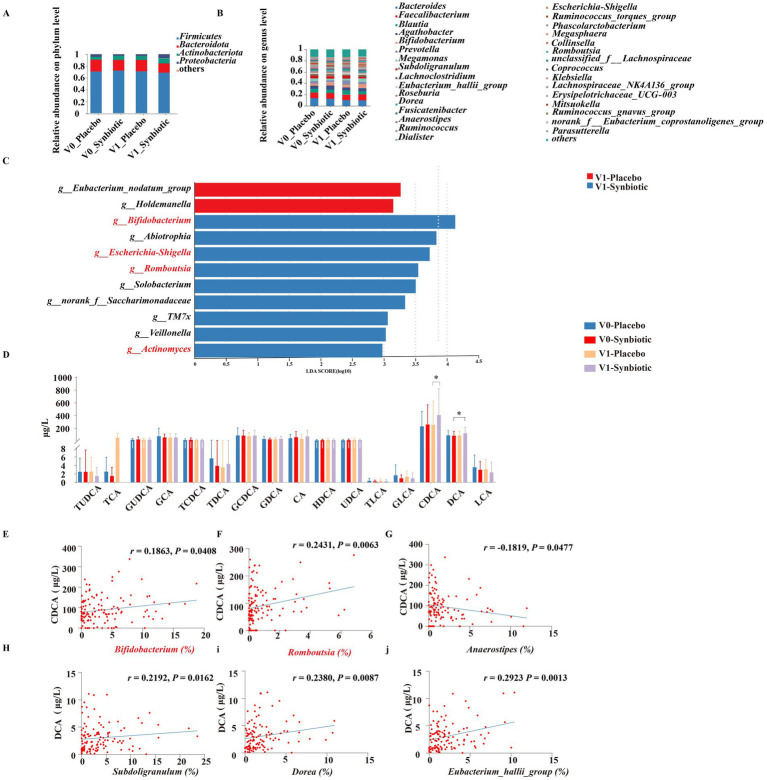
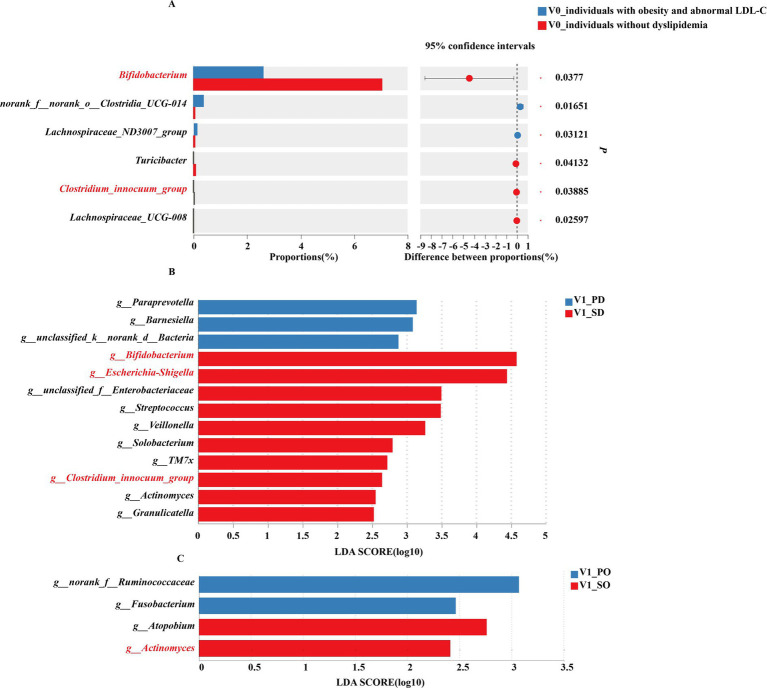
Synbiotics supplementation significantly decreased body fat percentage, waist, and serum low-density lipoprotein cholesterol (LDL-C), increased peptide YY, cholecystokinin, oxyntomodulin, GSH (glutathione peroxidase) in individuals with obesity. Additionally, synbiotic supplementation led to an enrichment of beneficial bacteria and bile acids chenodeoxycholic acid (CDCA). and were significantly positively correlated with CDCA. A more favorable effect was observed in individuals with obesity and abnormal LDL-C compared to those without dyslipidemia.
Twelve-week synbiotics intervention reduced body fat percentage, waist, and serum LDL-C, especially in individuals with obesity and abnormal LDL-C. The possible mechanisms may be related to changes in gut microbiota, bile acids and gut hormones.
Chictr.org.cn, identifier ChiCTR2200064156.
合生元是特定益生菌与精选益生元的组合,可能对肥胖等健康问题有益,但证据仍不一致。
本研究旨在验证预先筛选的合生元组合[包含副干酪乳杆菌MN-Gup(MN-Gup)、低聚半乳糖(GOS)和低聚木糖(XOS)]对人群肥胖的影响。
在一项随机、双盲、安慰剂对照试验中,80名肥胖个体每天服用合生元(含MN-Gup 1×10⁹CFU/天、GOS 0.7克/天和XOS 0.7克/天)或安慰剂,持续12周。在干预前后测量身体成分、血脂、血清激素、胆汁酸和肠道微生物群。
补充合生元显著降低了肥胖个体的体脂百分比、腰围和血清低密度脂蛋白胆固醇(LDL-C),增加了肽YY、胆囊收缩素、胃泌酸调节素、谷胱甘肽(谷胱甘肽过氧化物酶)。此外,补充合生元导致有益细菌和鹅去氧胆酸(CDCA)富集。[具体两种物质未明确写出英文]与CDCA呈显著正相关。与无血脂异常的个体相比,肥胖且LDL-C异常的个体观察到更有利的效果。
为期12周的合生元干预降低了体脂百分比、腰围和血清LDL-C,尤其是在肥胖且LDL-C异常的个体中。可能的机制可能与肠道微生物群、胆汁酸和肠道激素的变化有关。
Chictr.org.cn,标识符ChiCTR2200064156。