Xu Jinjing, Li Jintao, Chen Xiaohong
School of Civil Engineering, Architecture and Environment, Hubei University of Technology, Wuhan, China.
Sci Prog. 2024 Oct-Dec;107(4):368504241304198. doi: 10.1177/00368504241304198.
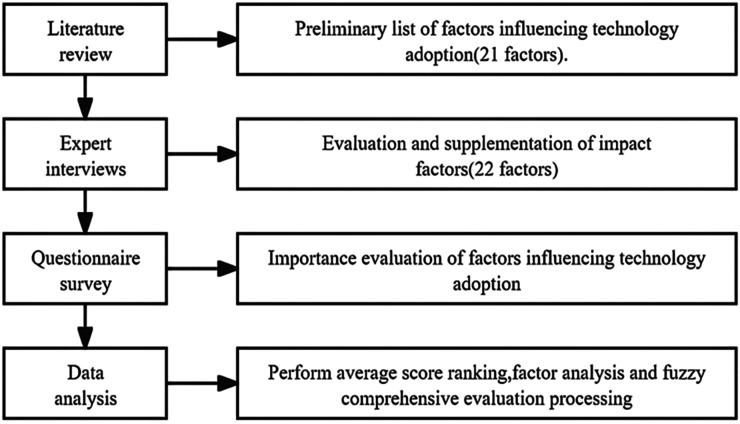
The current body of literature indicates that the utilization of emerging digital safety technologies has the potential to enhance the efficacy of safety management in construction significantly. Nevertheless, there has been limited uptake of digital safety technologies within the construction industry in developing countries. This study is focused on evaluating the adoption of digital safety technologies in construction specifically from the perspective of developing countries. Questionnaire data were gathered from project management professionals in China and subjected to analysis using mean ratings, factor analysis, and fuzzy composite evaluation. The developed model for assessing safety technology adoption comprises four primary criterion groups about factors influencing adoption, namely organizational, technological, individual, and external categories. The study results indicate that factors within the technology category exert the most significant influence on the adoption assessment model, followed by those in the external and organizational categories, and finally by individual category factors. These findings contribute to advancing the theory of digital technology adoption in construction safety management research within developing countries. Practitioners can utilize this information to effectively evaluate and compare success rates of safety technology adoption, thereby informing management decisions required for projects. The insights provided by this study will equip practitioners with scientific knowledge for more effective and sustainable program management, ultimately enhancing the success of safety technologies.
当前的文献表明,新兴数字安全技术的应用有潜力显著提高建筑安全管理的效率。然而,发展中国家的建筑业对数字安全技术的采用有限。本研究专注于从发展中国家的角度评估建筑中数字安全技术的采用情况。通过问卷调查收集了来自中国项目管理专业人员的数据,并使用平均评分、因子分析和模糊综合评价进行分析。所开发的评估安全技术采用情况的模型包括四个主要标准组,涉及影响采用的因素,即组织、技术、个人和外部类别。研究结果表明,技术类别中的因素对采用评估模型的影响最大,其次是外部和组织类别中的因素,最后是个人类别因素。这些发现有助于推动发展中国家建筑安全管理研究中数字技术采用理论的发展。从业者可以利用这些信息有效地评估和比较安全技术采用的成功率,从而为项目所需的管理决策提供依据。本研究提供的见解将为从业者提供科学知识,以实现更有效和可持续的项目管理,最终提高安全技术的成功率。