Li Jun, Liao Chun, Liu Zhaohui, Xiong Hu, Cai Jing, Liu Tiande
Department of General Surgery, The Second Affiliated Hospital, Jiangxi Medical College, Nanchang University, Nanchang, China.
Department of Oncology, The Second Affiliated Hospital, Jiangxi Medical College, Nanchang University, Nanchang, China.
Technol Cancer Res Treat. 2024 Jan-Dec;23:15330338241305700. doi: 10.1177/15330338241305700.
For advanced hepatocellular carcinoma (HCC), sorafenib remains the established therapy. PD-1/PD-L1 inhibitors plus antiangiogenic drugs (PIAD) as a new therapeutic approach for advanced HCC is still a subject of clinical debate regarding whether they offer improved treatment outcomes. This study was conducted to compare the two treatments in terms of antitumor efficacy and safety.
Randomized controlled trials (RCTs) comparing PIAD and sorafenib for advanced HCC were retrieved from six databases. Survival (overall survival [OS] and progression-free survival [PFS]) were the main outcomes measured. Secondary endpoints included responses, adverse events (AEs), and effects on quality of life.
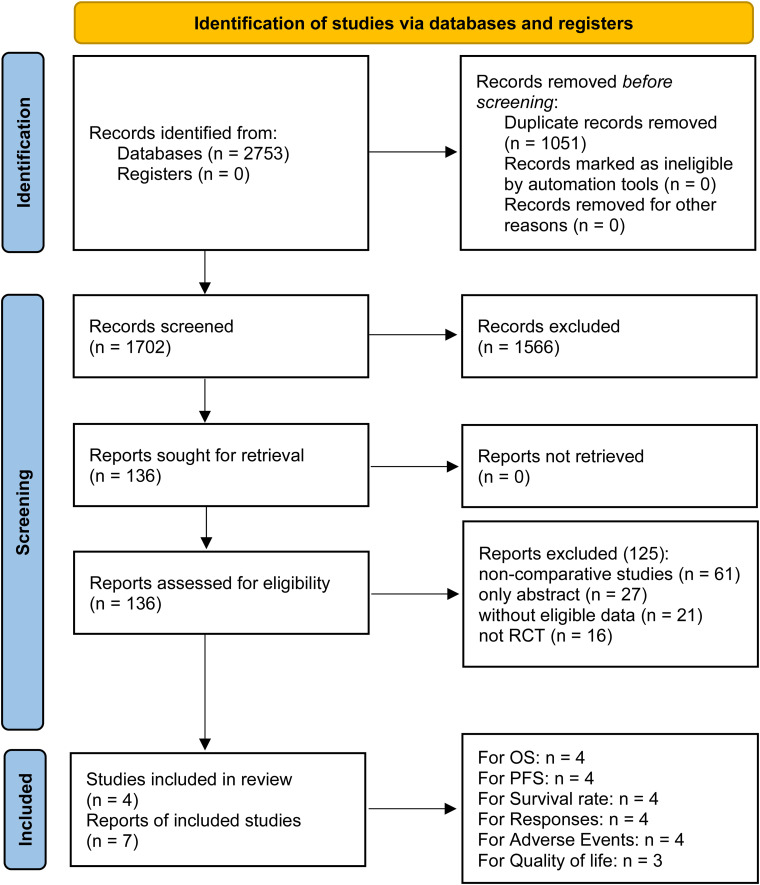
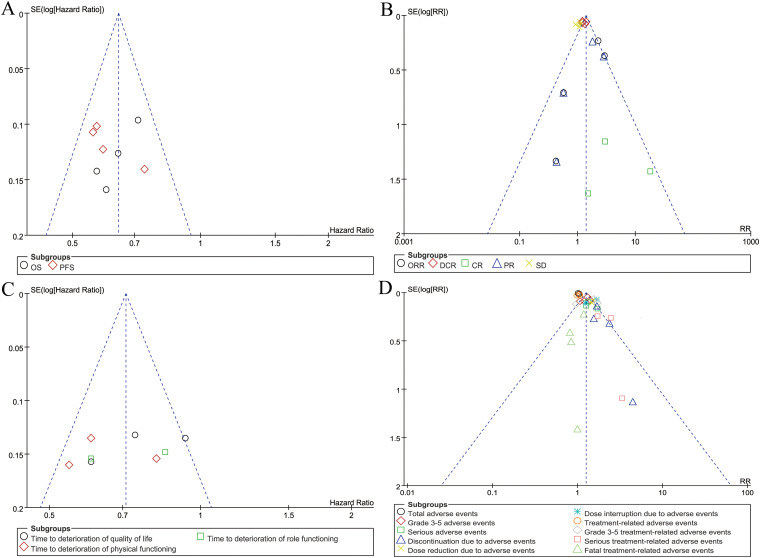
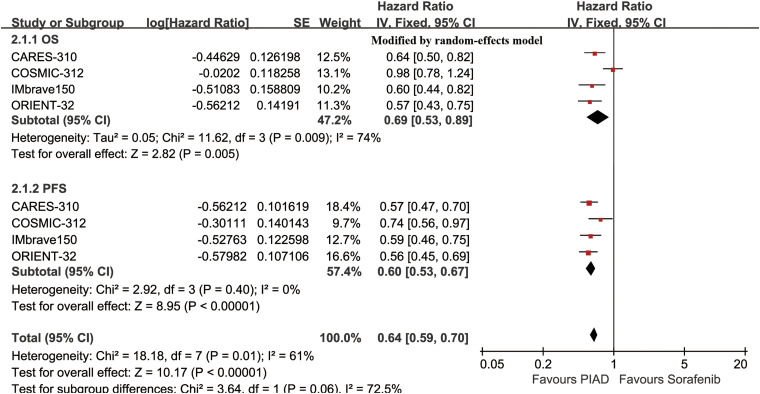
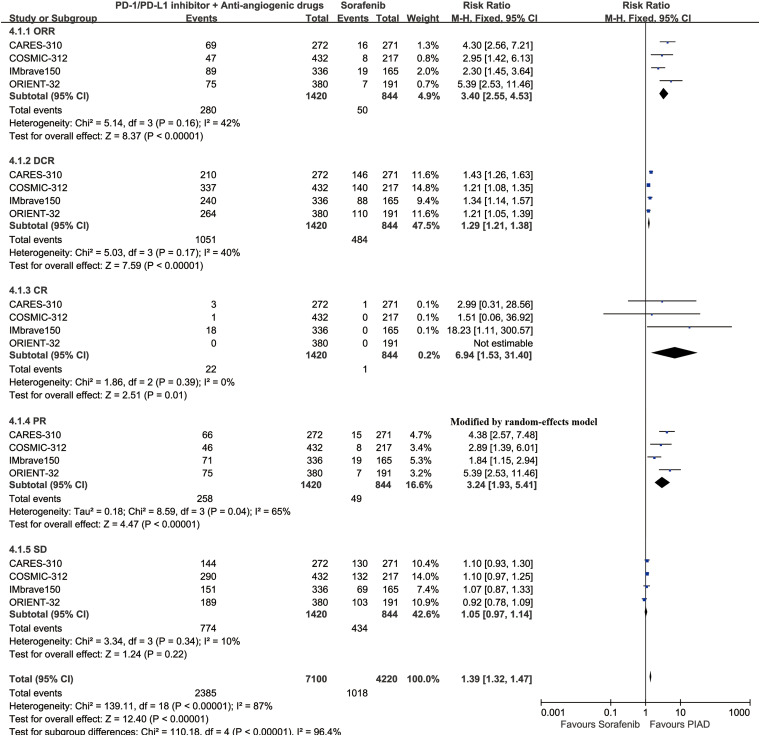
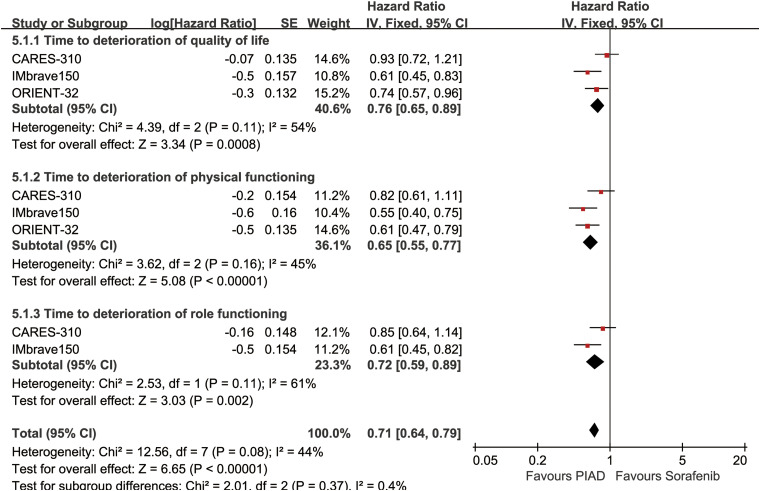
Seven studies based on four RCTs (CARES-310, COSMIC-312, IMbrave150, and ORIENT-32) were included. The PIAD group exhibited better OS (hazard ratio [HR]: 0.69, 95% confidence interval [CI]: [0.53, 0.89], P = 0.005), and PFS (HR: 0.60, 95% CI: [0.53, 0.67], P < 0.00001). The survival advantages of OS and PFS were confirmed in almost all subgroups. The PIAD group exhibited higher OS rates at 6-18 months and PFS rates at 6-12 months. Additionally, the objective response rate, disease control rate, complete response, and partial response were higher in PIAD group. The PIAD group had a delayed decline in quality of life, physical functioning, and role functioning. However, the PIAD group experienced more grades 3-5 and serious AEs, along with treatment discontinuation, dose reduction, and dose interruption.
PIAD appears to be better than sorafenib for advanced HCC with better survival and responses. However, its higher rate of AEs requires cautious attention.
对于晚期肝细胞癌(HCC),索拉非尼仍然是既定的治疗方法。PD-1/PD-L1抑制剂联合抗血管生成药物(PIAD)作为晚期HCC的一种新治疗方法,在是否能提供更好的治疗效果方面仍是临床争论的话题。本研究旨在比较这两种治疗方法在抗肿瘤疗效和安全性方面的差异。
从六个数据库中检索比较PIAD和索拉非尼治疗晚期HCC的随机对照试验(RCT)。生存(总生存期[OS]和无进展生存期[PFS])是主要测量指标。次要终点包括缓解率、不良事件(AE)和对生活质量的影响。
纳入了基于四项RCT(CARES-310、COSMIC-312、IMbrave150和ORIENT-32)的七项研究。PIAD组的OS(风险比[HR]:0.69,95%置信区间[CI]:[0.53,0.89],P = 0.005)和PFS(HR:0.60,95%CI:[0.53,0.67],P < 0.00001)表现更好。几乎所有亚组中OS和PFS的生存优势都得到了证实。PIAD组在6至18个月时的OS率和6至12个月时的PFS率更高。此外,PIAD组的客观缓解率、疾病控制率、完全缓解率和部分缓解率更高。PIAD组的生活质量、身体功能和角色功能下降延迟。然而,PIAD组经历了更多3至5级和严重AE,以及治疗中断、剂量减少和剂量中断。
对于晚期HCC,PIAD似乎比索拉非尼更好,具有更好的生存率和缓解率。然而,其较高的AE发生率需要谨慎关注。