Park Joo-Hee, Park Choul Yong
Department of Ophthalmology, Dongguk University Ilsan Hospital, Goyang, Republic of Korea.
Department of Ophthalmology, Samsung Medical Center, Sungkyunkwan University School of Medicine, Seoul, Republic of Korea.
Transl Vis Sci Technol. 2024 Dec 2;13(12):18. doi: 10.1167/tvst.13.12.18.
To investigate the toxicity of terpinen-4-ol (T4O) on primary cultured human corneal epithelial cells (HCECs).
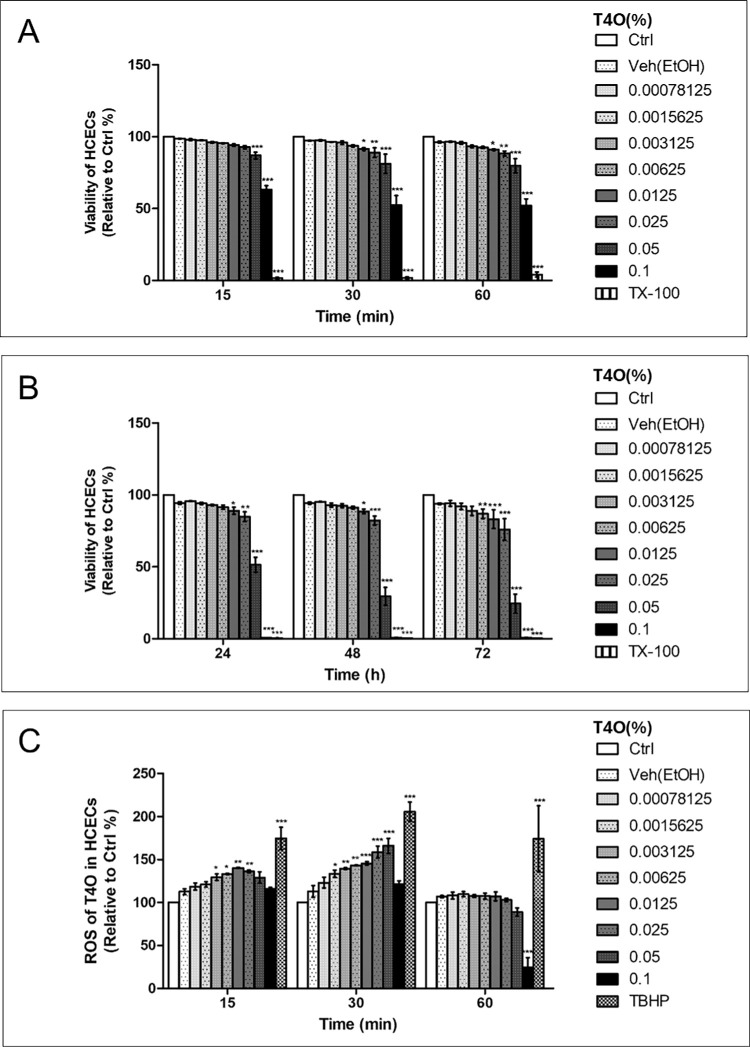
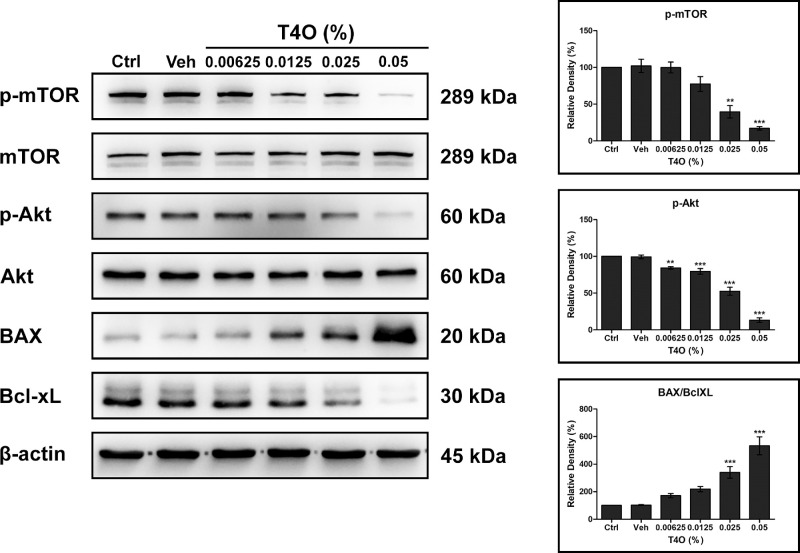
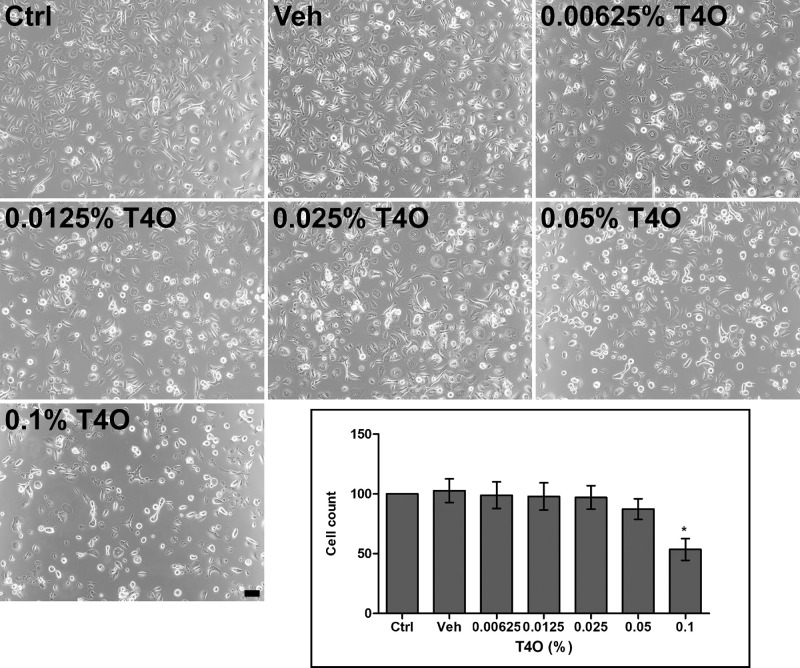
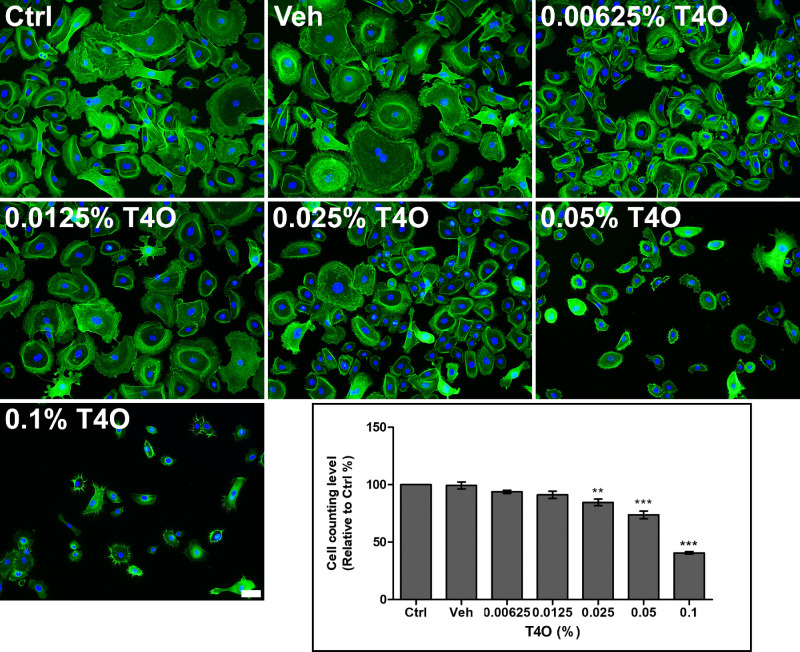
HCECs were exposed to various concentrations (0%-0.1%) of T4O for 15 minutes to 72 hours. Cell viability was assessed using the CCK8 kit and cell counting. Intracellular reactive oxygen species (ROS) were measured after 15 to 60 minutes of T4O exposure. Changes in cell morphology and cytoplasmic actin filaments were observed using phase contrast microscopy and immunocytochemistry. The expression levels of proteins involved in cell survival pathways (mTOR, Akt, Bcl-xL, and BAX) were evaluated by Western blot analysis.
T4O induced dose-dependent toxicity in HCECs. Exposure to 0.05% T4O for 15 minutes significantly decreased cell viability. Lower concentrations (0.025% and 0.0125%) also caused significant toxicity with longer exposure times. Prolonged exposure enhanced cytotoxicity, with 0.05% T4O reducing viability by half after 24 hours and 0.1% T4O causing complete cell death. Increased intracellular ROS and decreased levels of phosphorylated mTOR, phosphorylated Akt, and Bcl-xL, along with increased BAX expression, accompanied this toxicity. F-actin staining revealed significant changes in cell adhesion.
Our study demonstrates that T4O exposure causes significant toxicity in HCECs, depending on concentration and incubation time. This toxic response is associated with increased ROS and decreased cell survival pathway activity.
The corneal epithelial toxicity data of T4O revealed in this study may be useful in the future use of tea tree oil or the development of tee tree oil-containing eyelid scrub products for treating eyelid demodex infestation.
研究萜品-4-醇(T4O)对原代培养的人角膜上皮细胞(HCECs)的毒性。
将HCECs暴露于不同浓度(0%-0.1%)的T4O中15分钟至72小时。使用CCK8试剂盒和细胞计数评估细胞活力。在T4O暴露15至60分钟后测量细胞内活性氧(ROS)。使用相差显微镜和免疫细胞化学观察细胞形态和细胞质肌动蛋白丝的变化。通过蛋白质印迹分析评估参与细胞存活途径的蛋白质(mTOR、Akt、Bcl-xL和BAX)的表达水平。
T4O在HCECs中诱导剂量依赖性毒性。暴露于0.05% T4O 15分钟显著降低细胞活力。较低浓度(0.025%和0.0125%)在较长暴露时间下也会引起显著毒性。长时间暴露增强细胞毒性,0.05% T4O在24小时后使活力降低一半,0.1% T4O导致细胞完全死亡。这种毒性伴随着细胞内ROS增加以及磷酸化mTOR、磷酸化Akt和Bcl-xL水平降低,同时BAX表达增加。F-肌动蛋白染色显示细胞黏附发生显著变化。
我们的研究表明,T4O暴露在HCECs中会引起显著毒性,这取决于浓度和孵育时间。这种毒性反应与ROS增加和细胞存活途径活性降低有关。
本研究揭示的T4O角膜上皮毒性数据可能对茶树油的未来应用或含茶树油的眼睑擦洗产品治疗眼睑蠕形螨感染的开发有用。