Simpson Sarah E, Malek Angela M, Wen Chun-Che, Neelon Brian, Wilson Dulaney A, Mateus Julio, Pearce John, Chundru Kalyan J, Korte Jeffrey E, Florez Hermes, Alkis Mallory, Finneran Matt, Hunt Kelly J
Department of Public Health Sciences, Medical University of South Carolina, 135 Cannon St, Ste 302, Charleston, SC 29425 (
Department of Public Health Sciences, Medical University of South Carolina, Charleston.
Prev Chronic Dis. 2024 Dec 12;21:E98. doi: 10.5888/pcd21.240137.
We examined trends in prepregnancy obesity and gestational weight gain, with a focus on racial and ethnic differences, before and during the COVID-19 pandemic in South Carolina.
Hospital and emergency department discharge codes were linked to birth certificates. Prepregnancy obesity was defined as a body mass index (kg/m) of 30 or higher. Gestational weight gain was defined as inadequate, adequate, or excessive based on the 2009 Institute of Medicine guidelines. A generalized linear model with a multinomial distribution and glogit link estimated the risk of inadequate weight gain and excessive weight gain with adequate weight gain as the reference group. The generalized linear model with a modified Poisson distribution and log link estimated prepregnancy obesity risk with nonobese as the reference group.
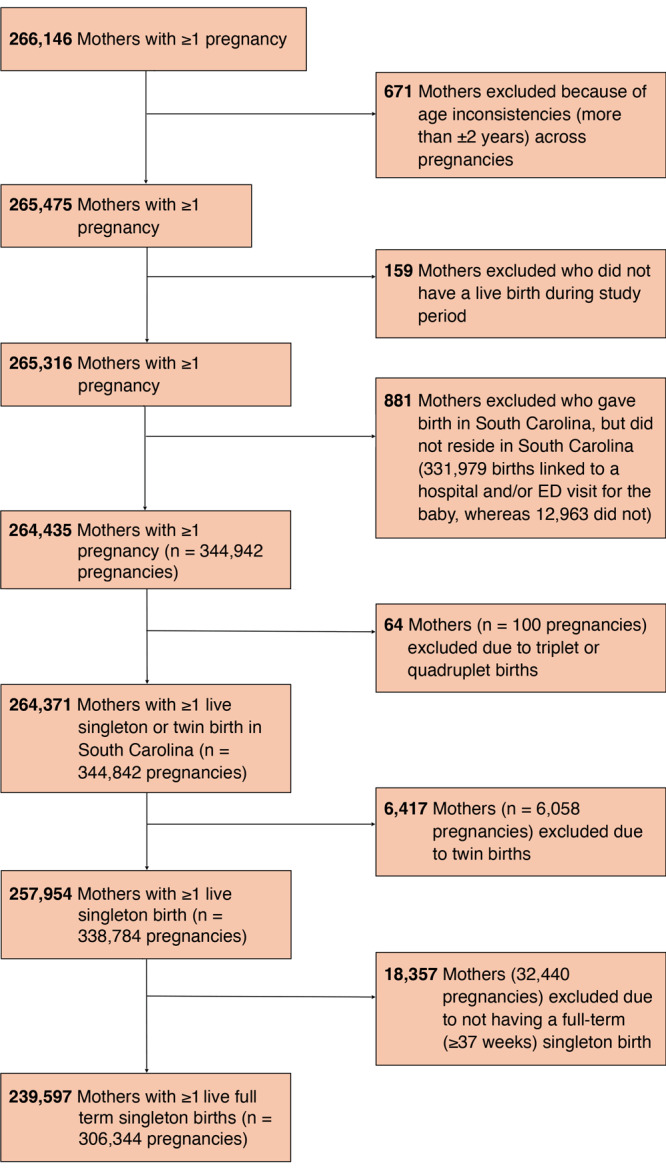
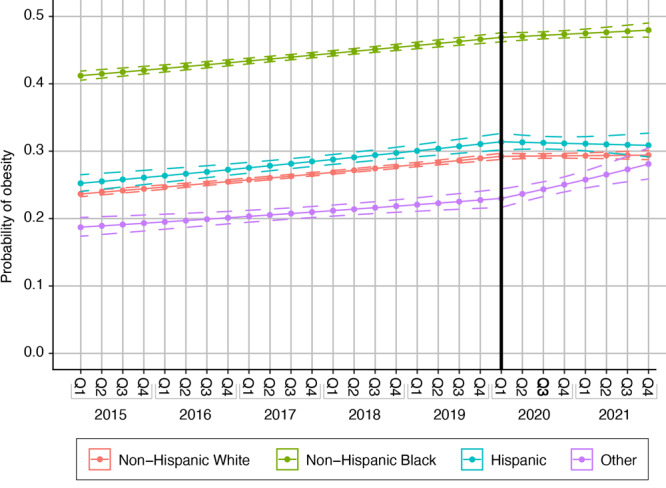
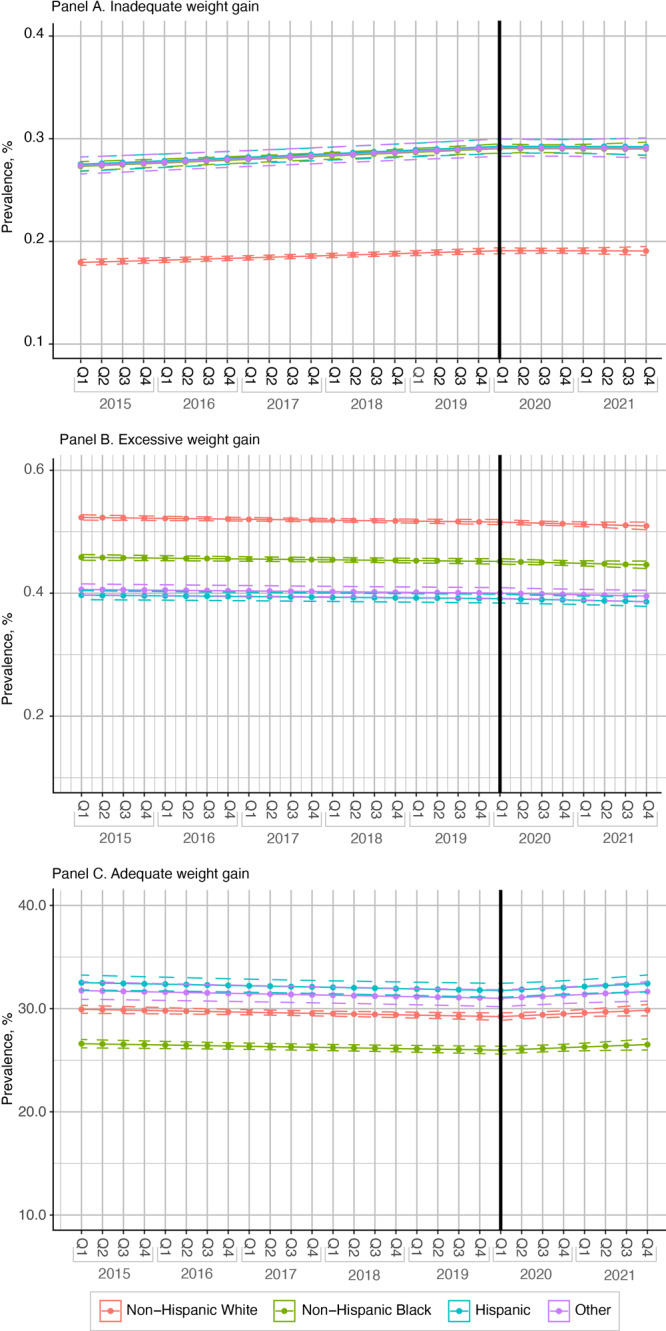
Our study included 306,344 full-term, singleton live births among 239,597 mothers from 2015 through 2021. The prevalence of inadequate weight gain increased across all racial and ethnic groups prepandemic (relative risk [RR] = 1.02; 95% CI, 1.01-1.02) and attenuated during the pandemic (RR = 0.99; 95% CI, 0.96-1.01). The prevalence of excessive weight gain was high and remained stable across all races and ethnicities before and during the pandemic. The prevalence of prepregnancy obesity increased across all racial and ethnic groups prepandemic; the prevalence after the start of the pandemic increased only among women of "other" races and ethnicities (RR = 1.12; 95% CI, 1.05-1.19) while attenuating among Hispanic, non-Hispanic Black, and non-Hispanic White women.
The COVID-19 pandemic did not alter trends of gestational weight gain; however, it did have a small effect on trends in prepregnancy obesity, with differential effects across racial and ethnic groups. The prevalence of prepregnancy obesity, inadequate weight gain, and excessive weight gain remains high among pregnant women in South Carolina. Obesity and weight gain are risk factors for many adverse maternal and infant pregnancy outcomes. Their high prevalence indicates the importance of developing effective weight management programs for women of childbearing age and pregnant women.
我们研究了南卡罗来纳州在新冠疫情之前及期间孕前肥胖和孕期体重增加的趋势,重点关注种族和民族差异。
医院和急诊科出院编码与出生证明相关联。孕前肥胖定义为体重指数(kg/m)为30或更高。孕期体重增加根据2009年医学研究所指南定义为不足、充足或过多。以充足体重增加为参照组,采用具有多项分布和glogit连接的广义线性模型估计体重增加不足和过多的风险。以非肥胖为参照组,采用具有修正泊松分布和对数连接的广义线性模型估计孕前肥胖风险。
我们的研究纳入了2015年至2021年期间239,597名母亲的306,344例足月单胎活产。在疫情之前,所有种族和民族群体中体重增加不足的患病率均有所上升(相对风险[RR]=1.02;95%置信区间,1.01-1.02),而在疫情期间有所减弱(RR=0.99;95%置信区间,0.96-1.01)。体重增加过多的患病率较高,且在疫情之前和期间在所有种族和民族中保持稳定。孕前肥胖的患病率在疫情之前所有种族和民族群体中均有所上升;疫情开始后,患病率仅在“其他”种族和民族的女性中有所增加(RR=1.12;95%置信区间,1.05-1.19),而在西班牙裔、非西班牙裔黑人及非西班牙裔白人女性中有所减弱。
新冠疫情并未改变孕期体重增加的趋势;然而,它确实对孕前肥胖趋势产生了微小影响,且对不同种族和民族群体的影响存在差异。在南卡罗来纳州的孕妇中,孕前肥胖、体重增加不足和体重增加过多的患病率仍然很高。肥胖和体重增加是许多不良母婴妊娠结局的危险因素。它们的高患病率表明为育龄妇女和孕妇制定有效的体重管理计划的重要性。