Dash Girish Chandra, Sahoo Krushna Chandra, Dubey Shubhankar, Sahoo Rakesh Kumar, Naik Jyotsna, Rajsekar Kavitha, Bhattacharya Debdutta, Pati Sanghamitra
Health Technology Assessment Hub, ICMR-Regional Medical Research Centre, Bhubaneswar, Odisha, India.
Health Technology Assessment in India, Department of Health Research, Ministry of Health and Family Welfare, Government of India, New Delhi, India.
Indian J Community Med. 2024 Nov-Dec;49(6):796-804. doi: 10.4103/ijcm.ijcm_9_24. Epub 2024 Oct 17.
Maintaining optimal hearing health and preventing ear infections is crucial across all life stages, spanning from before birth and infancy to middle age and beyond. The primary aim of the research was to evaluate and compare the effectiveness of the telemedicine-enabled otoscope (TEO) in diagnosing ear diseases with that of the conventional otoscope.
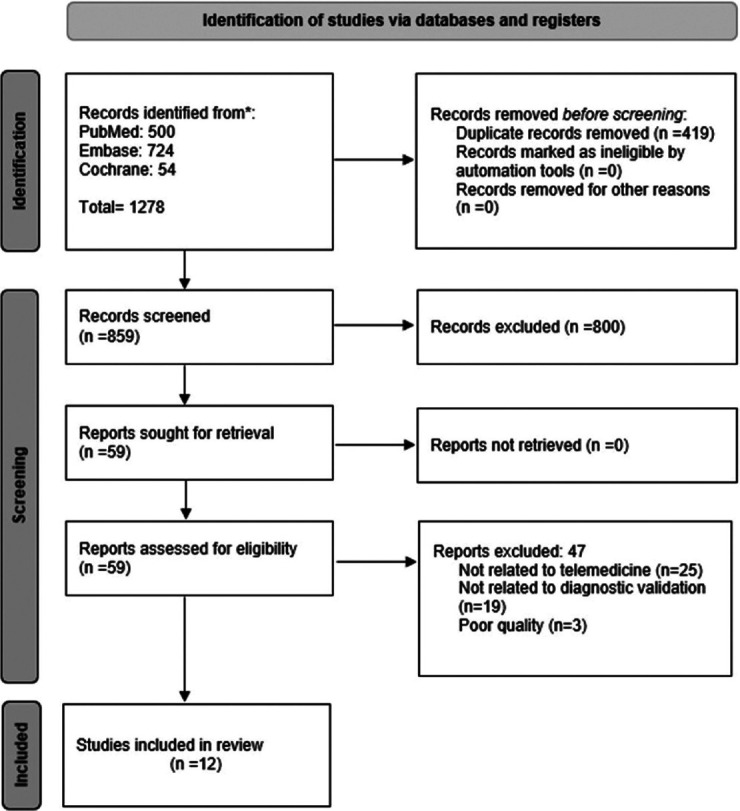
The databases PubMed, Cochrane, and Embase were thoroughly searched to find original studies on TEO at the community as well as hospital levels along with meta-analysis for comparison with standard diagnostic methods using traditional otoscopes.
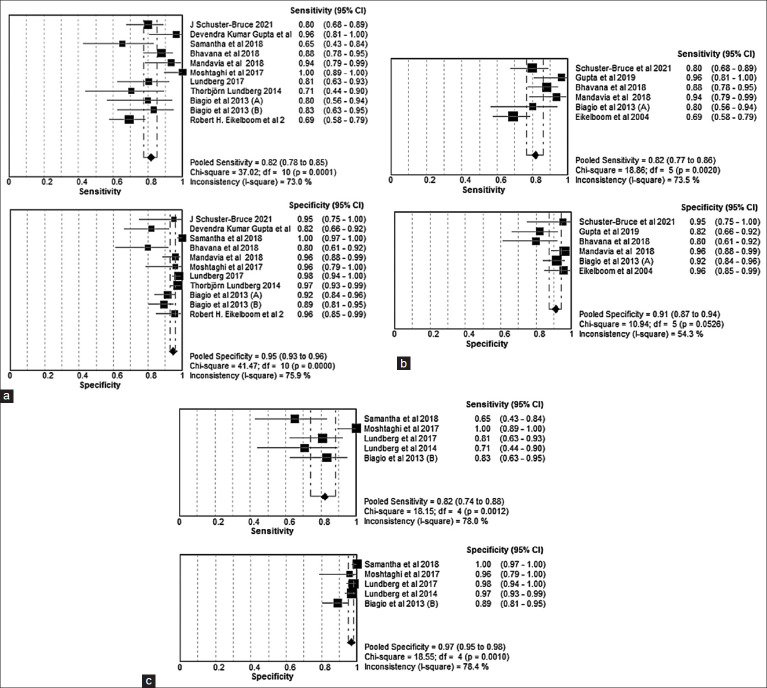
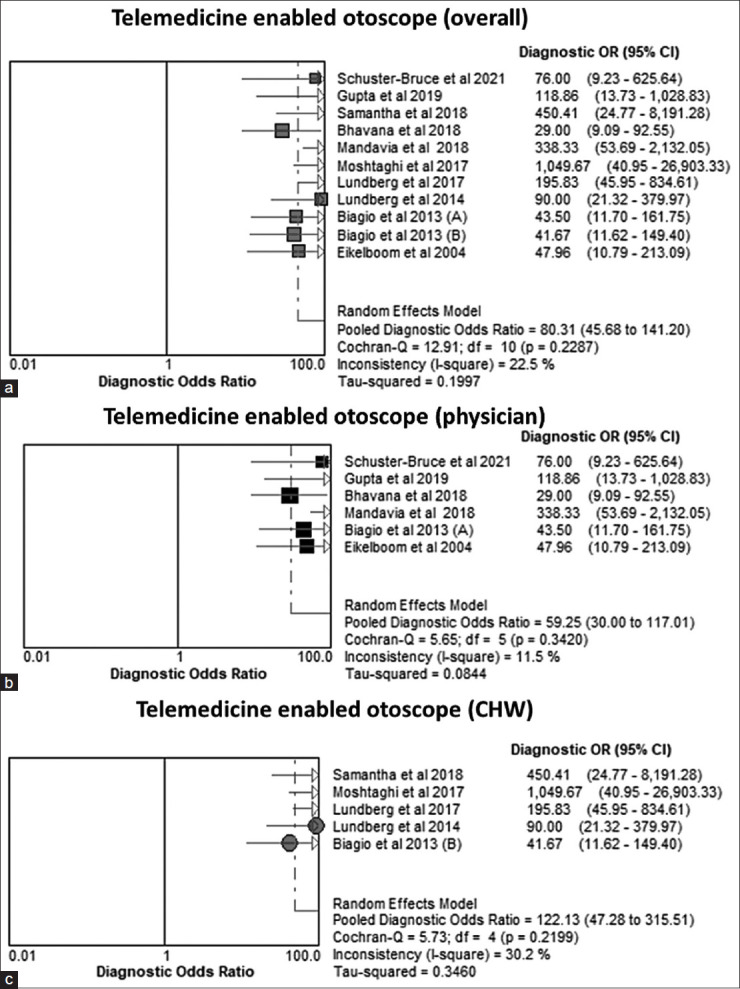
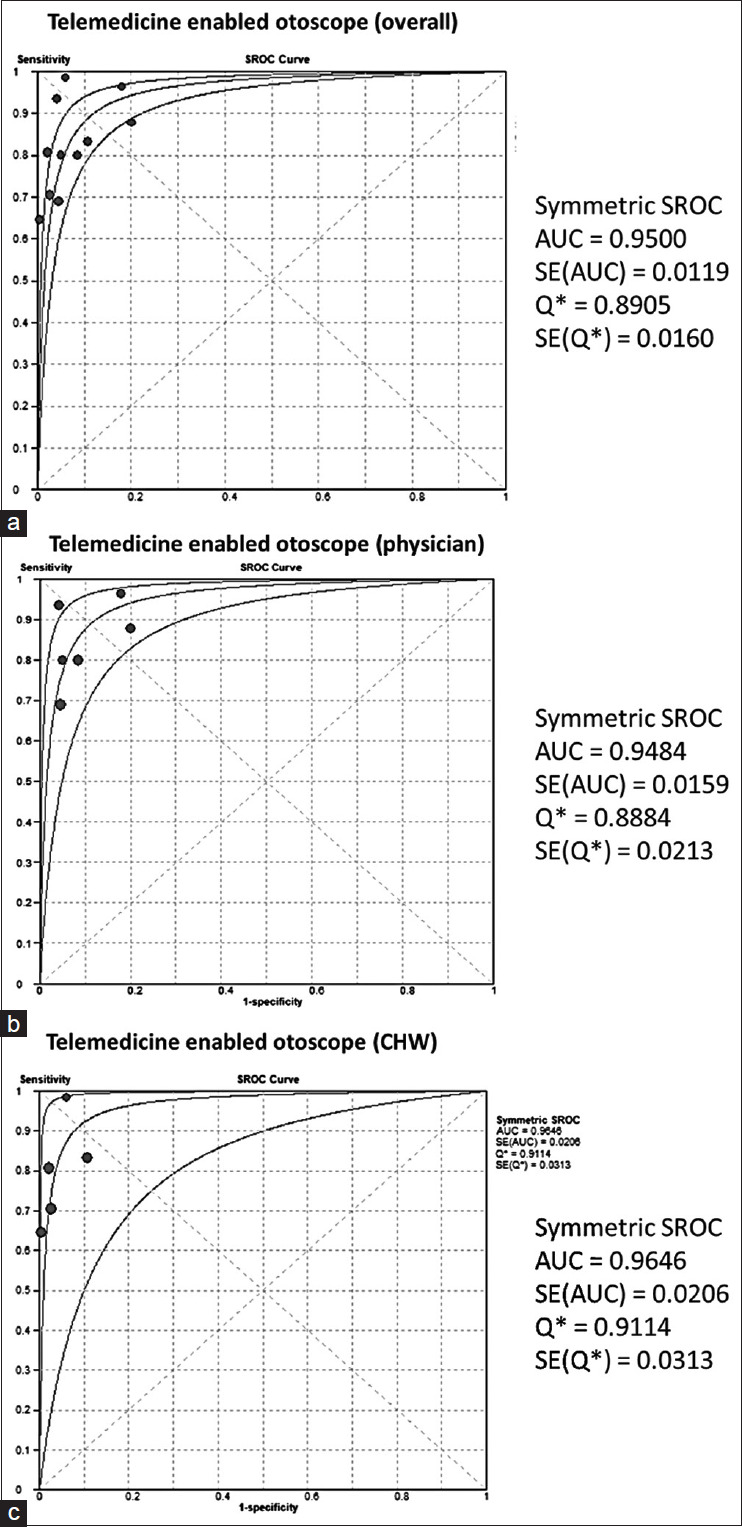
The telemedicine-equipped otoscope displays a sensitivity of 82% (confidence interval 0.78-0.95) and a specificity of 95% (confidence interval 0.93-0.96). When employed by physicians, the combined sensitivity and specificity become 84% (confidence interval 0.79-0.88) and 91% (confidence interval 0.87-0.94), respectively. Community Health Workers (CHWs) using telemedicine-enabled otoscopes exhibit a collective sensitivity of 80% (confidence interval 0.72-0.87) and a collective specificity of 97% (confidence interval 0.95-0.98). Snapping multiple photographs and removal of cerumen where necessary in increasing the quality of the photographs for diagnosis.
The TEO holds the promise of substantially enhancing the accessibility of audiology services, encompassing evaluation, public outreach, and fundamental care. Its implementation has the potential to fortify primary health care environments, contributing to the prevention of ear diseases and assisting in mitigating the shortage of skilled ear care professionals.
在从出生前、婴儿期到中年及以后的所有生命阶段,保持最佳听力健康和预防耳部感染都至关重要。该研究的主要目的是评估和比较远程医疗耳镜(TEO)与传统耳镜在诊断耳部疾病方面的有效性。
全面检索了PubMed、Cochrane和Embase数据库,以查找社区和医院层面关于TEO的原始研究,以及与使用传统耳镜的标准诊断方法进行比较的荟萃分析。
配备远程医疗功能的耳镜显示出82%的灵敏度(置信区间0.78 - 0.95)和95%的特异度(置信区间0.93 - 0.96)。当由医生使用时,综合灵敏度和特异度分别变为84%(置信区间0.79 - 0.88)和91%(置信区间0.87 - 0.94)。使用远程医疗耳镜的社区卫生工作者(CHW)的综合灵敏度为80%(置信区间0.72 - 0.87),综合特异度为97%(置信区间0.95 - 0.98)。拍摄多张照片并在必要时清除耳垢可提高用于诊断的照片质量。
TEO有望大幅提高听力服务的可及性,包括评估、公众宣传和基本护理。其实施有可能加强初级卫生保健环境,有助于预防耳部疾病并缓解熟练耳部护理专业人员短缺的问题。