Arumugam Mani, P Chacko Paul Joseph, Jeyaraman Naveen, Ramasubramanian Swaminathan, Hari Rajeswary, Jeyaraman Madhan
Department of Orthopaedics, Melmaruvathur Adhiparasakthi Institute of Medical Sciences, Melmaruvathur, Tamil Nadu, India.
Department of Orthopaedics, ACS Medical College and Hospital, Dr MGR Educational and Research Institute, Chennai, Tamil Nadu, India.
J Orthop Case Rep. 2024 Dec;14(12):237-245. doi: 10.13107/jocr.2024.v14.i12.5084.
Osteoarthritis (OA) is a prevalent degenerative joint disease characterized by cartilage deterioration, joint pain, and reduced mobility. This study aimed to quantify the association between specific biochemical markers and OA and to develop a predictive model for assessing OA risk based on these markers.
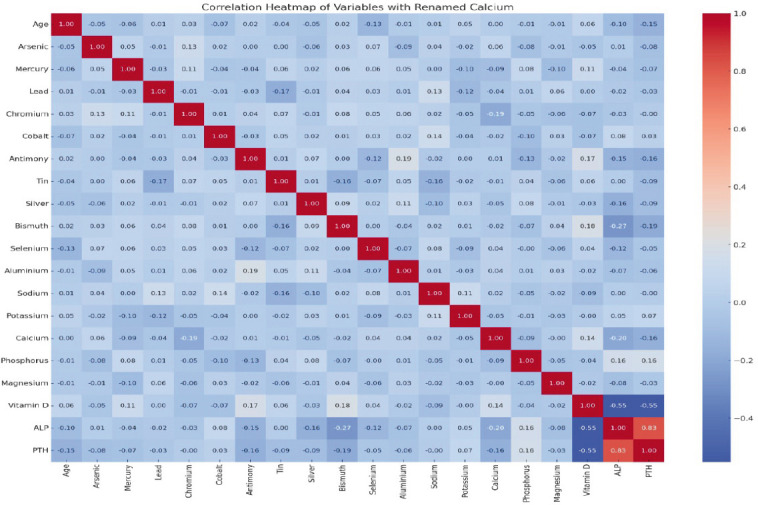
A total of 200 participants (mean age: 55.2 years) were recruited for this cross-sectional analysis, conducted at Sri Lalithamabigai Medical College and Hospital between June and September 2023. The study included 100 patients with X-ray-confirmed knee OA and 100 healthy controls. Biochemical markers - Vitamin D, parathyroid hormone (PTH), alkaline phosphatase (ALP), calcium, magnesium, chromium, and selenium - were measured using high-performance liquid chromatography tandem mass spectrometry, immunoassays, and inductively coupled plasma mass spectrometry. Statistical analysis involved independent t-tests and logistic regression, with model performance assessed by accuracy, precision, recall, F1-score, and area under the receiver operating characteristic (AUC-ROC).
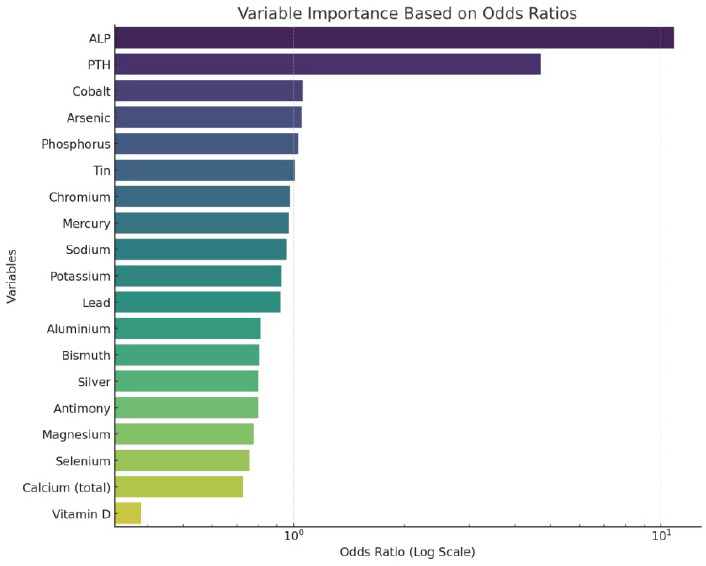
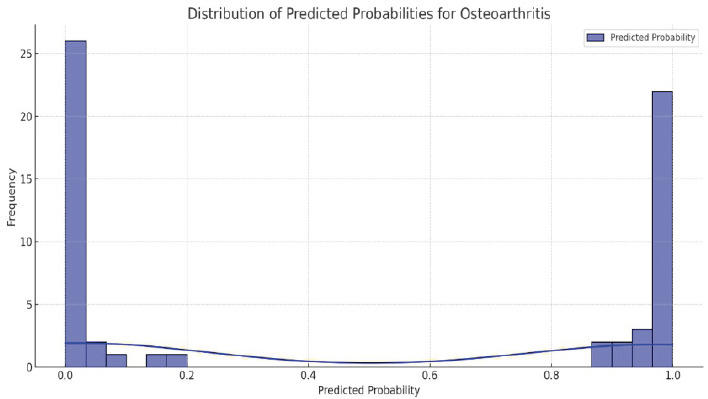
The mean levels of the measured markers in the OA group were 19.82 ng/mL for Vitamin D, 58.10 pg/mL for PTH, and 135.70 IU/L for ALP, compared to 43.24 ng/mL, 23.73 pg/mL, and 53.13 IU/L, respectively, in controls. Significant differences were observed in Vitamin D, PTH, and ALP levels between OA patients and controls (P < 0.05). The predictive model demonstrated excellent performance, with an AUC-ROC of 1.00.
The study identified significant associations between specific biochemical markers and OA. However, given the systemic influences on these markers, their role in predicting OA risk should be interpreted with caution. Further, research is needed to validate these findings and explore their potential in personalized OA management strategies.
骨关节炎(OA)是一种常见的退行性关节疾病,其特征为软骨退化、关节疼痛和活动能力下降。本研究旨在量化特定生化标志物与OA之间的关联,并基于这些标志物开发一种用于评估OA风险的预测模型。
本横断面分析共招募了200名参与者(平均年龄:55.2岁),于2023年6月至9月在Sri Lalithamabigai医学院及医院进行。该研究包括100名经X线确诊的膝关节OA患者和100名健康对照者。使用高效液相色谱串联质谱法、免疫测定法和电感耦合等离子体质谱法测量生化标志物——维生素D、甲状旁腺激素(PTH)、碱性磷酸酶(ALP)、钙、镁、铬和硒。统计分析采用独立t检验和逻辑回归,通过准确性、精确性、召回率、F1分数和受试者工作特征曲线下面积(AUC-ROC)评估模型性能。
OA组中测得的标志物平均水平分别为:维生素D为19.82 ng/mL,PTH为58.10 pg/mL,ALP为135.70 IU/L;而对照组中分别为43.24 ng/mL、23.73 pg/mL和53.13 IU/L。OA患者与对照组之间在维生素D、PTH和ALP水平上观察到显著差异(P < 0.05)。预测模型表现出色,AUC-ROC为1.00。
该研究确定了特定生化标志物与OA之间存在显著关联。然而,鉴于这些标志物受到全身影响,应谨慎解释它们在预测OA风险中的作用。此外,需要进一步研究来验证这些发现,并探索它们在个性化OA管理策略中的潜力。