Li Guoyong, Cheng Tao, Yu Xuefeng
Department of Orthopaedics, The Fourth Affiliated Hospital of Nanchang University, Nanchang, China.
Department of Orthopaedics, Shanghai Jiao Tong University Affiliated Sixth People's Hospital, Shanghai, China.
Front Med (Lausanne). 2021 Dec 23;8:771297. doi: 10.3389/fmed.2021.771297. eCollection 2021.
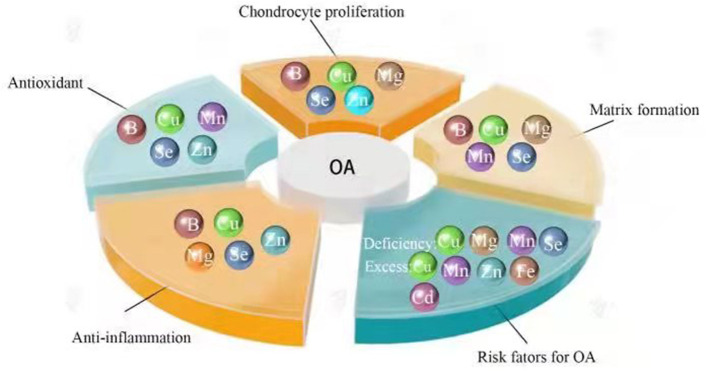
Osteoarthritis (OA) is a progressive degenerative disease characterized by cartilage degradation, synovial inflammation, subchondral sclerosis and osteophyte formation. It has a multifactorial etiology with potential contributions from heredity, endocrine function, abnormal mechanical load and nutrition. Of particular considerations are trace element status. Several trace elements, such as boron and magnesium are essential for normal development of the bone and joint in human. While cadmium correlates with the severity of OA. The present review focuses on the roles of trace elements (boron, cadmium, copper, iron, magnesium, manganese, selenium, zinc) in OA and explores the mechanisms by which they act.
骨关节炎(OA)是一种进行性退行性疾病,其特征为软骨降解、滑膜炎症、软骨下硬化和骨赘形成。它具有多因素病因,遗传、内分泌功能、异常机械负荷和营养等因素都可能起作用。特别值得考虑的是微量元素状况。几种微量元素,如硼和镁,对人体骨骼和关节的正常发育至关重要。而镉与骨关节炎的严重程度相关。本综述重点关注微量元素(硼、镉、铜、铁、镁、锰、硒、锌)在骨关节炎中的作用,并探讨它们发挥作用的机制。