Fu Shuiting, Xu Jiachen, Wang Chunming, Zhang Cheng, Li Chengcheng, Xie Wenchuan, Wang Guoqiang, Zhu Xin, Xu Yuyan, Wen Yaohong, Pei Jingyuan, Yang Jun, Tang Mingyang, Tan Hongkun, Cai Shangli, Cai Lei, Pan Mingxin
Department of Oral & Maxillofacial - Head & Neck Oncology, Shanghai Ninth People's Hospital, College of Stomatology, Shanghai Jiao Tong University School of Medicine, National Center for Stomatology, National Clinical Research Center for Oral Diseases, Shanghai Key Laboratory of Stomatology, Shanghai, 200011, China.
State Key Laboratory of Molecular Oncology, Department of Medical Oncology, National Cancer Center/Cancer Hospital, Chinese Academy of Medical Sciences & Peking Union Medical College, Beijing, China.
Heliyon. 2024 Oct 25;10(23):e39491. doi: 10.1016/j.heliyon.2024.e39491. eCollection 2024 Dec 15.
Although the lactate pathway has been reported to lead to immune escape through the inhibition of effector T cells, the cancer-intrinsic lactate signature has not been identified, and the immunotherapeutic efficacy and potential mechanism of the lactate signature are still unclear.
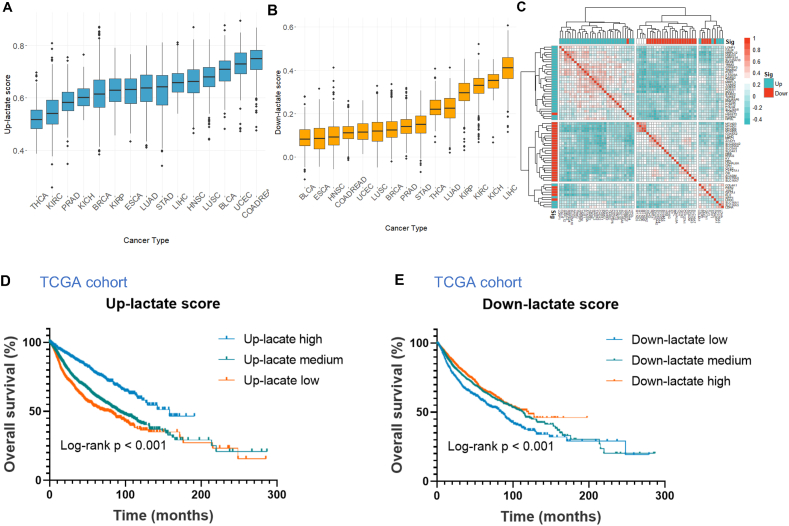
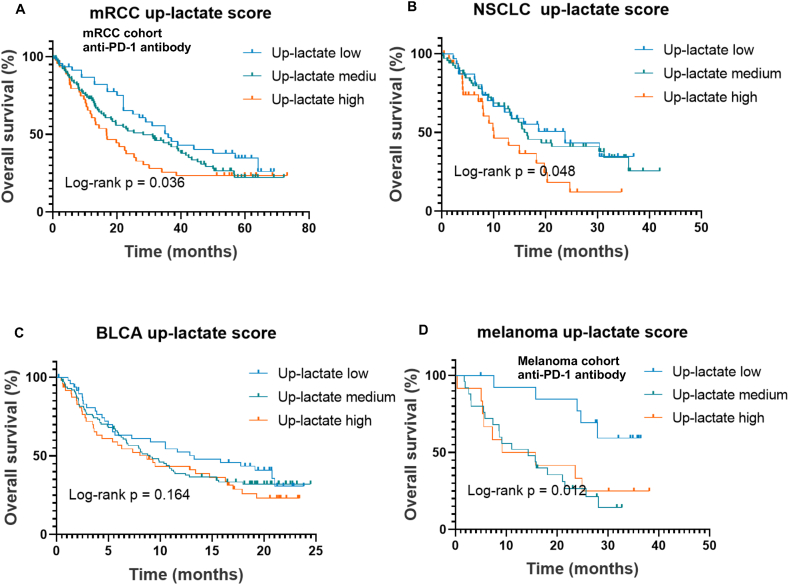
We defined a pan-cancer up-lactate score by comparing malignant tissues and normal tissues in the TCGA cohort. The immunotherapeutic efficacy was evaluated in non-small cell lung cancer (NSCLC), metastatic renal cancer (mRCC), bladder cancer (BLCA) and melanoma cohorts. The cancer cell-intrinsic mechanism to immune checkpoint inhibitors (ICIs) resistance was measured using single cell sequencing (scRNA-seq) data. Pathway activation was evaluated in the TCGA cohort and CPTAC cohort with transcriptomics and proteomics. The co-occurrence of up-lactate signature and mTOR signaling was determined by spatial transcriptomics of the tissue samples. Immunotherapy resistance and pathway regulation were validated in the in-house NSCLC cohort.
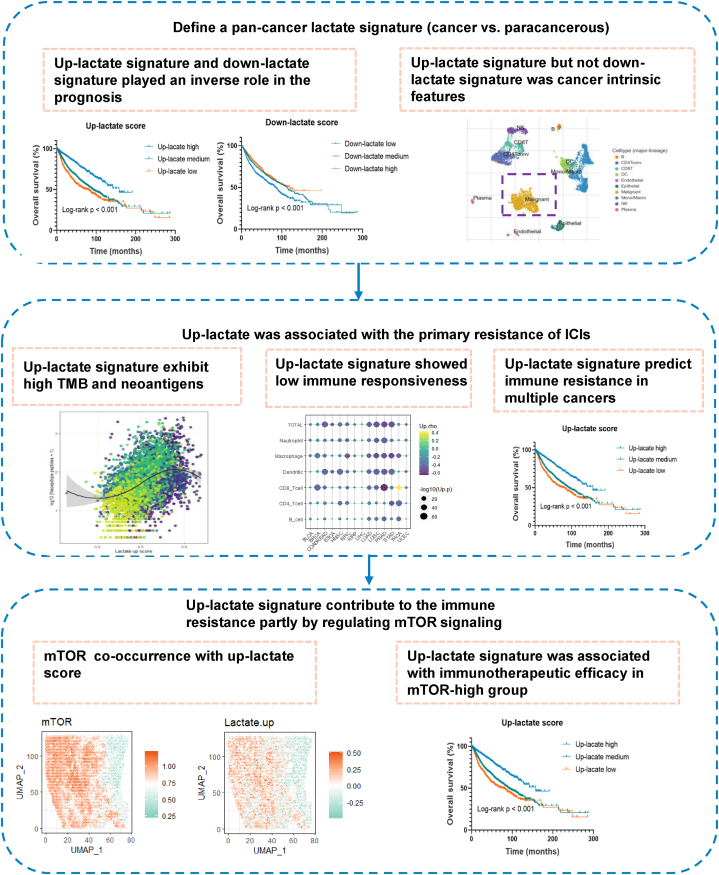
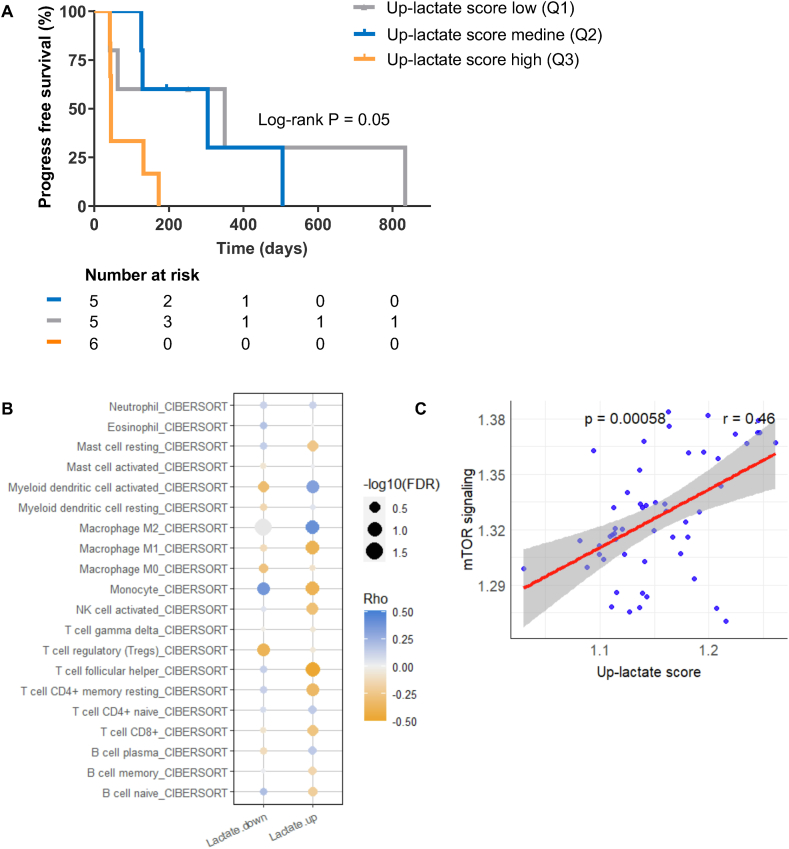
Patients with the high up-lactate scores had significantly short overall survival (OS) than those with the low up-lactate scores (p < 0.001) across multiple types of cancers. The up-regulated lactate signature exhibited higher expression in the malignant cells compared with stromal cells and immune cells in multiple scRNA-seq datasets. A high up-lactate score was associated with poor OS in NSCLC, mRCC, BLCA and melanoma patients who received anti-PD(L)1 antibody. The up-lactate score was higher in the responders of cancer cells, but not in immune cells and stromal cells compared with the non-responders (p < 0.05). Moreover, up-lactate score was positively correlated with mTOR signaling across multiple cancers. In patients with NSCLC who received anti-PD-1 antibody, higher up-lactate scores were associated with significantly shorter PFS compared to lower up-lactate scores (p < 0.001). Additionally, the up-lactate score was associated with cold tumor, and was positively correlated with mTOR signaling.
Collectively, we defined a pan-cancer up-lactate signature, which is a feature of malignant cells and is associated with ICIs resistance. This reveals a coherent program with prognostic and predictive value that may be therapeutically targeted.
尽管已有报道称乳酸途径可通过抑制效应T细胞导致免疫逃逸,但尚未确定癌症内在的乳酸特征,且乳酸特征的免疫治疗疗效及潜在机制仍不清楚。
我们通过比较TCGA队列中的恶性组织和正常组织,定义了一个泛癌高乳酸评分。在非小细胞肺癌(NSCLC)、转移性肾癌(mRCC)、膀胱癌(BLCA)和黑色素瘤队列中评估免疫治疗疗效。使用单细胞测序(scRNA-seq)数据测量癌细胞对免疫检查点抑制剂(ICIs)耐药的内在机制。在TCGA队列和CPTAC队列中通过转录组学和蛋白质组学评估通路激活情况。通过组织样本的空间转录组学确定高乳酸特征与mTOR信号传导的共现情况。在内部NSCLC队列中验证免疫治疗耐药性和通路调节情况。
在多种类型的癌症中,高乳酸评分患者的总生存期(OS)明显短于低乳酸评分患者(p < 0.001)。在多个scRNA-seq数据集中,与基质细胞和免疫细胞相比,上调的乳酸特征在恶性细胞中表达更高。在接受抗PD(L)1抗体的NSCLC、mRCC、BLCA和黑色素瘤患者中,高乳酸评分与较差的OS相关。与无反应者相比,癌细胞反应者的高乳酸评分更高,但免疫细胞和基质细胞中则不然(p < 0.05)。此外,在多种癌症中,高乳酸评分与mTOR信号传导呈正相关。在接受抗PD-1抗体的NSCLC患者中,与低乳酸评分相比,高乳酸评分与显著更短的无进展生存期(PFS)相关(p < 0.001)。此外,高乳酸评分与冷肿瘤相关,且与mTOR信号传导呈正相关联。
总体而言,我们定义了一种泛癌高乳酸特征,它是恶性细胞的一个特征,与ICIs耐药相关。这揭示了一个具有预后和预测价值的连贯程序,可能成为治疗靶点。