Molecular Oncology Unit, Department of Biological Chemistry, Medical School, National and Kapodistrian University of Athens, 11527 Athens, Greece.
First Department of Internal Medicine, 'Laiko' General Hospital, Medical School, National and Kapodistrian University of Athens, 11527 Athens, Greece.
Biomolecules. 2020 Apr 25;10(5):666. doi: 10.3390/biom10050666.
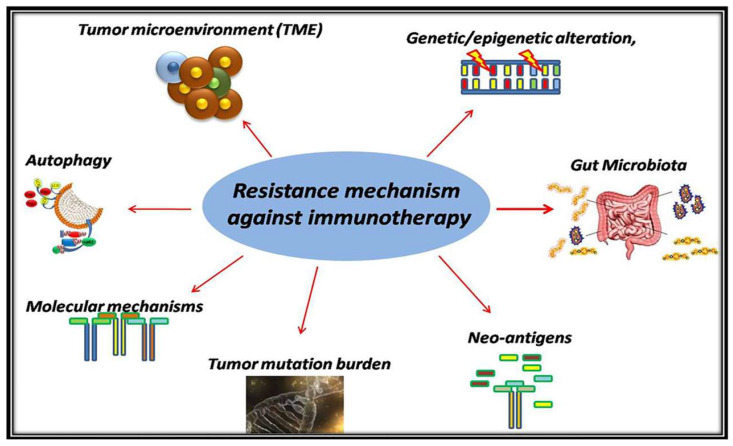
The emergence of cancer immunotherapy has already shown some remarkable results, having changed the treatment strategy in clinical practice for solid tumors. Despite these promising long-term responses, patients seem to lack the ability to respond to immune checkpoint inhibitors, thus demonstrating a primary resistance to immunotherapy. Moreover, a significant number of patients who initially respond to treatment eventually acquire resistance to immunotherapy. Both resistance mechanisms are a result of a complex interaction among different molecules, pathways, and cellular processes. Several resistance mechanisms, such as tumor microenvironment modification, autophagy, genetic and epigenetic alterations, tumor mutational burden, neo-antigens, and modulation of gut microbiota have already been identified, while more continue to be uncovered. In this review, we discuss the latest milestones in the field of immunotherapy, resistance mechanisms against this type of therapy as well as putative therapeutic strategies to overcome resistance in solid tumors.
癌症免疫疗法的出现已经显示出一些显著的效果,改变了实体瘤临床实践中的治疗策略。尽管这些有希望的长期反应,患者似乎缺乏对免疫检查点抑制剂的反应能力,从而表现出对免疫疗法的原发性耐药性。此外,相当数量的最初对治疗有反应的患者最终会对免疫疗法产生耐药性。这两种耐药机制都是不同分子、途径和细胞过程之间复杂相互作用的结果。已经确定了几种耐药机制,如肿瘤微环境修饰、自噬、遗传和表观遗传改变、肿瘤突变负担、新抗原和肠道微生物群的调节,而更多的耐药机制仍在不断被发现。在这篇综述中,我们讨论了免疫疗法领域的最新里程碑,以及针对这种治疗类型的耐药机制,以及克服实体瘤耐药性的潜在治疗策略。