Akasaki Yoshihiko, Tabira Takayuki, Maruta Michio, Makizako Hyuma, Shimokihara Suguru, Hidaka Yuma, Kamasaki Taishiro, Kukizako Wataru, Kubozono Takuro, Ohishi Mitsuru
Department of Rehabilitation, Tarumizu Central Hospital, Kagoshima, JPN.
Department of Occupational Therapy, School of Health Sciences, Faculty of Medicine, Kagoshima University, Kagoshima, JPN.
Cureus. 2024 Nov 11;16(11):e73433. doi: 10.7759/cureus.73433. eCollection 2024 Nov.
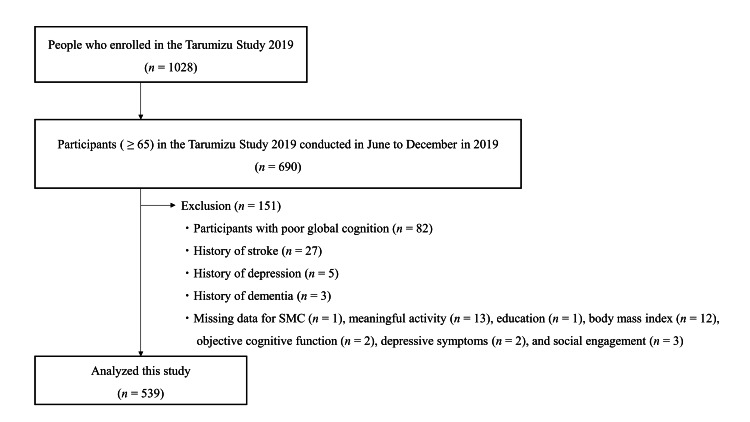
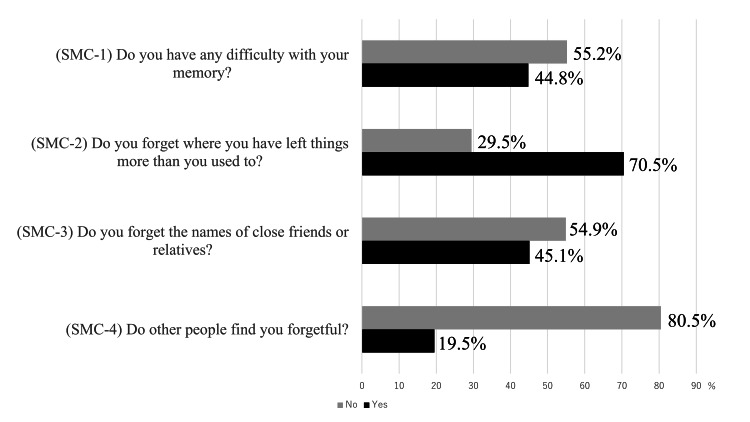
Objective This study explores the relationship between subjective memory complaints (SMC) and satisfaction with meaningful activities among community-dwelling older adults. Methods Data were analyzed from 539 older adults without cognitive decline (mean age 74.6 ± 6.1 years, 65.0% female) who participated in a community-based health check survey (Tarumizu Study, 2019). SMC was assessed using four questionnaires, and SMC was determined when at least one of the four questionnaires was applicable. From the Aid for Decision-making in Occupation Choice (ADOC), participants selected meaningful activities. Satisfaction with these selected activities was also evaluated. Satisfaction levels were compared between participants with and without SMC, and the relationship between SMC and satisfaction with meaningful activities was analyzed using multivariate analyses. Results The prevalence of SMC was 63.2% (n = 339). Participants with SMC reported lower satisfaction with meaningful activities compared to those without SMC (p = 0.012). Notably, participants who responded positively to SMC-2 ("Do you forget where you have left things more than you used to?") (p = 0.027) and SMC-4 ("Do other people find you forgetful?") (p = 0.004) had significantly lower satisfaction with meaningful activities. Logistic regression analyses revealed a significant relationship between SMC and satisfaction with meaningful activities after adjusting for covariates (OR, 0.79; 95% CI, 0.633-0.996; p = 0.046). Conclusions There is a relationship between SMC and satisfaction with meaningful activities among community-dwelling older adults. Participation in and satisfaction with meaningful activities may play a role in developing effective support for individuals with SMC.
目的 本研究探讨社区居住老年人的主观记忆抱怨(SMC)与对有意义活动的满意度之间的关系。方法 对539名无认知功能减退的老年人(平均年龄74.6±6.1岁,65.0%为女性)的数据进行分析,这些老年人参与了一项基于社区的健康检查调查(垂水研究,2019年)。使用四份问卷评估SMC,当四份问卷中至少有一份适用时即确定存在SMC。参与者从职业选择决策辅助工具(ADOC)中选择有意义的活动。还评估了对这些选定活动的满意度。比较有SMC和无SMC参与者的满意度水平,并使用多变量分析分析SMC与对有意义活动的满意度之间的关系。结果 SMC的患病率为63.2%(n = 339)。与无SMC的参与者相比,有SMC的参与者对有意义活动的满意度较低(p = 0.012)。值得注意的是,对SMC-2(“你是否比过去更经常忘记东西放在哪里?”)回答为肯定的参与者(p = 0.027)和对SMC-4(“其他人是否觉得你健忘?”)回答为肯定的参与者(p = 0.004)对有意义活动的满意度显著较低。逻辑回归分析显示,在调整协变量后,SMC与对有意义活动的满意度之间存在显著关系(优势比,0.79;95%置信区间,0.633 - 0.996;p = 0.046)。结论 社区居住老年人的SMC与对有意义活动的满意度之间存在关系。参与有意义活动并对其感到满意可能在为有SMC的个体制定有效支持方面发挥作用。