Sahi Nitin, Haider Lukas, Chung Karen, Prados Carrasco Ferran, Kanber Baris, Samson Rebecca, Thompson Alan J, Trip S Anand, Brownlee Wallace, Ciccarelli Olga, Barkhof Frederik, Tur Carmen, Houlden Henry, Chard Declan
NMR Research Unit, Queen Square Multiple Sclerosis Centre, Department of Neuroinflammation, University College London Queen Square Institute of Neurology, London WC1N 3BG, UK.
Department of Biomedical Imaging and Image Guided Therapy, Medical University Vienna, 1090 Vienna, Austria.
Brain Commun. 2024 Dec 5;6(6):fcae443. doi: 10.1093/braincomms/fcae443. eCollection 2024.
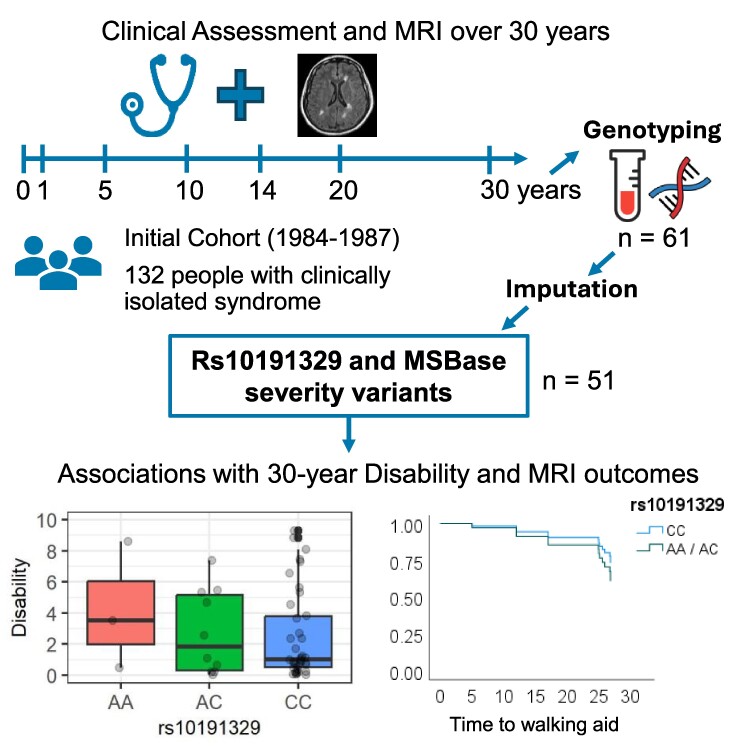
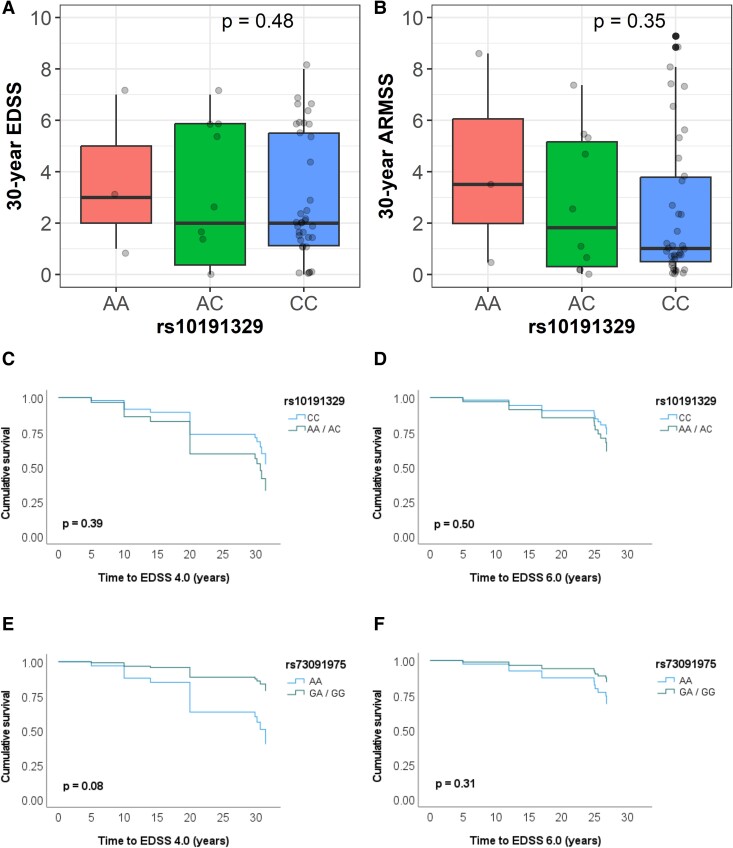
The first genome-wide significant multiple sclerosis severity locus, rs10191329, has been pathologically linked to cortical lesion load and brain atrophy. However, observational cohorts such as MSBase have not replicated associations with disability outcomes, instead finding other loci. We evaluated rs10191329 and MSBase loci in a unique cohort of 53 people followed for 30 years after a clinically isolated syndrome, with deep clinical phenotyping and MRI measures of inflammation and neurodegeneration. After 30 years, 26 had developed relapsing-remitting multiple sclerosis, 15 secondary progressive multiple sclerosis and 12 remained diagnosed with a clinically isolated syndrome. Genetic associations with disease severity (age-related multiple sclerosis severity score and Expanded Disability Status Scale), disease course and brain MRI features (white matter lesions, cortical lesions and grey matter fraction) were investigated using regression models and survival analyses. rs10191329 was not associated with multiple sclerosis severity, secondary progressive multiple sclerosis diagnosis or brain MRI features at 30 years. Similarly, MSBase loci were not associated with 30-year disease severity, although rs73091975 was significantly associated with lower 14-year age-related multiple sclerosis severity score in those developing multiple sclerosis. Given that effect sizes for both rs10191329 and rs73091975 were greatest between 14 and 20 years, these findings suggest genetic effects on multiple sclerosis severity may interact non-linearly with disease duration.
首个全基因组显著的多发性硬化严重程度位点rs10191329,在病理上与皮质病变负荷和脑萎缩相关。然而,像MSBase这样的观察性队列并未重现其与残疾结局的关联,而是发现了其他位点。我们在一个独特的队列中评估了rs10191329和MSBase位点,该队列由53人组成,在临床孤立综合征后随访了30年,进行了深入的临床表型分析以及炎症和神经退行性变的MRI测量。30年后,26人发展为复发缓解型多发性硬化,15人发展为继发进展型多发性硬化,12人仍被诊断为临床孤立综合征。使用回归模型和生存分析研究了与疾病严重程度(年龄相关的多发性硬化严重程度评分和扩展残疾状态量表)、病程和脑MRI特征(白质病变、皮质病变和灰质分数)的遗传关联。rs10191329与30年时的多发性硬化严重程度、继发进展型多发性硬化诊断或脑MRI特征无关。同样,MSBase位点与30年时的疾病严重程度无关,尽管rs73091975与发展为多发性硬化的患者中较低的14年年龄相关的多发性硬化严重程度评分显著相关。鉴于rs10191329和rs73091975的效应大小在14至20岁之间最大,这些发现表明对多发性硬化严重程度的遗传效应可能与疾病持续时间呈非线性相互作用。