Mah Jasmine C, Theou Olga, Perez-Zepeda Mario Ulises, Penwarden Jodie L, Godin Judith, Rockwood Kenneth, Andrew Melissa K
Department of Medicine, Dalhousie University, Halifax, Nova Scotia, Canada.
Division of Geriatric Medicine, Dalhousie University, Halifax, Nova Scotia, Canada.
PLoS One. 2024 Dec 13;19(12):e0315474. doi: 10.1371/journal.pone.0315474. eCollection 2024.
The construct of social vulnerability attempts to understand social circumstances not merely as a descriptor, but as a predictor of adverse health events. It can be measured by aggregating social deficits in a social vulnerability index (SVI). We describe a standard procedure for constructing a multi-level SVI using two working examples.
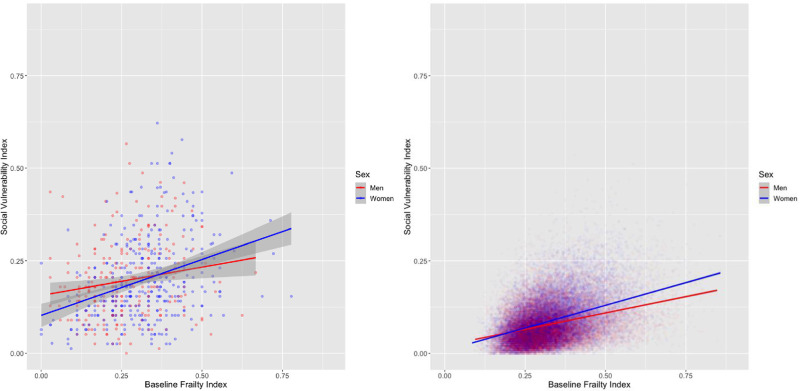
First, we describe a six-step approach to constructing a SVI. Then, we conducted a secondary analysis of a clinical dataset (Canadian Immunization Research Network's Serious Outcomes Surveillance Network (SOS)) and a population-based dataset (Canadian Longitudinal Study on Aging (CLSA)). In both datasets, we construct SVIs, use descriptive statistics to report distributions by age and sex, and perform a multivariable linear regression of social vulnerability on frailty.
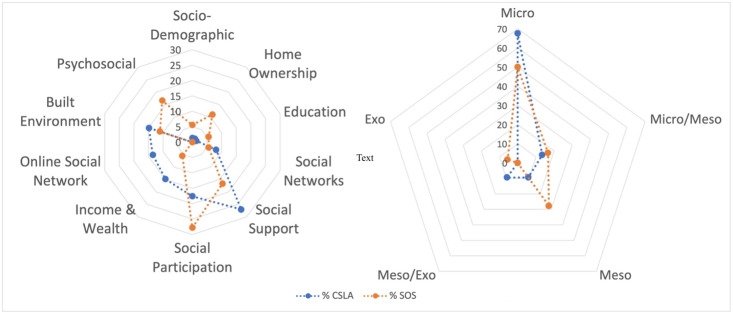
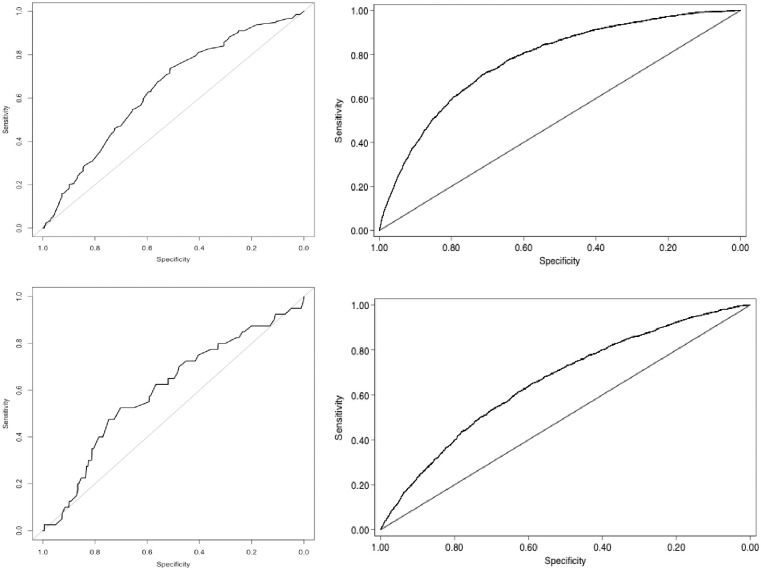
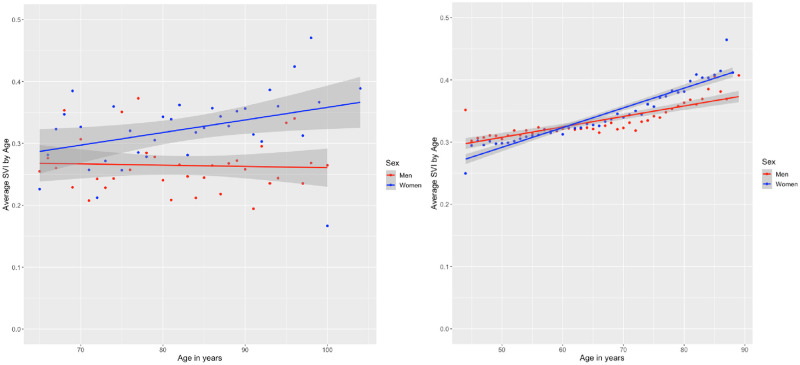
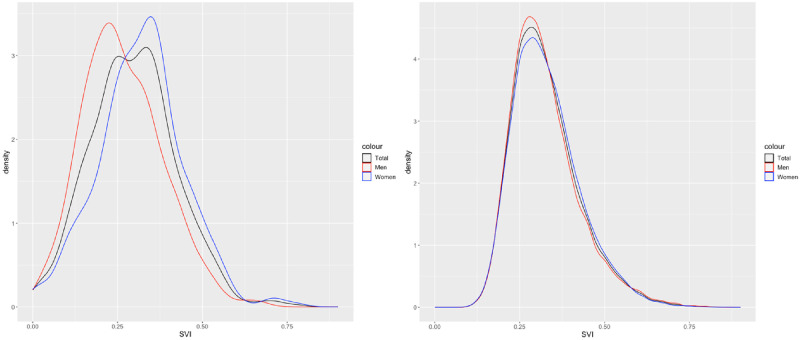
Procedures for drafting a list of candidate social items, selecting deficits for inclusion, and screening deficits to meet inclusion criteria were applied to yield a 18-deficit SVI for the SOS and 74-deficit SVI for the CLSA. Deficits in each SVI were re-scored between 0 and 1, where 1 indicates the greater risk. Finally, the sum of all deficits is calculated into an index. In the SOS, SVI was associated with age only for females and was weakly associated with frailty (r = 0.26, p<0.001). In the CLSA, SVI was associated with age for both sexes and moderately associated with frailty (r = 0.41, p<0.001).
We present a standard method of constructing a SVI by incorporating factors from multiple social domains and levels in a social-ecological model. This SVI can be used to improve our understanding of social vulnerability and its impacts on the health of communities and individuals.
社会脆弱性这一概念试图将社会环境不仅仅理解为一种描述,更是作为不良健康事件的预测指标。它可以通过在社会脆弱性指数(SVI)中汇总社会缺陷来衡量。我们使用两个实际例子描述构建多层次SVI的标准程序。
首先,我们描述构建SVI的六步方法。然后,我们对一个临床数据集(加拿大免疫研究网络的严重后果监测网络(SOS))和一个基于人群的数据集(加拿大老龄化纵向研究(CLSA))进行二次分析。在这两个数据集中,我们构建SVI,使用描述性统计按年龄和性别报告分布情况,并对社会脆弱性与衰弱进行多变量线性回归分析。
应用起草候选社会项目清单、选择纳入的缺陷以及筛选缺陷以满足纳入标准的程序,得出SOS的18项缺陷SVI和CLSA的74项缺陷SVI。每个SVI中的缺陷重新评分在0到1之间,其中1表示风险更大。最后,将所有缺陷的总和计算为一个指数。在SOS中,SVI仅与女性年龄相关,与衰弱的相关性较弱(r = 0.26,p<0.001)。在CLSA中,SVI与男女年龄均相关,与衰弱的相关性中等(r = 0.41,p<0.001)。
我们提出了一种通过将社会生态模型中多个社会领域和层面的因素纳入其中来构建SVI的标准方法。该SVI可用于增进我们对社会脆弱性及其对社区和个人健康影响的理解。