Adwall Linda, Fredriksson Irma, Hultin Hella, Mani Maria, Norlén Olov
Department of Surgery, South General Hospital, Stockholm, Sweden.
Department of Surgical Sciences, Uppsala University, Uppsala, Sweden.
BJS Open. 2024 Oct 29;8(6). doi: 10.1093/bjsopen/zrae137.
There is conflicting evidence regarding whether postoperative complications after breast cancer surgery are associated with worse oncological outcome. This study aimed to assess the risk of systemic breast cancer recurrence after surgical site infection and also the impact of surgical site infection on locoregional recurrence, breast cancer-specific survival and overall survival.
This nationwide cohort study included patients who underwent surgery for primary breast cancer in Sweden between January 2008 and September 2019. The study cohort was identified in the Breast Cancer Database Sweden 3.0, a database linking the National Breast Cancer Quality Register to national population-based healthcare registers held by the National Board of Health and Welfare and Statistics Sweden. The primary exposure was surgical site infection within 90 days from surgery, and the primary outcome was systemic recurrence of breast cancer. Secondary outcomes included locoregional recurrence, overall survival and breast cancer-specific survival. Multivariable Cox regression analysis was performed to assess the association between exposure, predictors and outcomes.
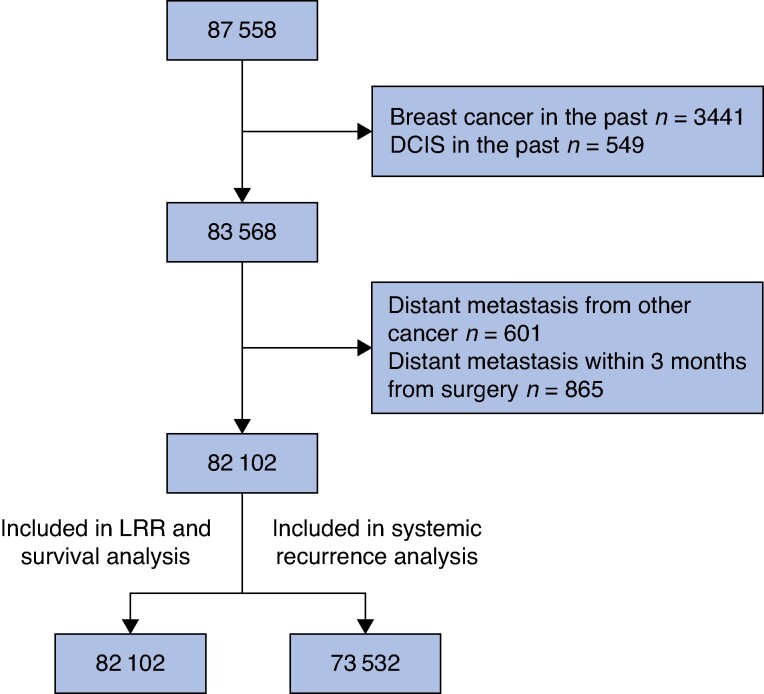
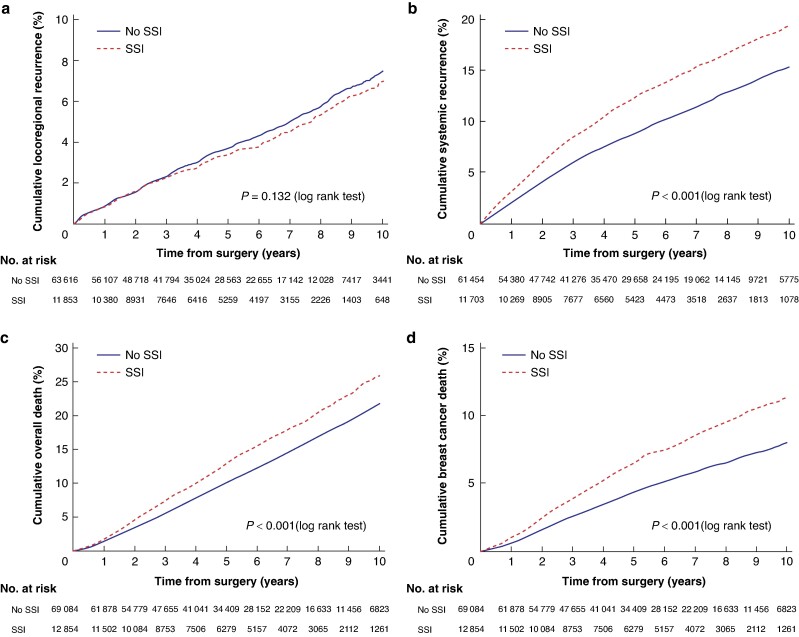
Of 82 102 patients included in the study, 15.7% experienced a surgical site infection within 90 days of surgery. Surgical site infection was not significantly associated with systemic recurrence, locoregional recurrence or breast cancer-specific survival after adjustment for confounding variables. Surgical site infection was significantly associated with worse overall survival, but the significant association disappeared in a sensitivity analysis excluding all patients with any kind of malignancy before breast cancer diagnosis.
Surgical site infection after breast cancer surgery does not significantly increase the risk of systemic recurrence. All possible actions should nevertheless be taken to reduce complication rates.
关于乳腺癌手术后的并发症是否与更差的肿瘤学结局相关,存在相互矛盾的证据。本研究旨在评估手术部位感染后全身性乳腺癌复发的风险,以及手术部位感染对局部区域复发、乳腺癌特异性生存和总生存的影响。
这项全国性队列研究纳入了2008年1月至2019年9月在瑞典接受原发性乳腺癌手术的患者。研究队列在瑞典乳腺癌数据库3.0中确定,该数据库将国家乳腺癌质量登记册与瑞典国家卫生和福利委员会及瑞典统计局持有的基于全国人口的医疗保健登记册相链接。主要暴露因素为术后90天内的手术部位感染,主要结局为乳腺癌的全身性复发。次要结局包括局部区域复发、总生存和乳腺癌特异性生存。进行多变量Cox回归分析以评估暴露因素、预测因素和结局之间的关联。
在纳入研究的82102例患者中,15.7%在术后90天内发生了手术部位感染。在对混杂变量进行调整后,手术部位感染与全身性复发、局部区域复发或乳腺癌特异性生存无显著关联。手术部位感染与更差的总生存显著相关,但在排除乳腺癌诊断前患有任何类型恶性肿瘤的所有患者的敏感性分析中,这种显著关联消失了。
乳腺癌手术后的手术部位感染不会显著增加全身性复发的风险。尽管如此,仍应采取一切可能的措施来降低并发症发生率。