Gilbert Jennifer L, Brooks Edward Marshall, Funk Adam, Webel Benjamin, Britz Jacqueline, Kelly Cameron, Wilson Jacqueline, Lee Jong Hyung, Sabo Roy T, Huebschmann Amy, Glasglow Russell E, Krist Alex H
Virginia Commonwealth University, Richmond, VA, USA.
University of Colorado, Aurora, CO, USA.
J Prim Care Community Health. 2024 Jan-Dec;15:21501319241307741. doi: 10.1177/21501319241307741.
Guidelines recommend addressing health behaviors, mental health, and social needs in primary care. However, it is unclear how often patients want support to address these risks. As part of a randomized trial comparing enhanced care planning versus usual care, we evaluated what risks patients wanted to address.
All patients with multiple chronic conditions, 1 or more of which was uncontrolled, from 81 clinicians in 30 primary care practices. Using My Own Health Report (MOHR), patients identified and prioritized their health risks to create a care plan.
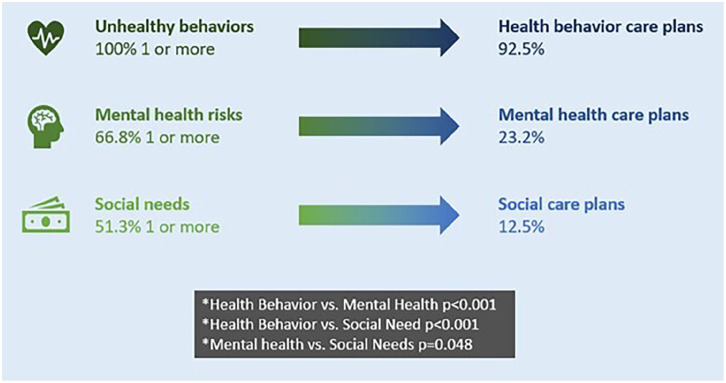
All patients had at least 1 unhealthy behavior (100%) and most had a mental health risk (66.8%) and a social need (51.3%). Participants more often chose to create care plans addressing unhealthy behaviors (92.5%) rather than mental health (23.2%), or social needs (12.5%). The most frequently created care plans were for exercise (65.1%), weight loss (37.2%), and nutrition (36.2%).
All patients had 1 or more unhealthy behaviors, mental health risks, or social needs, and were more likely to address health behaviors. We need to better understand these patient choices, and change the culture to normalize the integration of mental health and social care into primary care.
指南建议在初级保健中关注健康行为、心理健康和社会需求。然而,尚不清楚患者希望获得解决这些风险的支持的频率。作为一项比较强化护理计划与常规护理的随机试验的一部分,我们评估了患者希望解决哪些风险。
来自30家初级保健机构的81名临床医生的所有患有多种慢性病且其中1种或更多未得到控制的患者。使用“我的健康报告”(MOHR),患者识别并优先考虑他们的健康风险以制定护理计划。
所有患者都至少有一种不健康行为(占100%),大多数患者存在心理健康风险(占66.8%)和社会需求(占51.3%)。参与者更常选择制定解决不健康行为的护理计划(占92.5%),而非心理健康(占23.2%)或社会需求(占12.5%)。最常制定的护理计划是关于锻炼(占65.1%)、减肥(占37.2%)和营养(占36.2%)。
所有患者都有1种或更多种不健康行为、心理健康风险或社会需求,并且更倾向于解决健康行为问题。我们需要更好地理解这些患者的选择,并改变文化观念,使心理健康和社会护理融入初级保健常态化。