Chen De-Qing, Wu Yong-Xin, Zhang Ying-Xiao, Yang Hai-Ling, Huang Huan-Huan, Lv Jiang-Yan, Xiao Qian
Department of Geriatrics, The First Affiliated Hospital of Chongqing Medical University, Chongqing 400042, China.
Department of Nursing, The First Affiliated Hospital of Chongqing Medical University, Chongqing 400042, China.
World J Diabetes. 2024 Dec 15;15(12):2285-2292. doi: 10.4239/wjd.v15.i12.2285.
Chronic hyperglycemia can damage the microcirculation, which impairs the function of various organs and tissues and predisposes individuals to chronic complications. Sarcopenia (SP) is the age-related decline in muscle mass and function that contributes to the sequelae of type 2 diabetes. In particular, diabetic patients are at higher risk of SP because of insulin resistance, chronic inflammation, and decreased physical activity.
To identify SP-associated factors in middle-aged and elderly male type 2 diabetes mellitus (T2DM) patients and their correlation with bone mineral density (BMD).
A retrospective analysis was conducted on 196 middle-aged and elderly male T2DM inpatients in the First Affiliated Hospital of Chongqing Medical University between June 2021 and June 2023, with 60 concurrent healthy individuals as the control group. Differences in general information, blood biochemistry, glycosylated hemoglobin, muscle strength, and detection rate of SP were compared between groups. The BMD, appendicular skeletal muscle (ASM), and fat mass, as well as grip strength and gait speed, were determined for each patient, and the ASM index (ASMI) was counted. The quantitative data were subjected to correlation and logistic regression analyses to identify risk factors for SP.
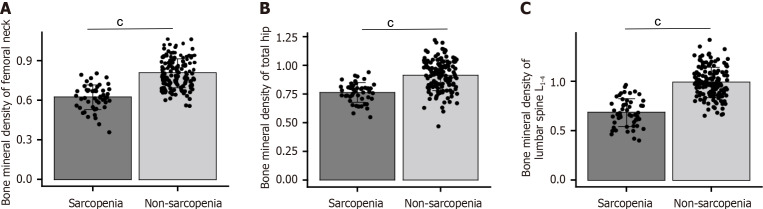
Fifty-one of the 196 middle-aged and elderly male T2DM patients were diagnosed with SP, which accounted for 26.02%. The middle-aged and elderly T2DM patients with SP exhibited a longer diabetes mellitus (DM) course and a lower body mass index (BMI) and 25(OH)D compared with the non-SP patients. The T2DM + SP patients exhibited lower BMI, ASM, ASMI, left- and right-hand grip strength, gait speed, and muscle and fat mass of the upper and lower limbs compared with the diabetic non-SP patients. The femoral neck, total hip, and lumbar spine L BMD were markedly lower in T2DM + SP patients compared with those in the non-SP diabetics. Long-term DM course, low BMI, and low BMD of the femoral neck, lumbar spine L, and total hip were identified as risk factors for the development of SP.
T2DM patients are at risk for SP; however, measures can be taken to prevent the related risk factors.
慢性高血糖会损害微循环,进而损害各器官和组织的功能,并使个体易患慢性并发症。肌肉减少症(SP)是与年龄相关的肌肉质量和功能下降,它会导致2型糖尿病的后遗症。特别是,糖尿病患者由于胰岛素抵抗、慢性炎症和体力活动减少,患SP的风险更高。
确定中老年男性2型糖尿病(T2DM)患者中与SP相关的因素及其与骨密度(BMD)的相关性。
对2021年6月至2023年6月期间重庆医科大学附属第一医院的196例中老年男性T2DM住院患者进行回顾性分析,并以60名同期健康个体作为对照组。比较两组之间的一般信息、血液生化、糖化血红蛋白、肌肉力量和SP检出率的差异。测定每位患者的骨密度、四肢骨骼肌(ASM)、脂肪量以及握力和步速,并计算ASM指数(ASMI)。对定量数据进行相关性和逻辑回归分析,以确定SP的危险因素。
196例中老年男性T2DM患者中有51例被诊断为SP,占26.02%。与非SP患者相比,患有SP的中老年T2DM患者的糖尿病病程更长,体重指数(BMI)和25(OH)D更低。与糖尿病非SP患者相比,T2DM + SP患者的BMI、ASM、ASMI、左手和右手握力、步速以及上下肢的肌肉和脂肪量更低。与非SP糖尿病患者相比,T2DM + SP患者的股骨颈、全髋和腰椎L1的骨密度明显更低。长期糖尿病病程、低BMI以及股骨颈、腰椎L1和全髋的低骨密度被确定为发生SP的危险因素。
T2DM患者有患SP的风险;然而,可以采取措施预防相关危险因素。