College of Acupuncture-Moxibustion and Tuina, Anhui University of Chinese Medicine, Hefei, 230012, China.
Graduate School, Wuhan Sports University, Wuhan, 430079, China.
J Orthop Surg Res. 2023 Aug 9;18(1):588. doi: 10.1186/s13018-023-04034-7.
In the aging process of the body, in addition to changes in fat and muscle content, there is also bone loss, implying the possibility of a strong muscle-bone-lipid link. In this study, we initially investigated the relationship between lumbar BMD and low muscle mass and the relationship between "muscle-bone-lipid."
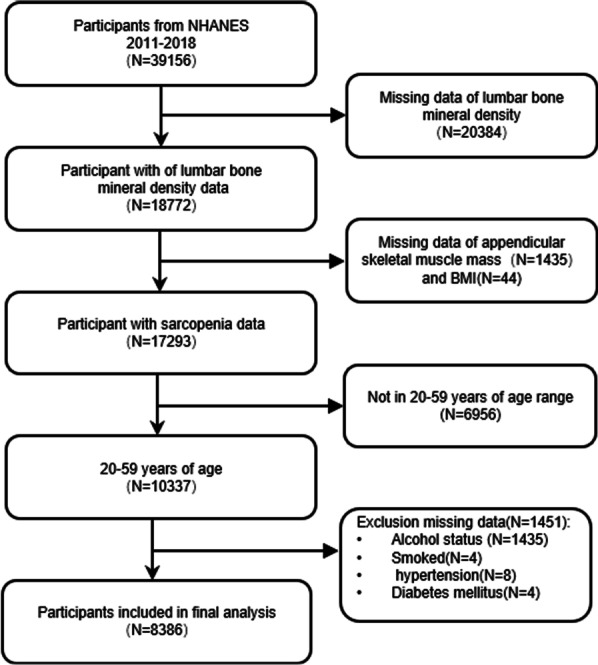
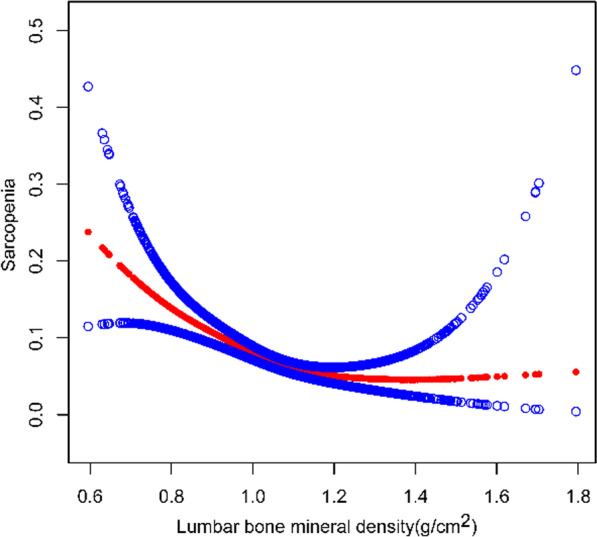
The datasets from the National Health and Nutrition Examination Survey (NHANES) 2011-2018 were used in a cross-sectional investigation. BMD and appendicular skeletal muscle (ASM) were measured by dual-energy X-ray absorptiometry (DXA), and appendicular skeletal muscle was adjusted by body mass index (BMI) as a marker of sarcopenia. Weighted multivariate regression and logistic regression analysis were used to explore the independent relationship between lumbar BMD and sarcopenia. Fitted smoothing curves and threshold effect analysis were used to describe the nonlinear relationship.
In 8386 participants with ages 20-59 years, there was a negative association between lumbar BMD and sarcopenia. In the fully adjusted model, the risk of developing sarcopenia decreased by 93% for each 1-unit increase in lumbar BMD (OR = 0.07, 95%CI 0.03-0.20). The risk of sarcopenia was 58% lower in participants in the highest quartile of lumbar BMD than in those in the lowest quartile (OR = 0.42, 95%CI 0.27-0.64). This negative association was more pronounced in the population of women with BMI ≥ 25.
Our findings suggest that lumbar BMD is negatively associated with sarcopenia in US adults. The dynamic balance between "muscle-bone-lipid" is likely to be related to the pathogenesis of bone loss.
在人体衰老过程中,除了脂肪和肌肉含量的变化外,还存在骨质流失,这意味着肌肉-骨骼-脂质之间可能存在紧密联系。在本研究中,我们初步探讨了腰椎骨密度与低肌肉量之间的关系,以及“肌肉-骨骼-脂质”之间的关系。
本研究采用 2011-2018 年全国健康与营养调查(NHANES)的横断面数据。双能 X 射线吸收法(DXA)测量骨密度和四肢骨骼肌(ASM),并通过身体质量指数(BMI)调整四肢骨骼肌作为肌少症的标志物。采用加权多变量回归和逻辑回归分析探讨腰椎骨密度与肌少症之间的独立关系。采用拟合平滑曲线和阈值效应分析来描述非线性关系。
在 8386 名年龄在 20-59 岁的参与者中,腰椎骨密度与肌少症呈负相关。在完全调整的模型中,腰椎骨密度每增加 1 个单位,发生肌少症的风险降低 93%(OR=0.07,95%CI 0.03-0.20)。与腰椎骨密度最低四分位组相比,腰椎骨密度最高四分位组发生肌少症的风险降低 58%(OR=0.42,95%CI 0.27-0.64)。这种负相关在 BMI≥25 的女性人群中更为明显。
我们的研究结果表明,美国成年人的腰椎骨密度与肌少症呈负相关。“肌肉-骨骼-脂质”的动态平衡可能与骨丢失的发病机制有关。