Redersdorff Ingrid E, Rodríguez Ailen N, Escobar Mariana, Studdert Claudia A, Seitz M Karina Herrera
Instituto de Investigaciones Biológicas, CONICET - Universidad Nacional de Mar del Plata, Buenos Aires, Argentina.
Instituto de Agrobiotecnología del Litoral, CONICET - Universidad Nacional del Litoral, Santa Fe, Argentina.
Bio Protoc. 2024 Dec 5;14(23):e5130. doi: 10.21769/BioProtoc.5130.
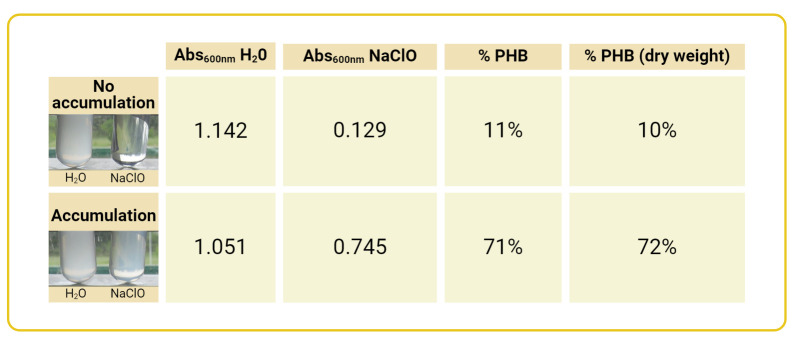
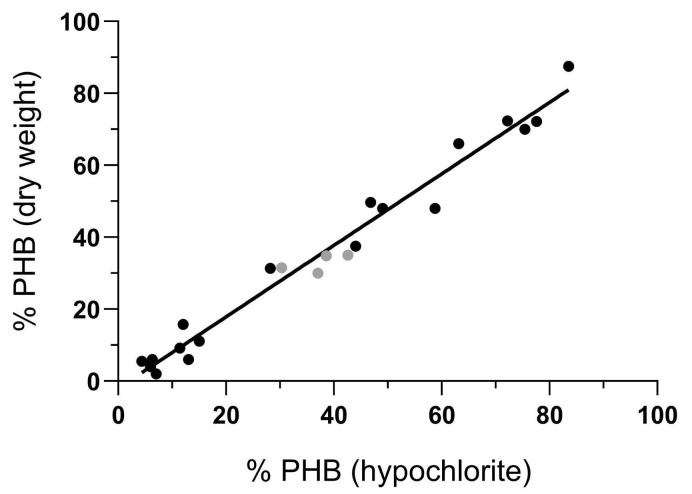
This protocol outlines the use of the previously described sodium hypochlorite extraction method for estimating the accumulation of polyhydroxybutyrate (PHB) in bacteria. Sodium hypochlorite (NaClO) is widely used for PHB extraction as it oxidizes most components of the cells except PHB. We assessed the feasibility of using NaClO extraction for the estimation of PHB accumulation in bacterial cells (expressed as a percentage w/w). This allowed us to use a simple spectrophotometric measurement of the turbidity of the PHB extracted by NaClO as a semiquantitative estimation of PHB accumulation in the marine microorganisms KHS3, sp., and sp. However, this fast and easy protocol could be used for any bacterial species as long as some details are considered. This estimation exhibited a good correlation with the accumulation measured as dry cell weight or even with the accumulation measured by crotonic acid and HPLC quantifications. The key advantage of this protocol is how fast it allows an estimation of PHB accumulation in , , and cultures (results are available in 50 min), enabling the identification of the appropriate moment to harvest cells for further extraction, polymer characterization, and accurate quantification using more reliable and time-consuming methods. This protocol is very useful during bacterial cultivation for a quick evaluation of PHA accumulation without requiring (i) large volumes of cultures, (ii) a long time for analysis compared to dry cell weight, (iii) preparation of standard curves with sulfuric acid hydrolysis for crotonic acid quantification, or (iv) specific equipment and/or technical services for HPLC quantification. Key features • Fast and easy method for bacterial PHB content estimation in cultures of different marine microorganisms. It can be used in other PHB-accumulating bacteria. • Useful to explore culture conditions to achieve maximal PHB accumulation. • Useful to follow the kinetics of both PHB accumulation and mobilization throughout culture development. • In cultures with high (50%-70% dry cell weight) or very low (<15%) PHB accumulation, differences are visible by the naked eye before spectrophotometric measurement.
本方案概述了使用先前描述的次氯酸钠提取法来估算细菌中聚羟基丁酸酯(PHB)的积累量。次氯酸钠(NaClO)被广泛用于PHB提取,因为它能氧化细胞中除PHB之外的大多数成分。我们评估了使用NaClO提取法估算细菌细胞中PHB积累量(以重量百分比表示)的可行性。这使我们能够通过简单的分光光度法测量NaClO提取的PHB的浊度,从而对海洋微生物KHS3、[具体菌种1]和[具体菌种2]中PHB的积累进行半定量估算。然而,只要考虑一些细节,这个快速简便的方案可用于任何细菌物种。该估算结果与以干细胞重量测量的积累量,甚至与通过巴豆酸和高效液相色谱(HPLC)定量测量的积累量都具有良好的相关性。本方案的关键优势在于它能快速估算[具体菌种1]、[具体菌种2]和[具体菌种3]培养物中PHB的积累量(50分钟内即可得到结果),从而能够确定收获细胞以进行进一步提取、聚合物表征以及使用更可靠但耗时的方法进行准确定量的合适时机。在细菌培养过程中,本方案非常有用,可快速评估PHA的积累情况,而无需(i)大量培养物,(ii)与干细胞重量分析相比耗时较长,(iii)为巴豆酸定量制备硫酸水解标准曲线,或(iv)进行HPLC定量所需的特定设备和/或技术服务。关键特性 • 快速简便的方法,用于估算不同海洋微生物培养物中细菌的PHB含量。也可用于其他积累PHB的细菌。 • 有助于探索培养条件以实现最大的PHB积累。 • 有助于跟踪整个培养过程中PHB积累和动员的动力学。 • 在PHB积累量高(50%-70%干细胞重量)或非常低(<15%)的培养物中,在分光光度测量之前肉眼就能看出差异。