Friedberg Jonathan W, Brady Michael T, Strawderman Myla, Kahl Brad S, Lossos Izidore S, Cohen Jonathon B, Reagan Patrick M, Casulo Carla, Averill Barbara L, Baran Andrea, Sutamtewagul Grerk, Barr Paul M, Leonard John P, Ashton John M, Strang John G, Vega Francisco, Peterson Derick R, Nastoupil Loretta J
Wilmot Cancer Institute, University of Rochester, Rochester, NY, USA.
Department of Biostatistics and Computational Biology, University of Rochester, Rochester, NY, USA.
EClinicalMedicine. 2024 Nov 27;78:102959. doi: 10.1016/j.eclinm.2024.102959. eCollection 2024 Dec.
There is a significant association between low vitamin D levels at diagnosis of indolent B-cell lymphomas and inferior overall survival (OS). To determine whether supplemental vitamin D improves event-free survival (EFS) in these patients, we conducted a comparative double-blind study of vitamin D vs. placebo.
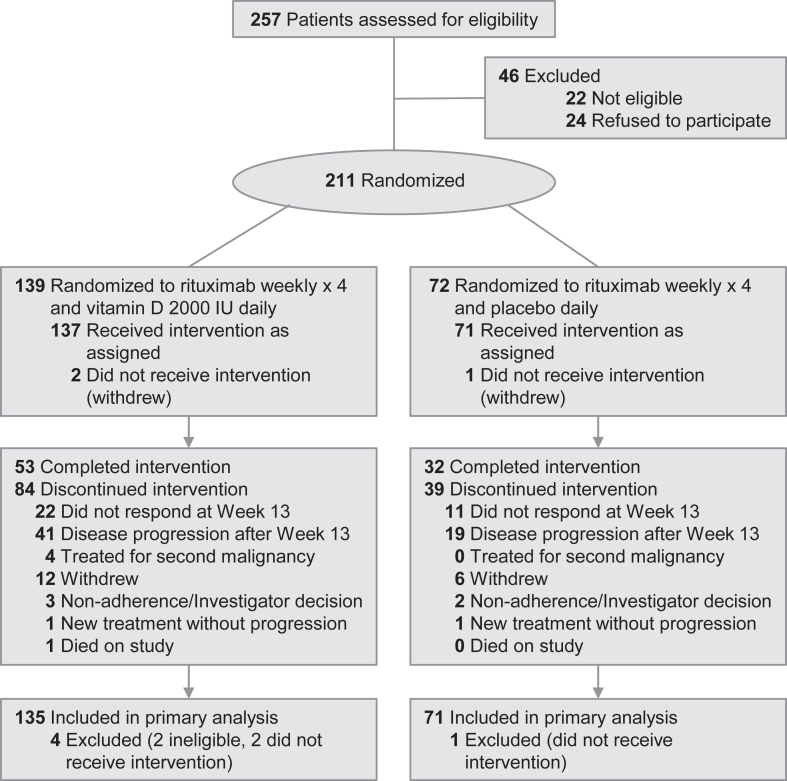
In this phase 3, randomized, double-blind, placebo-controlled trial, patients with low tumor burden follicular, marginal zone or small lymphocytic lymphoma, age 18 or older, with stage two or greater disease and no prior systemic treatment were enrolled at 7 academic cancer centers. Patients were stratified by histology and FLIPI (Follicular Lymphoma International Prognostic Index) score and randomized 2:1 to receive 2000 IU vitamin D or placebo daily beginning on day one with rituximab 375 mg/m administered weekly times four. 257 patients were assessed for participation: 24 were not eligible and 22 refused. Patients with stable disease or disease progression at week 13 counted as events; responding patients continued treatment with vitamin D or placebo until progression for up to three years. The primary endpoint was EFS, defined as the time from randomization to lack of response at week 13, initiation of a new treatment, disease progression or death. Secondary endpoints included week 13 response and OS. This trial is registered at clinicaltrials.gov, NCT03078855.
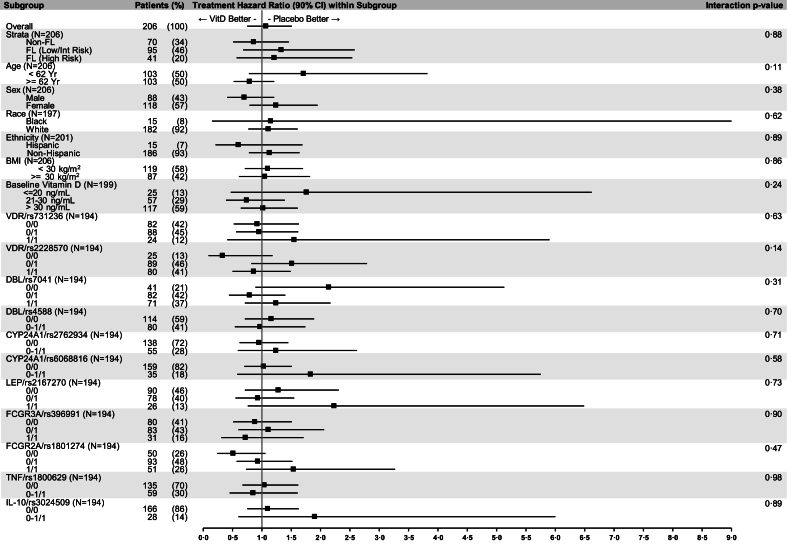
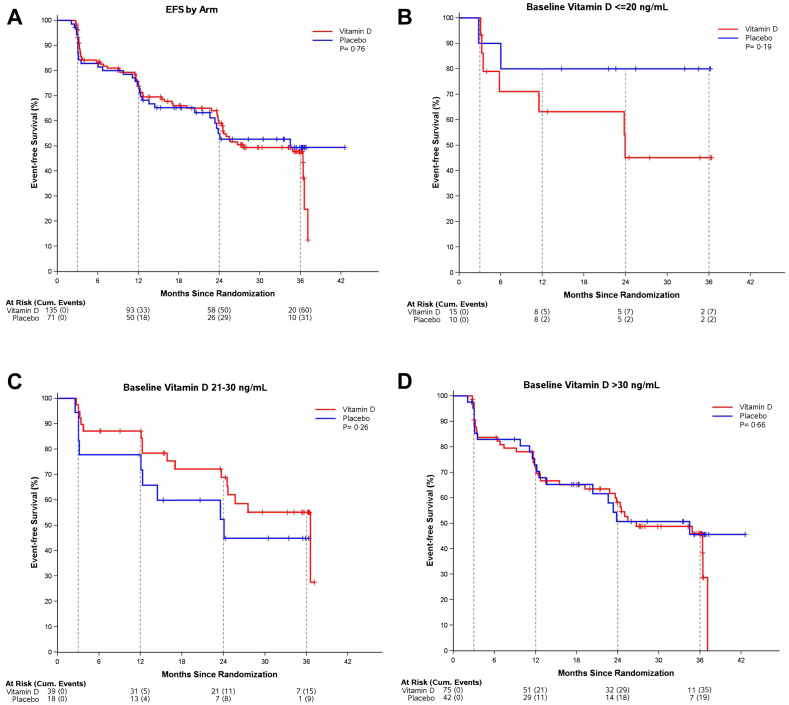
206 evaluable patients (135 on vitamin D and 71 on placebo) were enrolled between September 2017 and March 2022 with a median EFS follow-up of 19.6 months (IQR, 9.3-33.5). The median age was 62 years (IQR, 54-70); 118 (57%) female; 182 (89%) white. At week 13 the mean vitamin D level increased to 41.6 ng/mL (SD 10.1) in the vitamin D arm vs. remaining stable (31.3 ng/mL, SD 11.2) in the placebo arm. There was insufficient evidence of a difference in EFS between the two arms (P = 0.26): three-year EFS in the vitamin D arm was 47.7% (95% CI, 39.0-58.4) compared to 49.5% (95% CI, 37.6-65.0) in the placebo arm. There was no difference in week 13 response between the arms (both 84%). Adverse events associated with vitamin D supplementation were rare. The median OS follow-up was 35.1 months (IQR, 22.9-45.1), overall survival was 96.6% (95% CI, 93.1-98.6) and there was no significant difference between the vitamin D and placebo arms (P = 0.47).
As tested in this study, there is no benefit to routine vitamin D supplementation in patients with indolent lymphoma treated with rituximab. These results have implications for ongoing and planned studies of vitamin D supplementation in other malignancies.
This study was funded by the National Institutes of Health, National Cancer Institute grant R01CA214890.
惰性B细胞淋巴瘤诊断时维生素D水平低与总生存期(OS)较差之间存在显著关联。为了确定补充维生素D是否能改善这些患者的无事件生存期(EFS),我们开展了一项维生素D与安慰剂对比的双盲研究。
在这项3期随机双盲安慰剂对照试验中,7家学术癌症中心纳入了年龄18岁及以上、肿瘤负荷低的滤泡性、边缘区或小淋巴细胞淋巴瘤患者,疾病分期为二期或更高且未曾接受过全身治疗。患者按组织学和滤泡性淋巴瘤国际预后指数(FLIPI)评分进行分层,随机按2:1比例分配,从第1天开始每天接受2000 IU维生素D或安慰剂,同时每周一次静脉注射375 mg/m²利妥昔单抗,共4次。对257例患者进行了参与评估:24例不符合条件,22例拒绝参与。第13周时疾病稳定或进展的患者计为发生事件;有反应的患者继续接受维生素D或安慰剂治疗直至进展,最长3年。主要终点是EFS,定义为从随机分组到第13周无反应、开始新治疗、疾病进展或死亡的时间。次要终点包括第13周时的反应和OS。本试验已在clinicaltrials.gov注册,注册号为NCT03078855。
206例可评估患者(135例接受维生素D治疗,71例接受安慰剂治疗)于2017年9月至2022年3月入组,EFS的中位随访时间为19.6个月(四分位间距,9.3 - 33.5)。中位年龄为62岁(四分位间距,54 - 70);118例(57%)为女性;182例(89%)为白人。在第13周时,维生素D组的平均维生素D水平升至41.6 ng/mL(标准差10.1),而安慰剂组保持稳定(31.3 ng/mL,标准差11.2)。两组之间EFS差异的证据不足(P = 0.26):维生素D组的三年EFS为47.7%(95%置信区间,39.0 - 58.4),而安慰剂组为49.5%(95%置信区间,37.6 - 65.0)。两组在第13周时的反应无差异(均为84%)。与补充维生素D相关的不良事件很少见。OS的中位随访时间为35.1个月(四分位间距,22.9 - 45.1),总生存率为96.6%(95%置信区间,93.1 - 98.6),维生素D组和安慰剂组之间无显著差异(P = 0.47)。
如本研究中所测试的,对于接受利妥昔单抗治疗的惰性淋巴瘤患者,常规补充维生素D没有益处。这些结果对正在进行和计划开展的其他恶性肿瘤维生素D补充研究具有启示意义。
本研究由美国国立卫生研究院国立癌症研究所授予的R01CA214890资助。