Le Verger Kévin, Küng Laurelle C, Fabre Anne-Claire, Schmelzle Thomas, Wegmann Alexandra, Sánchez-Villagra Marcelo R
Department of Paleontology, University of Zurich, Zurich, Switzerland.
Institute of Ecology and Evolution, Universität Bern, Bern, Switzerland.
Evol Lett. 2024 Jul 11;8(6):774-786. doi: 10.1093/evlett/qrae032. eCollection 2024 Dec.
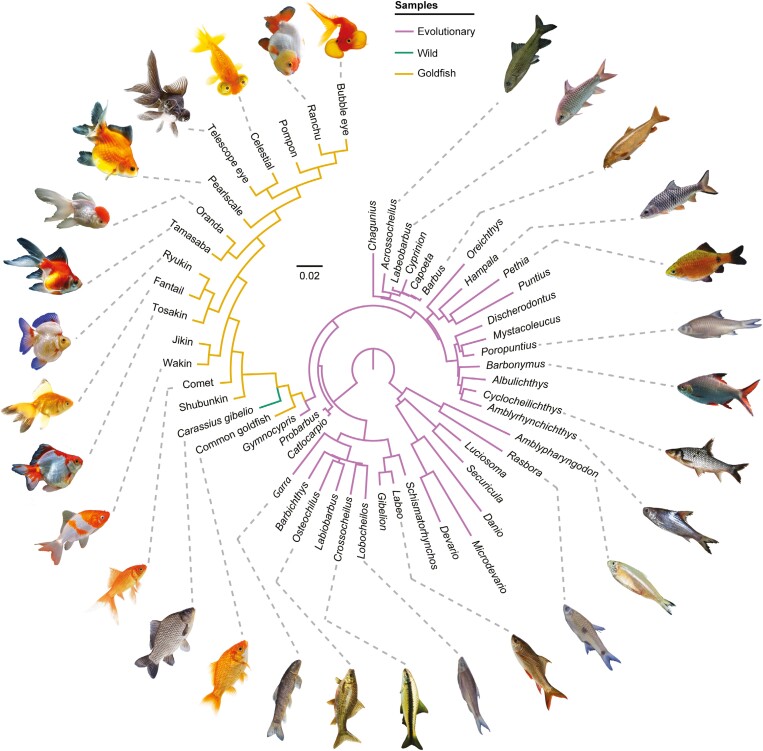
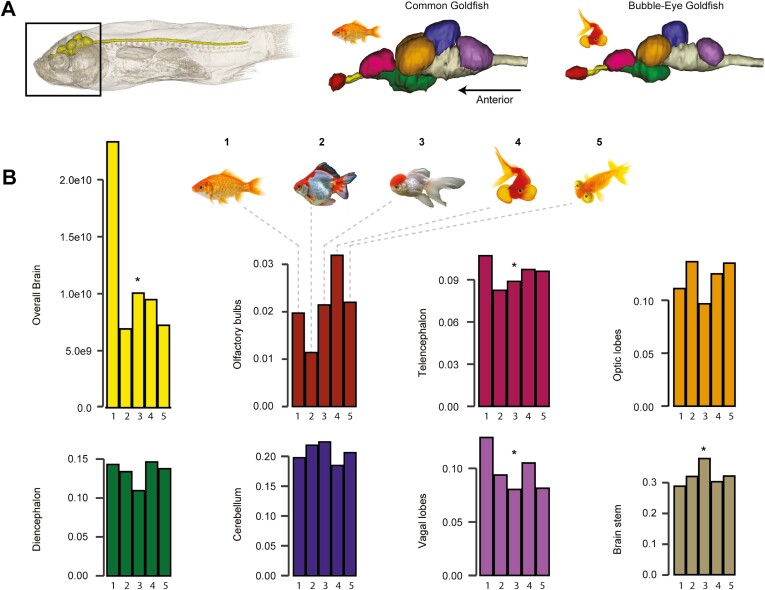
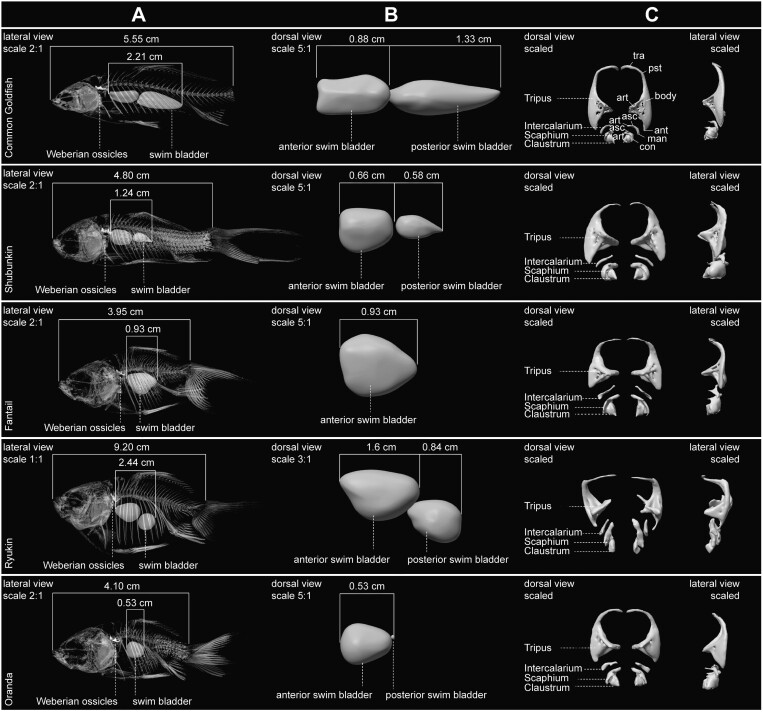
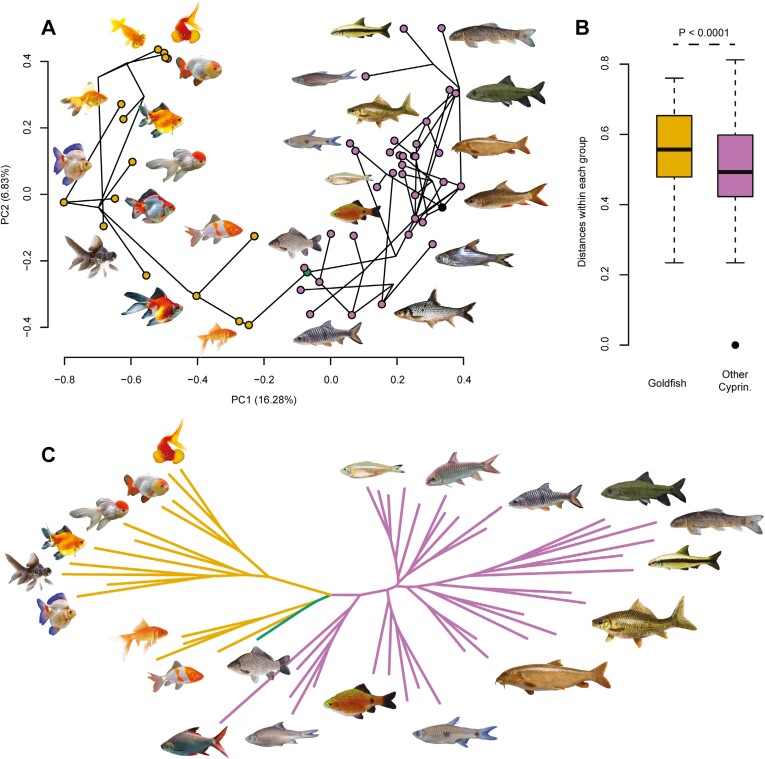
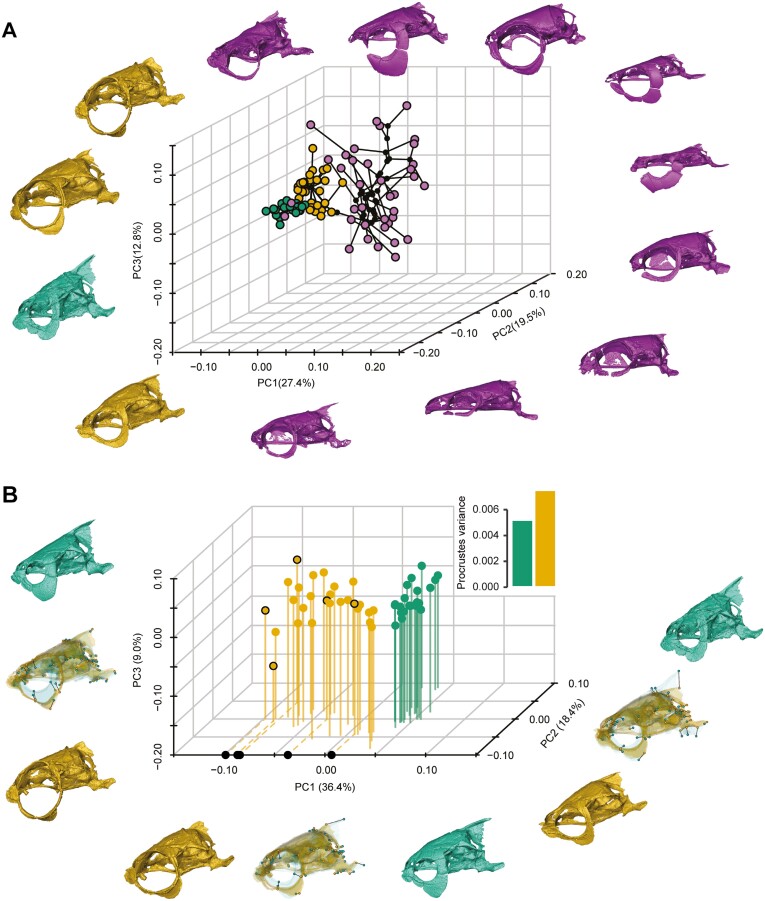
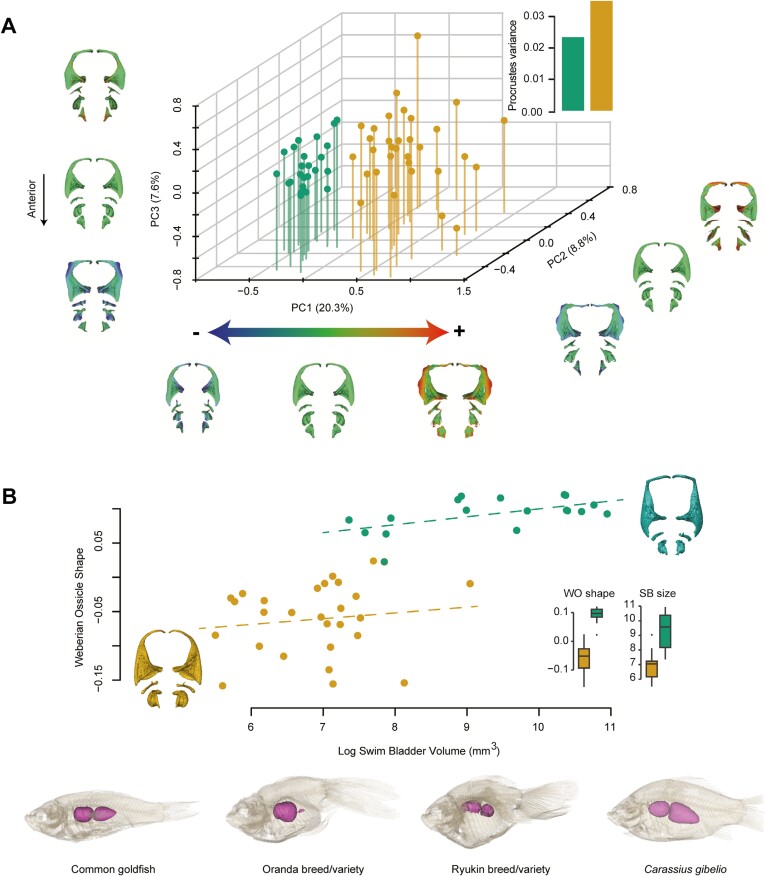
Domestication process effects are manifold, affecting genotype and phenotype, and assumed to be universal in animals by part of the scientific community. While mammals and birds have been thoroughly investigated, from taming to intensive selective breeding, fish domestication remains comparatively unstudied. The most widely bred and traded ornamental fish species worldwide, the goldfish, underwent the effect of long-term artificial selection on differing skeletal and soft tissue modules through ornamental domestication. Here, we provide a global morphological analysis in this emblematic ornamental domesticated fish. We demonstrate that goldfish exhibit unique morphological innovations in whole-body, cranial, and sensory (Weberian ossicles and brain) anatomy compared to their evolutionary clade, highlighting a remarkable morphological disparity within a single species comparable to that of a macroevolutionary radiation. In goldfish, as in the case of dogs and pigeons in their respective evolutionary contexts, the most ornamented varieties are extremes in the occupied morphological space, emphasizing the power of artificial selection for nonadaptive traits. Using 21st century tools on a dataset comprising the 16 main goldfish breeds, 23 wild close relatives, and 39 cypriniform species, we show that Charles Darwin's expressed wonder at the goldfish is justified. There is a commonality of overall pattern in the morphological differentiation of domesticated forms selected for ornamental purposes, but the singularity of goldfish occupation and extension within (phylo)morphospaces, speaks against a universality in the domestication process.
驯化过程的影响是多方面的,会影响基因型和表型,并且部分科学界人士认为在动物界中具有普遍性。虽然哺乳动物和鸟类已经得到了深入研究,从驯化到密集的选择性育种,但鱼类驯化相对来说仍未得到充分研究。全球养殖和交易最广泛的观赏鱼品种金鱼,通过观赏驯化在不同的骨骼和软组织模块上经历了长期人工选择的影响。在此,我们对这种标志性的观赏驯化鱼类进行了全面的形态学分析。我们证明,与它们的进化分支相比,金鱼在全身、头部和感官(韦伯氏骨和大脑)解剖结构上表现出独特的形态创新,突出了单一物种内显著的形态差异,堪比宏观进化辐射的差异。在金鱼身上,就像在各自进化背景下的狗和鸽子一样,装饰性最强的品种处于所占据的形态空间的极端位置,强调了人工选择对非适应性性状的影响力。利用21世纪的工具,对一个包含16个主要金鱼品种、23个野生近缘种和39个鲤形目物种的数据集进行分析,我们表明查尔斯·达尔文对金鱼表达的惊叹是有道理的。为观赏目的而选择的驯化形态在形态分化上存在总体模式的共性,但金鱼在(系统发育)形态空间中的占据和扩展的独特性,反驳了驯化过程具有普遍性的观点。