Song Qingliang, Pan Jinyue, Pan Maoxing, Zheng Chuiyang, Fan Wen, Zhen Jianwei, Pi Dajin, Liang Zheng, Shen Haiyan, Li Yuanyou, Yang Qinhe, Zhang Yupei
School of Traditional Chinese Medicine, Jinan University, Guangzhou, Guangdong, China.
Front Endocrinol (Lausanne). 2024 Nov 29;15:1396032. doi: 10.3389/fendo.2024.1396032. eCollection 2024.
Non-alcoholic fatty liver disease (NAFLD) is a common metabolic disorder worldwide, with an increasing incidence in recent years. While previous studies have suggested an association between the air pollutant PM2.5 and NAFLD, there is still considerable debate regarding the existence of a clear causal relationship between air pollution and NAFLD. This study aims to employ Mendelian randomization methods to evaluate the causal relationship between major air pollutants and NAFLD.
We conducted Mendelian randomization analyses on a large-scale publicly available genome-wide association study (GWAS) dataset of European populations to dissect the association between air pollutants, NAFLD, and liver function indicators. We used five different analysis methods, including Inverse-variance weighted (IVW), Weighted median, MR-Egger, Simple mode, and Weighted mode, to analyze the data. We also tested for pleiotropy, heterogeneity, and sensitivity of the results.
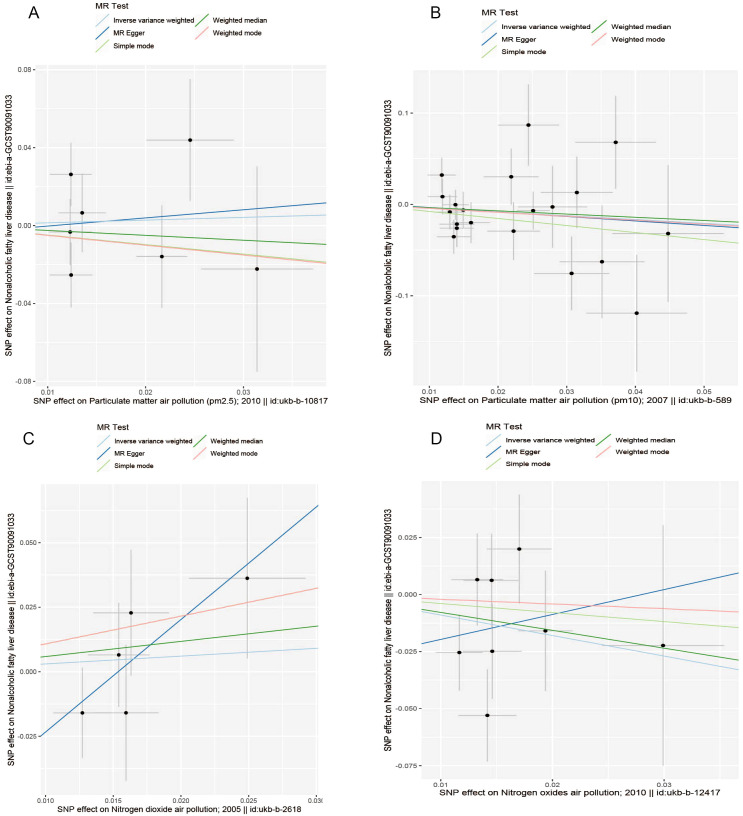
This study utilized four common exposures related to air pollution and four outcomes related to NAFLD. The results regarding the association between air pollutants and NAFLD (PM2.5: =0.808, 95% CI=0.37-3.56; PM10: =0.238, 95% CI=0.33-1.31; nitrogen dioxide: =0.629, 95% CI=0.40-4.61; nitrogen oxides: =0.123, 95% CI=0.13-1.28) indicated no statistically significant correlation between them. However, notably, there was a causal relationship between PM10 and serum albumin (ALB) levels (=0.019, 95% CI=1.02-1.27).
This MR study found no evidence of a causal relationship between air pollution and NAFLD in European populations. However, a statistically significant association was observed between PM10 and ALB levels, suggesting that the air pollutant PM10 may impact the liver's ability to synthesize proteins.
非酒精性脂肪性肝病(NAFLD)是一种全球常见的代谢紊乱疾病,近年来发病率不断上升。虽然先前的研究表明空气污染物PM2.5与NAFLD之间存在关联,但空气污染与NAFLD之间是否存在明确的因果关系仍存在相当大的争议。本研究旨在采用孟德尔随机化方法评估主要空气污染物与NAFLD之间的因果关系。
我们对欧洲人群的大规模公开全基因组关联研究(GWAS)数据集进行孟德尔随机化分析,以剖析空气污染物、NAFLD和肝功能指标之间的关联。我们使用了五种不同的分析方法,包括逆方差加权(IVW)、加权中位数、MR-Egger、简单模式和加权模式,来分析数据。我们还对结果进行了多效性、异质性和敏感性测试。
本研究利用了四种与空气污染相关的常见暴露因素和四种与NAFLD相关的结果。关于空气污染物与NAFLD之间关联的结果(PM2.5:=0.808,95%CI=0.37-3.56;PM10:=0.238,95%CI=0.33-1.31;二氧化氮:=0.629,95%CI=0.40-4.61;氮氧化物:=0.123,95%CI=0.13-1.28)表明它们之间没有统计学上的显著相关性。然而,值得注意的是,PM10与血清白蛋白(ALB)水平之间存在因果关系(=0.019,95%CI=1.02-1.27)。
这项孟德尔随机化研究没有发现欧洲人群中空气污染与NAFLD之间存在因果关系的证据。然而,观察到PM10与ALB水平之间存在统计学上的显著关联,这表明空气污染物PM10可能会影响肝脏合成蛋白质的能力。