Satoh Taijyu, Yaoita Nobuhiro, Higuchi Satoshi, Nochioka Kotaro, Yamamoto Saori, Sato Haruka, Tatebe Shunsuke, Yamada Kaito, Yamada Yusuke, Komaru Kohei, Chiba Naoki, Sarashina Yuki, Mori Ryuichi, Nakada Mitsuru, Hayashi Hideka, Suzuki Hideaki, Takahama Hiroyuki, Ota Hideki, Yasuda Satoshi
Department of Cardiovascular Medicine Tohoku University Graduate School of Medicine Sendai Japan.
Department of Diagnostic Radiology Tohoku University Graduate School of Medicine Sendai Japan.
Pulm Circ. 2024 Dec 15;14(4):e70026. doi: 10.1002/pul2.70026. eCollection 2024 Oct.
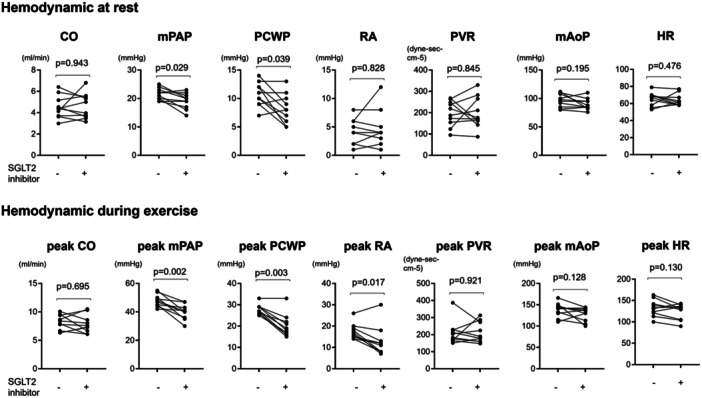
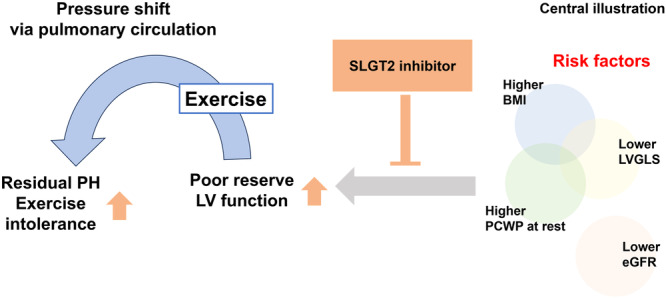
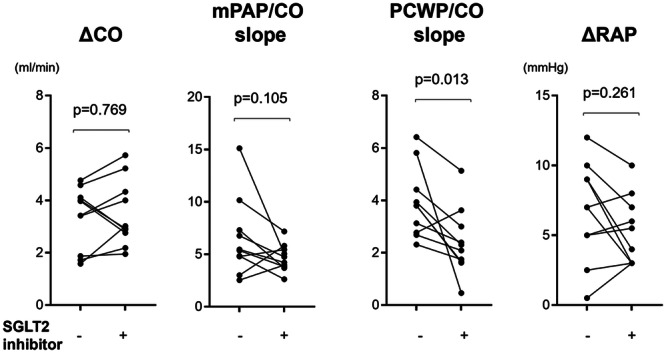
Patients with borderline pulmonary hypertension (PH) often experience shortness of breath or exacerbation of PH during exercise, known as exercise-induced PH. However, the pathogenesis of exercise-induced post-capillary PH (post-EIPH) and its treatment strategies remain unclear. Recent guidelines and consensus documents have highlighted the benefits of sodium-glucose cotransporter-2 (SGLT2) inhibitors in heart failure and chronic kidney disease (CKD). This study aimed to investigate the effects of SGLT2 inhibitors in patients with post-EIPH and CKD. This single-center prospective cohort study enroled 10 patients with CKD (age, 68 years; female, 60%) who exhibited post-EIPH between 1 July 2022 and 31 December 2023. Post-EIPH was defined as a pulmonary capillary wedge pressure (PCWP)/cardiac output (CO) slope > 2 and peak PCWP during exercise ≥ 25 mmHg measured by catheterization. The patients received SGLT2 inhibitor treatment for 6 months. At rest, patients with post-EIPH had borderline-PH (21.5 ± 1.8 mmHg), with preserved left and right ventricular function. SGLT2 inhibitors treatment significantly reduced the PCWP/CO slope during exercise (3.9 ± 1.2 vs. 2.4 ± 1.2 mmHg/L/min, = 0.013) and improved the 6-min walking distance (489.9 ± 80.2 vs. 568.3 ± 91.9 m, = 0.014). Magnetic resonance imaging revealed a lower left ventricular global longitudinal strain in patients with post-EIPH, which was increased by SGLT2 inhibitor treatment (-13.8 ± 2.0 vs. -17.3 ± 2.0%, = 0.003). SGLT2 treatment inhibitors mitigated post-EIPH hemodynamic abnormalities and exercise intolerance, suggesting their potential as its therapeutic option.
临界性肺动脉高压(PH)患者在运动期间常出现呼吸急促或PH加重,即所谓的运动诱发性PH。然而,运动诱发性毛细血管后PH(运动后EIPH)的发病机制及其治疗策略仍不清楚。最近的指南和共识文件强调了钠-葡萄糖协同转运蛋白2(SGLT2)抑制剂在心力衰竭和慢性肾脏病(CKD)中的益处。本研究旨在调查SGLT2抑制剂对运动后EIPH合并CKD患者的影响。这项单中心前瞻性队列研究纳入了10例CKD患者(年龄68岁;女性占60%),这些患者在2022年7月1日至2023年12月31日期间出现运动后EIPH。运动后EIPH定义为通过导管检查测得的肺毛细血管楔压(PCWP)/心输出量(CO)斜率>2且运动期间的PCWP峰值≥25 mmHg。患者接受SGLT2抑制剂治疗6个月。静息时,运动后EIPH患者存在临界性PH(21.5±1.8 mmHg),左、右心室功能保留。SGLT2抑制剂治疗显著降低了运动期间的PCWP/CO斜率(3.9±1.2与2.4±1.2 mmHg/L/min,P=0.013),并改善了6分钟步行距离(489.9±80.2与568.3±91.9 m,P=0.014)。磁共振成像显示,运动后EIPH患者的左心室整体纵向应变较低,SGLT2抑制剂治疗使其增加(-13.8±2.0与-17.3±2.0%,P=0.003)。SGLT2治疗抑制剂减轻了运动后EIPH的血流动力学异常和运动不耐受,表明其作为治疗选择的潜力。