Hasnaoui Anis, Trigui Racem, Giuffrida Mario
Faculty of Medicine of Tunis, Tunis El Manar University, Bab Saadoun Tunis 1007, Tunisia.
Department of General Surgery, Menzel Bourguiba Hospital, Menzel Bourguiba 7050, Bizerte, Tunisia.
World J Gastroenterol. 2024 Dec 14;30(46):4969-4976. doi: 10.3748/wjg.v30.i46.4969.
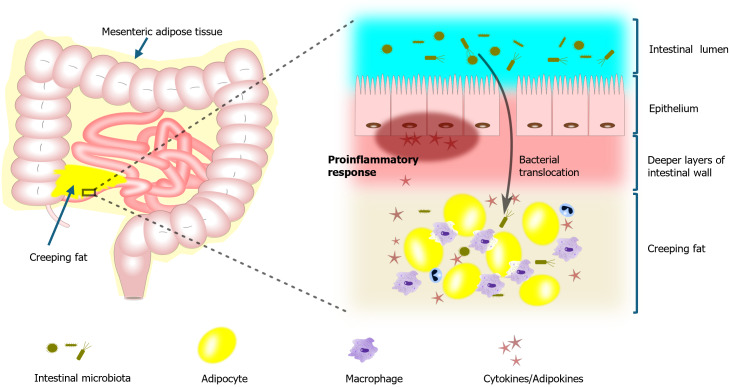
In this letter, we commented on the article by Wu . We examined the interactions between mesenteric adipose tissue, creeping fat, and gut microbiota in Crohn's disease (CD), a condition marked by chronic gastrointestinal inflammation with a rising global incidence. The pathogenesis of CD involves complex genetic, environmental, and microbial factors. Dysbiosis, which is an imbalance in gut microbial communities, is frequently observed in CD patients, highlighting the pivotal role of the gut microbiota in disease progression and the inflammatory response. Recent studies have shown that mesenteric adipose tissue and creeping fat actively contribute to inflammation by producing proinflammatory cytokines. The relationship between creeping fat and altered microbiota can shift from a potentially protective role to one that encourages bacterial translocation, further complicating disease management. Recent research has suggested that fecal microbiota transplantation could help restore microbial balance, offering a promising therapeutic strategy to improve clinical disease response.
在这封信中,我们对吴的文章进行了评论。我们研究了克罗恩病(CD)中肠系膜脂肪组织、爬行脂肪和肠道微生物群之间的相互作用,CD是一种以慢性胃肠道炎症为特征且全球发病率不断上升的疾病。CD的发病机制涉及复杂的遗传、环境和微生物因素。肠道微生物群落失衡即生态失调在CD患者中经常被观察到,这突出了肠道微生物群在疾病进展和炎症反应中的关键作用。最近的研究表明,肠系膜脂肪组织和爬行脂肪通过产生促炎细胞因子积极促进炎症。爬行脂肪与微生物群改变之间的关系可能从潜在的保护作用转变为促进细菌易位的作用,这进一步使疾病管理复杂化。最近的研究表明,粪便微生物群移植有助于恢复微生物平衡,为改善临床疾病反应提供了一种有前景的治疗策略。