Ghimire Laxman, Luo Hongbo R
J Clin Invest. 2024 Dec 16;134(24):e187056. doi: 10.1172/JCI187056.
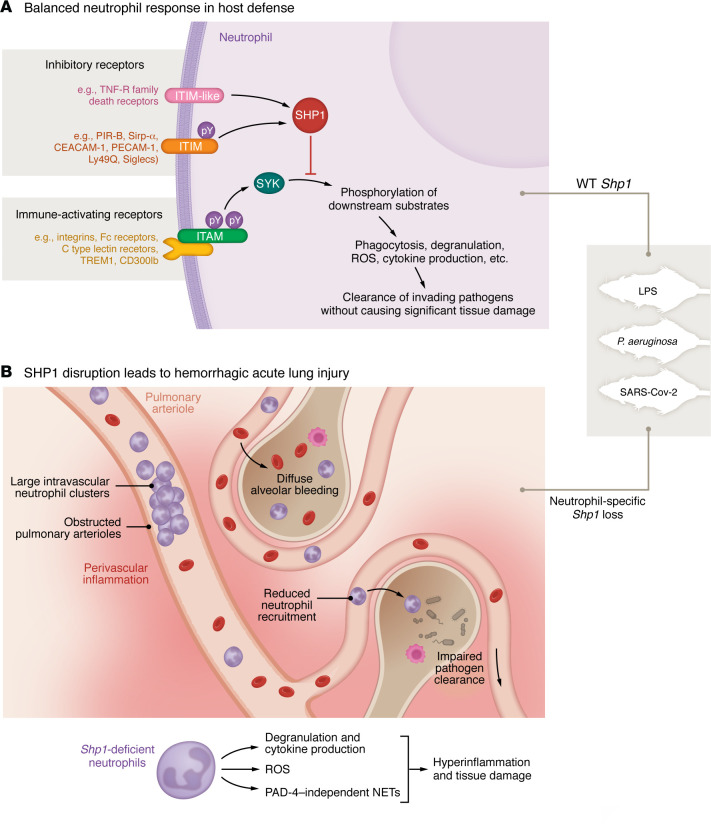
Following respiratory infection or injury, neutrophil hyperactivation can damage surrounding lung tissue by releasing harmful compounds. In this issue of the JCI, Moussavi-Harami and colleagues identified tyrosine phosphatase SHP1 as a key negative regulator of neutrophil activation in acute respiratory distress syndrome (ARDS). Neutrophil-specific Shp1 disruption leads to hyperinflammation, pulmonary hemorrhage, and increased mortality in both sterile and pathogen-induced acute lung injury (ALI). Large intravascular neutrophil clusters and excessive PAD4-independent neutrophil extracellular traps (NETs) were identified as key features of lung injury. Mechanistically, Shp1 deficiency resulted in uncontrolled SYK kinase activation, driving chaotic neutrophil hyperactivation and inflammation.
呼吸道感染或损伤后,中性粒细胞过度活化可通过释放有害化合物损害周围肺组织。在本期《临床研究杂志》中,穆萨维 - 哈拉米及其同事确定酪氨酸磷酸酶SHP1是急性呼吸窘迫综合征(ARDS)中中性粒细胞活化的关键负调节因子。中性粒细胞特异性Shp1缺失会导致无菌性和病原体诱导的急性肺损伤(ALI)出现炎症反应过度、肺出血及死亡率增加。大型血管内中性粒细胞簇和过量的不依赖于肽基精氨酸脱亚氨酶4(PAD4)的中性粒细胞胞外诱捕网(NETs)被确定为肺损伤的关键特征。从机制上讲,Shp1缺乏导致脾酪氨酸激酶(SYK)激酶不受控制地激活,从而引发混乱的中性粒细胞过度活化和炎症反应。