Lee Ju-Young, Kim Yeongjoo, Oh Jung-Min, Kim Yun Hak, Kim Hyun-Joo
Department of Periodontology, Dental and Life Science Institute, School of Dentistry, Pusan National University, Yangsan, Korea.
Department of Periodontics and Dental Research Institute, Pusan National University Dental Hospital, Yangsan, Korea.
J Periodontal Implant Sci. 2025 Jun;55(3):217-231. doi: 10.5051/jpis.2401500075. Epub 2024 Nov 20.
This study aimed to identify new susceptibility modules and genes by analyzing the transcriptional profiles of peri-implantitis and periodontitis within the same host environment, using weighted gene co-expression network analysis (WGCNA).
Gingival tissue samples were collected from 10 patients, each presenting with both periodontitis and peri-implantitis sites, and were used for RNA sequencing. We conducted WGCNA to identify key modules that showed distinct transcriptional expression profiles between periodontitis and peri-implantitis. Gene Ontology enrichment and Kyoto Encyclopedia of Genes and Genomes pathway analyses were carried out using R software. Genes with an adjusted value greater than 0.05 were excluded from gene selection using the Pearson correlation method.
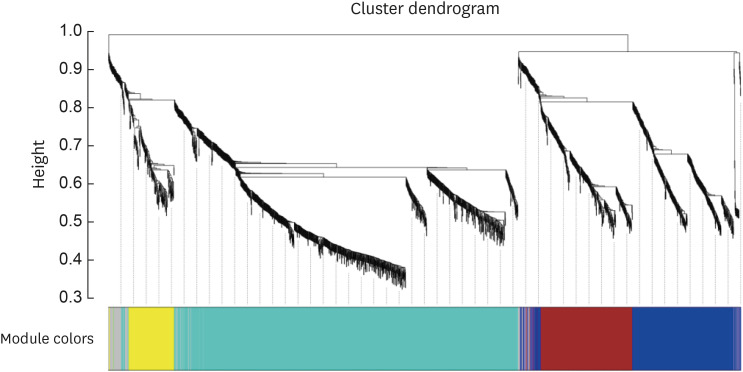
A total of 2,226 regulated genes were identified, and those with similar expression patterns were grouped into 5 color-coded functional modules using WGCNA. Among these, 3 modules showed distinct differences in expression profiles between peri-implantitis and periodontitis. The turquoise and yellow modules were associated with upregulation in peri-implantitis, while the blue module was linked to periodontitis. This finding suggests that peri-implantitis and periodontitis have significantly different transcriptional signatures. Over-representation analysis was conducted to explore the component genes of the established modules. The top-ranked genes, selected based on their network connectivity within the modules, were identified using DESeq2 and were considered hub genes.
WGCNA revealed distinct modular gene patterns in peri-implantitis and periodontitis, highlighting transcriptional differences between the 2 conditions. Notably, we identified 10 key genes from each of the 3 modules-the blue module associated with periodontitis-dominant pathways, and the turquoise and yellow modules associated with peri-implantitis-dominant pathways. The hub genes and pathways unveiled in this research are likely key contributors to the progression of peri-implantitis and warrant further exploration as promising candidates.
本研究旨在通过加权基因共表达网络分析(WGCNA),在同一宿主环境中分析种植体周炎和牙周炎的转录谱,以识别新的易感性模块和基因。
从10名同时患有牙周炎和种植体周炎部位的患者中采集牙龈组织样本,用于RNA测序。我们进行WGCNA以识别在牙周炎和种植体周炎之间显示出不同转录表达谱的关键模块。使用R软件进行基因本体富集分析和京都基因与基因组百科全书通路分析。使用Pearson相关方法从基因选择中排除调整后 值大于0.05的基因。
共鉴定出2226个调控基因,使用WGCNA将表达模式相似的基因分为5个颜色编码的功能模块。其中,3个模块在种植体周炎和牙周炎之间的表达谱显示出明显差异。绿松石色和黄色模块与种植体周炎中的上调相关,而蓝色模块与牙周炎相关。这一发现表明种植体周炎和牙周炎具有显著不同的转录特征。进行过表达分析以探索已建立模块的组成基因。使用DESeq2鉴定基于其在模块内的网络连通性选择的排名靠前的基因,并将其视为枢纽基因。
WGCNA揭示了种植体周炎和牙周炎中不同的模块化基因模式,突出了这两种情况之间的转录差异。值得注意的是,我们从3个模块中的每一个中鉴定出10个关键基因——与牙周炎主导途径相关的蓝色模块,以及与种植体周炎主导途径相关的绿松石色和黄色模块。本研究中揭示的枢纽基因和途径可能是种植体周炎进展的关键因素,作为有前途的候选者值得进一步探索。