Daumas Alice, Bigarre Celestin, Boucekine Mohamed, Zaccariotto Audrey, Kaeppelin Bertrand, Mogenet Alice, Gouton Etienne, Pluvy Johan, Tomasini Pascale, Muracciole Xavier, Benzekry Sebastien, Greillier Laurent, Padovani Laetitia
Oncology Radiotherapy Department, Assistance Publique des Hôpitaux de Marseille, Aix-Marseille Université, 13005 Marseille, France.
COMPO, Inria Méditerranée, Cancer Research Center of Marseille, Inserm UMR1068, CNRS UMR7258, UM105, Aix-Marseille Université, 13273 Marseille, France.
Cancers (Basel). 2024 Dec 9;16(23):4122. doi: 10.3390/cancers16234122.
Prophylactic cranial irradiation (PCI) is recommended to decrease the incidence of brain metastases (BM) in extensive-stage small-cell lung cancer (ESSCLC) without BM after response to chemotherapy. However, PCI is associated with significant neurocognitive effects, and new studies are debating its benefits. Moreover, the introduction of immunotherapy in the management of the disease has raised new questions, and there is a lack of data on PCI and immunotherapy. We report a single-center retrospective study evaluating the impact of omitting PCI from real-life treatment, including immunotherapy, of patients with ES-SCLC.
We identified patients followed at APHM between January 2014 and January 2021 for ES-SCLC without BM with an indication for PCI. The main assessment criteria considered in this study were overall survival (OS) and brain metastasis-free survival (BMFS) between patients who received PCI and those who did not.
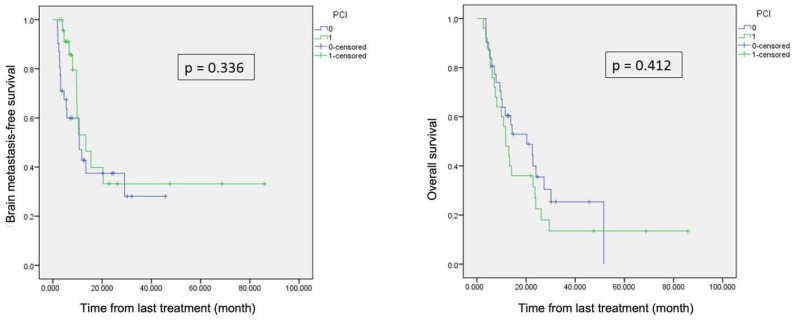
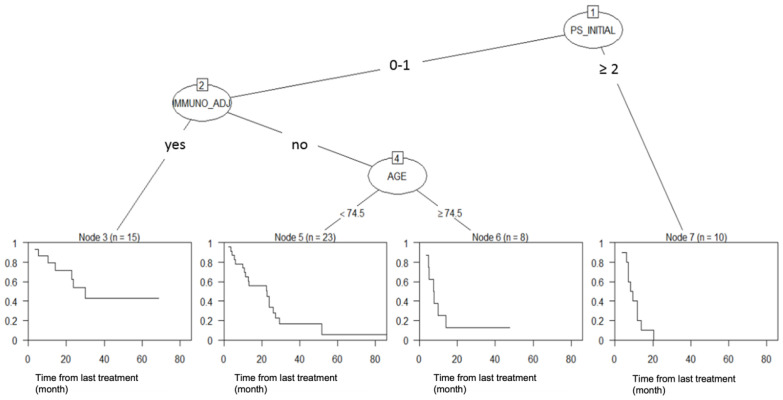
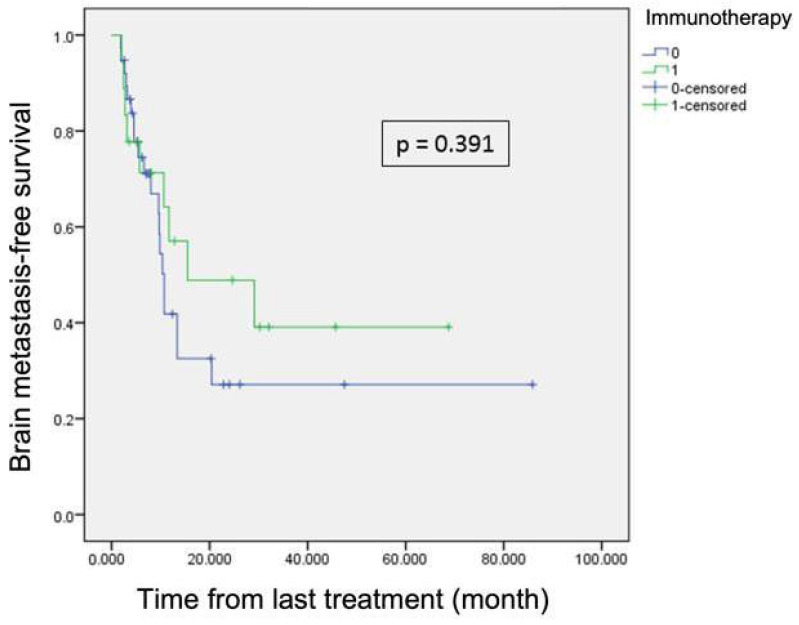
56 patients were included, 25 receiving PCI and 31 without PCI. The median follow-up was 16 months. Eighteen patients received immunotherapy, mostly in the group without PCI ( = 0.024). The median OS and BMFS were, respectively, 11.7 and 13.4 months in patients with PCI, and 20.3 and 10.7 months in patients without PCI, without any significant statistical difference ( = 0.412, = 0.336). The prognostic factors highlighted in multivariate analysis were initial performance status (PS) < 2 for OS (HR = 2.74 (IC95% [1.23; 6.13])) and monocyte lymphocyte ratio (MLR) < 0.12 for BMFS (HR = 1.21 (IC95% [1.01; 1.45])). A recursive partitioning analysis (RPA) found PS, immunotherapy, and age to be influential factors for OS but not PCI.
The clinical results of our study showed no benefit of PCI in terms of OS and BMFS for patients with ES-SCLC. This can be explained by the lack of benefit of PCI or by the introduction of immunotherapy.
对于广泛期小细胞肺癌(ESSCLC)且无脑转移(BM)且化疗有效后的患者,推荐进行预防性颅脑照射(PCI)以降低脑转移的发生率。然而,PCI与显著的神经认知效应相关,并且新的研究对其益处存在争议。此外,免疫疗法在该疾病治疗中的引入引发了新的问题,并且缺乏关于PCI与免疫疗法的数据。我们报告一项单中心回顾性研究,评估在ESSCLC患者的实际治疗(包括免疫疗法)中省略PCI的影响。
我们确定了2014年1月至2021年1月期间在APHM接受随访的ESSCLC且无脑转移且有PCI指征的患者。本研究考虑的主要评估标准是接受PCI和未接受PCI的患者之间的总生存期(OS)和无脑转移生存期(BMFS)。
纳入56例患者,25例接受PCI,31例未接受PCI。中位随访时间为16个月。18例患者接受了免疫疗法,大多在未接受PCI的组中(P = 0.024)。接受PCI的患者中位OS和BMFS分别为11.7个月和13.4个月,未接受PCI的患者分别为20.3个月和10.7个月,无任何显著统计学差异(P = 0.412,P = 0.336)。多因素分析中突出的预后因素是OS的初始体力状态(PS)<2(HR = 2.74(95%置信区间[1.23;6.13]))和BMFS的单核细胞淋巴细胞比值(MLR)<0.12(HR = 1.21(95%置信区间[1.01;1.45]))。递归划分分析(RPA)发现PS、免疫疗法和年龄是OS的影响因素,但PCI不是。
我们研究的临床结果显示,对于ESSCLC患者,PCI在OS和BMFS方面无益处。这可以通过PCI缺乏益处或免疫疗法的引入来解释。