Zhang Liting, Pan Zhaoyang, Lu Zhanhua, Wang Shiguang, Liu Wei, Wang Xiaofei, Wu Haoxiang, Chen Hao, Chen Tengkui, Hu Juan, He Xiuying
Guangdong Rice Engineering Laboratory, Guangdong Key Laboratory of Rice Science and Technology, Key Laboratory of Genetics and Breeding of High Quality Rice in Southern China (Co-Construction by Ministry and Province), Ministry of Agriculture and Rural Affairs, Rice Research Institute, Guangdong Academy of Agricultural Sciences, Guangzhou 510640, China.
Binhai College of Agriculture, Guangdong Ocean University, Zhanjiang 524088, China.
Foods. 2024 Nov 25;13(23):3776. doi: 10.3390/foods13233776.
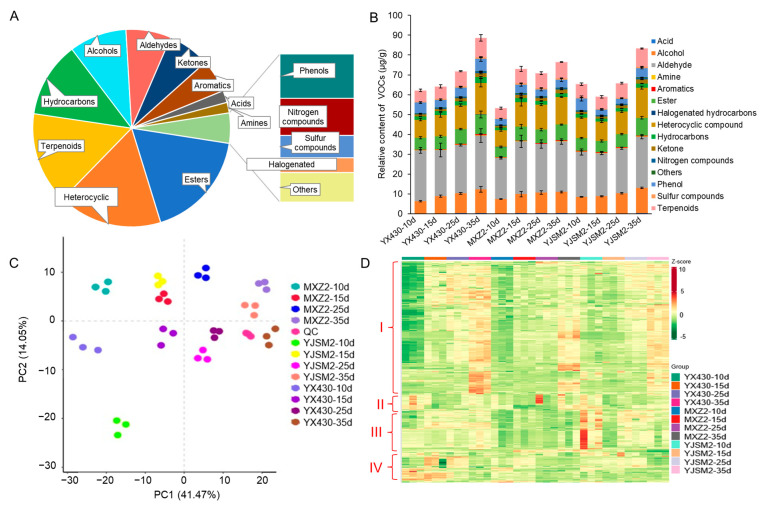
Aroma is a crucial determinant of rice taste quality, with volatile organic compounds (VOCs) playing a key role in defining this characteristic. However, limited research has explored the dynamic changes in these aromatic substances during the ripening stages of rice grains. In this study, we analyzed VOCs in rice grains across four ripening stages post-flowering using headspace solid-phase microextraction combined with gas chromatography-mass spectrometry (HS-SPME-GC-MS). A total of 417 VOCs were identified, among which 65 were determined to be key aroma-active compounds based on relative odor activity value (rOAV) analysis. Most of these aroma-active compounds exhibited an accumulation pattern as the grains matured. Notably, 5-ethyl-3-hydroxy-4-methyl-2(5H)-furanone and 2-Methyloxolan-3-one had the largest rOAV values. Additionally, (Z)-6-nonenal, (Z,Z)-3,6-nonadienal, 2-thiophenemethanethiol, 5-methyl-2-furanmethanethiol, 2,2,6-trimethyl-cyclohexanone, and 3-octen-2-one were identified as potential key markers for distinguishing rice-grain maturity stages. Moreover, 2-acetyl-1-pyrroline (2-AP), heptanal, and 1-nonanol were identified as marker metabolites differentiating aromatic from non-aromatic brown rice. These findings contribute to a deeper understanding of the dynamic variation and retention of aroma compounds during rice-grain ripening, and they offer valuable insights into the improvement of fragrant rice varieties.
香气是稻米食味品质的关键决定因素,挥发性有机化合物(VOCs)在定义这一特性方面起着关键作用。然而,关于这些芳香物质在水稻籽粒成熟阶段的动态变化的研究有限。在本研究中,我们采用顶空固相微萃取结合气相色谱-质谱联用(HS-SPME-GC-MS)技术分析了水稻开花后四个成熟阶段籽粒中的挥发性有机化合物。共鉴定出417种挥发性有机化合物,其中65种基于相对气味活性值(rOAV)分析被确定为关键香气活性化合物。随着籽粒成熟,这些香气活性化合物大多呈现积累模式。值得注意的是,5-乙基-3-羟基-4-甲基-2(5H)-呋喃酮和2-甲基四氢呋喃-3-酮的rOAV值最大。此外,(Z)-6-壬烯醛、(Z,Z)-3,6-壬二烯醛、2-噻吩甲硫醇、5-甲基-2-呋喃甲硫醇、2,2,6-三甲基环己酮和3-辛烯-2-酮被确定为区分水稻籽粒成熟阶段的潜在关键标志物。此外,2-乙酰基-1-吡咯啉(2-AP)、庚醛和1-壬醇被确定为区分香糙米和非香糙米的标记代谢物。这些发现有助于更深入地了解水稻籽粒成熟过程中香气化合物的动态变化和保留情况,并为香稻品种的改良提供了有价值的见解。