Lungaro Lisa, Malfa Patrizia, Manza Francesca, Costanzini Anna, Valentini Guido, Squarzanti Diletta Francesca, Viciani Elisa, Velichevskaya Alena, Castagnetti Andrea, Barbalinardo Marianna, Gentili Denis, Cariani Alessio, Ghisellini Sara, Caputo Fabio, De Giorgio Roberto, Caio Giacomo
Department of Translational Medicine, University of Ferrara, 44121 Ferrara, Italy.
SynBalance Srl, 21040 Origgio, Italy.
Nutrients. 2024 Nov 30;16(23):4173. doi: 10.3390/nu16234173.
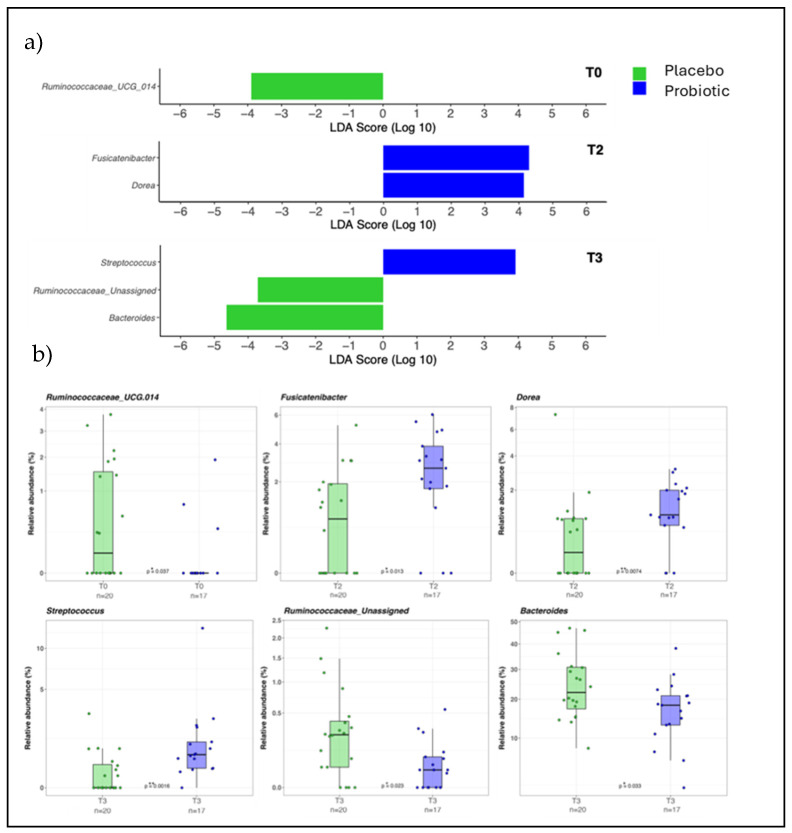
Allergic Rhinitis (AR) is an atopic disease affecting the upper airways of predisposed subjects exposed to aeroallergens. This study evaluates the effects of a mix of specific probiotics ( PBS066, LRH020, BB077, and subsp. BLG240) on symptoms and fecal microbiota modulation in subjects with AR. Probiotic effects were evaluated at the beginning (T0), at four and eight weeks of treatment (T1 and T2, respectively), and after four weeks of follow-up from the end of treatment (T3) ( = 19) compared to the placebo group ( = 22). AR symptoms and quality of life were evaluated by the mini rhinitis quality of life questionnaire (MiniRQLQ) at each time point. Allergic immune response and fecal microbiota compositions were assessed at T0, T2, and T3. The study was registered on Clinical-Trial.gov (NCT05344352). The probiotic group showed significant improvement in the MiniRQLQ score at T1, T2, and T3 vs. T0 ( < 0.01, < 0.05, < 0.01, respectively). At T2, the probiotic group showed an increase in , which can be negatively associated with allergic diseases, and , an intestinal bacterial genus with anti-inflammatory properties (-value FDR-corrected = 0.0074 and 0.013, respectively). Conversely, at T3 the placebo group showed an increase in and , (-value FDR-corrected = 0.033 and 0.023, respectively) which can be associated with allergies, while the probiotic group showed a significative increase in the / ratio (-value FDR-corrected = 0.023). This probiotic formulation improves symptoms and quality of life in subjects with AR, promoting a shift towards anti-inflammatory and anti-allergic bacterial species in the intestinal microbiota.
变应性鼻炎(AR)是一种特应性疾病,影响易患个体暴露于空气过敏原时的上呼吸道。本研究评估了特定益生菌混合物(PBS066、LRH020、BB077和亚种BLG240)对AR患者症状及粪便微生物群调节的影响。与安慰剂组(n = 22)相比,在治疗开始时(T0)、治疗四周和八周时(分别为T1和T2)以及治疗结束后四周随访时(T3)(n = 19)评估益生菌效果。在每个时间点通过小型鼻炎生活质量问卷(MiniRQLQ)评估AR症状和生活质量。在T0、T2和T3评估变应性免疫反应和粪便微生物群组成。该研究已在Clinical - Trial.gov上注册(NCT05344352)。与T0相比,益生菌组在T1、T2和T3时MiniRQLQ评分有显著改善(分别为P < 0.01、P < 0.05、P < 0.01)。在T2时,益生菌组中与变应性疾病呈负相关的Faecalibacterium和具有抗炎特性的肠道细菌属Blautia增加(FDR校正P值分别为0.0074和0.013)。相反,在T3时,安慰剂组中与过敏相关的Dialister和Clostridium_sensu_stricto_1增加(FDR校正P值分别为0.033和0.023),而益生菌组中Faecalibacterium/Clostridium_sensu_stricto_1比值显著增加(FDR校正P值 = 0.023)。这种益生菌制剂可改善AR患者的症状和生活质量,促进肠道微生物群向抗炎和抗过敏细菌种类转变。