Zheng Siyun, Yang Hengzheng, Zheng Jingxian, Wang Yidan, Jia Bo, Li Wannan
Key Laboratory for Molecular Enzymology and Engineering of Ministry of Education, School of Life Science, Jilin University, 2699 Qianjin Street, Changchun 130012, China.
Edmond H. Fischer Signal Transduction Laboratory, School of Life Sciences, Jilin University, Changchun 130012, China.
Int J Mol Sci. 2024 Nov 21;25(23):12501. doi: 10.3390/ijms252312501.
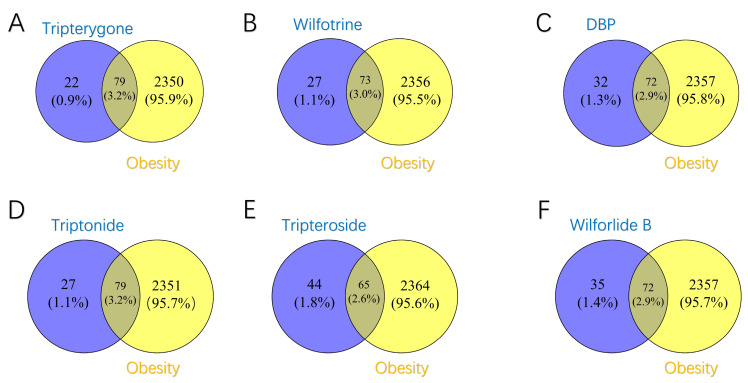
Obesity, characterized by abnormal or excessive fat accumulation, has become a chronic degenerative health condition that poses significant threats to overall well-being. Pharmacological intervention stands at the forefront of strategies to combat this issue. Recent studies, notably by Umut Ozcan's team, have uncovered the remarkable potential of Celastrol, a small-molecule compound derived from the traditional Chinese herb thunder god vine (Tripterygium wilfordii) as an anti-obesity agent. In this research, computational chemical analysis was employed, incorporating the "TriDimensional Hierarchical Fingerprint Clustering with Tanimoto Representative Selection (3DHFC-TRS)" algorithm to systematically explore 139 active small molecules from thunder god vine. These compounds were classified into six categories, with a particular focus on Category 1 molecules for their exceptional binding affinity to obesity-related targets, offering new avenues for therapeutic development. Using advanced molecular docking techniques and Cytoscape prediction models, six representative Celastrol-like molecules were identified, namely 3-Epikatonic Acid, Hederagenin, Triptonide, Triptotriterpenic Acid B, Triptotriterpenic Acid C, and Ursolic Acid. These compounds demonstrated superior binding affinity and specificity toward two key obesity targets, PPARG and PTGS2, suggesting their potential to regulate fat metabolism and mitigate inflammatory responses. To further substantiate these findings, molecular dynamics simulations and MM-PBSA free-energy calculations were applied to analyze the dynamic interactions between these small molecules and the enzymatic active sites of their targets. The results provide robust theoretical evidence that support the feasibility of these molecules as promising candidates for anti-obesity therapies. This study underscores the power of the 3DHFC-TRS algorithm in uncovering bioactive compounds from natural sources, such as thunder god vine, and highlights the therapeutic promise of PPARG and PTGS2 as novel obesity-related targets. Furthermore, it emphasizes the essential role of computational science in expediting drug discovery, paving the way for personalized and precision-based treatments for obesity and heralding a future of more effective healthcare solutions.
肥胖症以异常或过度的脂肪堆积为特征,已成为一种慢性退行性健康状况,对整体健康构成重大威胁。药物干预是应对这一问题的策略前沿。最近的研究,特别是乌穆特·奥兹坎团队的研究,发现了雷公藤红素(一种从传统中药雷公藤中提取的小分子化合物)作为抗肥胖剂的巨大潜力。在这项研究中,采用了计算化学分析,结合“基于Tanimoto代表性选择的三维层次指纹聚类(3DHFC - TRS)”算法,系统地探索了雷公藤中的139种活性小分子。这些化合物被分为六类,特别关注第1类分子,因为它们对肥胖相关靶点具有特殊的结合亲和力,为治疗开发提供了新途径。使用先进的分子对接技术和Cytoscape预测模型,确定了六种代表性的雷公藤红素样分子,即3 - 表齐墩果酸、常春藤皂苷元、雷公藤内酯醇、雷公藤三萜酸B、雷公藤三萜酸C和熊果酸。这些化合物对两个关键的肥胖靶点PPARG和PTGS2表现出优异的结合亲和力和特异性,表明它们具有调节脂肪代谢和减轻炎症反应的潜力。为了进一步证实这些发现,应用分子动力学模拟和MM - PBSA自由能计算来分析这些小分子与其靶点酶活性位点之间的动态相互作用。结果提供了有力的理论证据,支持这些分子作为抗肥胖治疗有前景的候选药物的可行性。这项研究强调了3DHFC - TRS算法在从雷公藤等天然来源中发现生物活性化合物方面的作用,并突出了PPARG和PTGS2作为新型肥胖相关靶点的治疗前景。此外,它强调了计算科学在加速药物发现中的重要作用,为肥胖症的个性化和精准治疗铺平道路,并预示着更有效的医疗解决方案的未来。