Carbonneau Rene, Vitaro Frank, Brendgen Mara, Boivin Michel, Tremblay Richard E
Department of Pediatrics, University of Montréal, Montréal, QC H3T 1J7, Canada.
Centre de Recherche Azrieli du CHU Sainte-Justine, Montréal, QC H3T 1C5, Canada.
Healthcare (Basel). 2024 Nov 27;12(23):2380. doi: 10.3390/healthcare12232380.
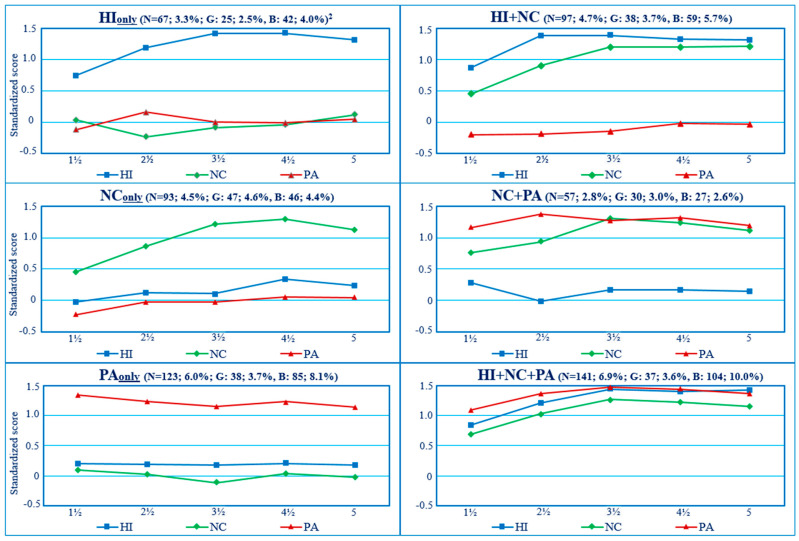
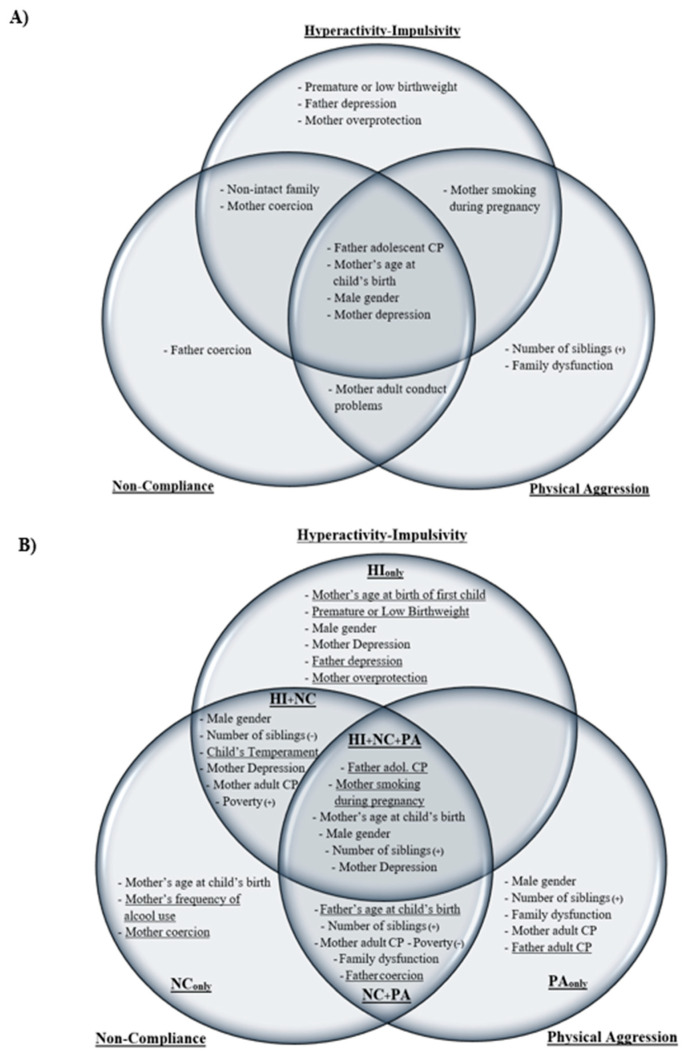
BACKGROUND/OBJECTIVES: Research on early risk factors for disruptive behaviors (DBs: hyperactivity-impulsivity/HI, non-compliance/NC, or physical aggression/PA) has predominantly focused on individual DBs in silos (i.e., HI, NC, PA) or the broader category of externalizing, reporting mostly common risk factors among them. However, studies addressing DB comorbidity, i.e., the simultaneous occurrence of more than one DB, showed differences in risk factors among DB comorbid profiles. Aiming to clarify this discrepancy, the present study compared the early risk factors associated with different longitudinal patterns (i.e., trajectories) of single-DBs (HI, NC, PA) with risk factors associated with monomorbid (HI, NC, PA) and comorbid (HI + NC, NC + PA, HI + NC + PA) joint-DBs trajectories during the preschool period.
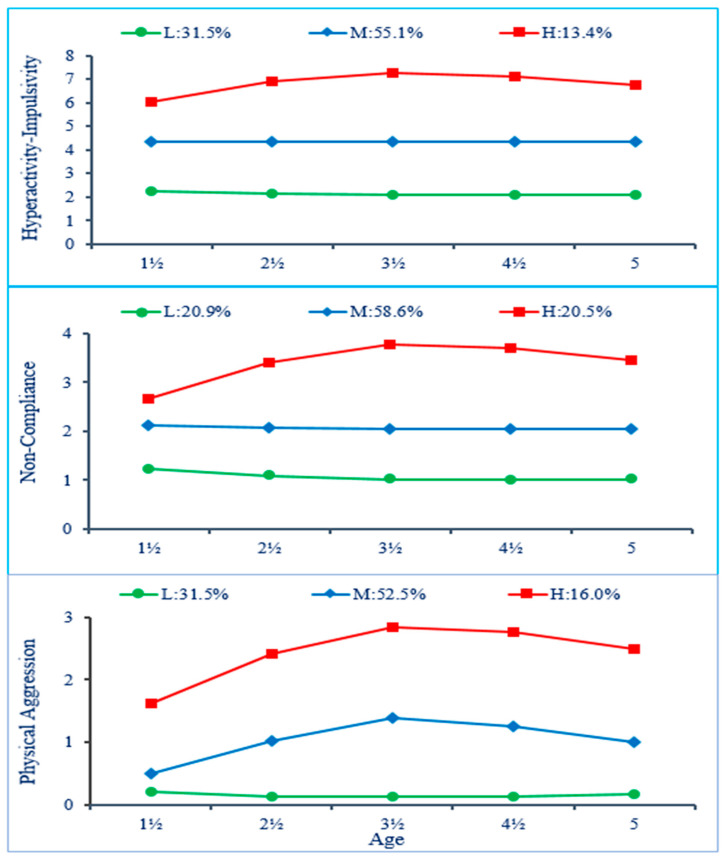
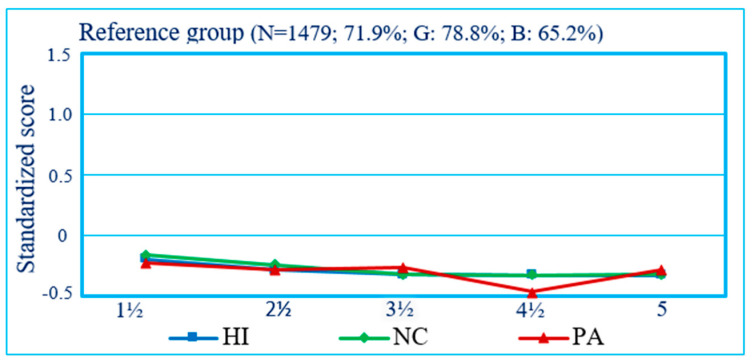
In a population-based birth cohort (N = 2045), parents' pre-conception characteristics, pregnancy and perinatal conditions, and age 5 months child and family characteristics were used to compare children following single-DB and joint-DBs high trajectories to children following low or moderate trajectories. The DB trajectories were derived from mother ratings at ages 1½, 2½, 3½, 4½, and 5 years.
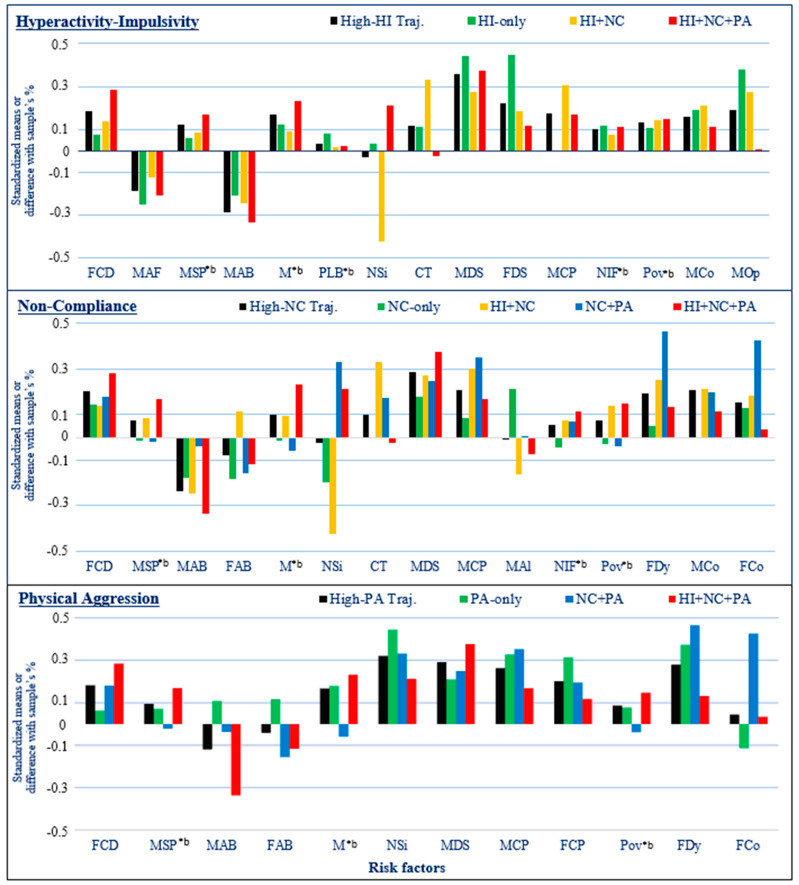
More risk factors were identified for single-DB high trajectories than for joint-DBs high trajectories. On average, children on a single-DB high trajectory shared only 44.2% of their risk factors with children on a related joint-DBs high trajectory. Moreover, high trajectories of single-DBs shared a larger proportion of their risk factors than did high trajectories of joint-DBs. The findings show that categories of DBs include different subgroups of children based on their comorbidity patterns across DBs, which are differentially linked to early risk factors.
Addressing comorbidity when investigating early risk factors of preschool DBs may improve our understanding of the etiological processes leading to these distinct but related behaviors and increase our ability to intervene upstream to prevent the earliest forms of potentially life-altering psychopathological conditions.
背景/目的:关于破坏性行为(DBs:多动冲动/HI、不依从/NC或身体攻击/PA)早期风险因素的研究主要集中在孤立的个体破坏性行为(即HI、NC、PA)或更广泛的外化行为类别上,大多报告了它们之间的共同风险因素。然而,针对破坏性行为共病情况(即同时出现不止一种破坏性行为)的研究表明,不同破坏性行为共病模式的风险因素存在差异。为了澄清这一差异,本研究比较了与单一破坏性行为(HI、NC、PA)不同纵向模式(即轨迹)相关的早期风险因素,以及与学龄前阶段单一共病(HI、NC、PA)和共病(HI + NC、NC + PA、HI + NC + PA)联合破坏性行为轨迹相关的风险因素。
在一个基于人群的出生队列(N = 2045)中,利用父母的孕前特征、怀孕和围产期状况,以及5个月大儿童和家庭特征,将单一破坏性行为和联合破坏性行为高轨迹的儿童与低或中等轨迹的儿童进行比较。破坏性行为轨迹来自母亲在1.5岁、2.5岁、3.5岁、4.5岁和5岁时的评分。
单一破坏性行为高轨迹比联合破坏性行为高轨迹识别出更多的风险因素。平均而言,单一破坏性行为高轨迹的儿童与相关联合破坏性行为高轨迹的儿童仅共享44.2%的风险因素。此外,单一破坏性行为的高轨迹比联合破坏性行为的高轨迹共享更大比例的风险因素。研究结果表明,破坏性行为类别根据其跨破坏性行为的共病模式包括不同的儿童亚组,这些亚组与早期风险因素的关联各不相同。
在调查学龄前破坏性行为的早期风险因素时考虑共病情况,可能会增进我们对导致这些不同但相关行为的病因过程的理解,并提高我们在早期进行干预以预防潜在改变生活的精神病理状况最早形式的能力。