Kim Nayoung, Lee Hanna, Han Jeongwon
College of Nursing Science, Kyung Hee University, 26, Kyunghee-daero, Dongdaemun-gu, Seoul 02447, Republic of Korea.
Department of Nursing, Gangneung-Wonju National University, Gangneung-si 25457, Republic of Korea.
Healthcare (Basel). 2024 Dec 4;12(23):2445. doi: 10.3390/healthcare12232445.
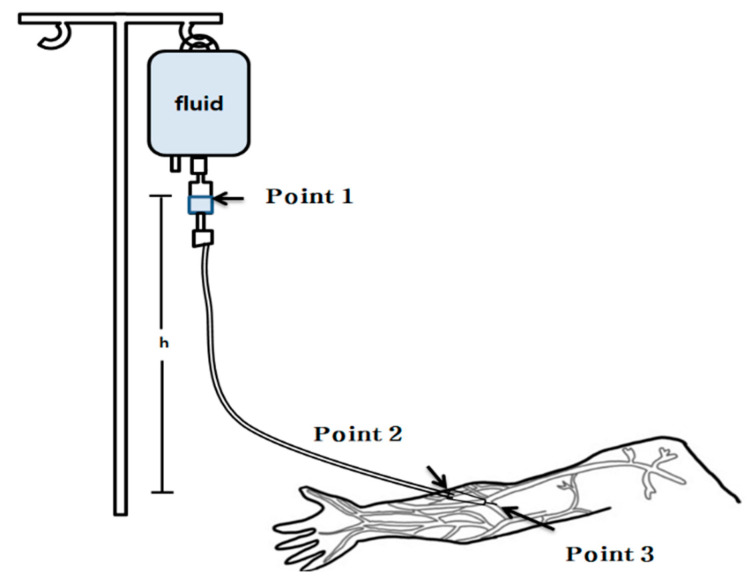
This study is performed to determine the effects of fluid height, inner catheter diameter, and peripheral venous pressure on room-temperature intravenous fluid administration.
We employed the Bernoulli equation, with frictional forces considered for volumetric analysis.
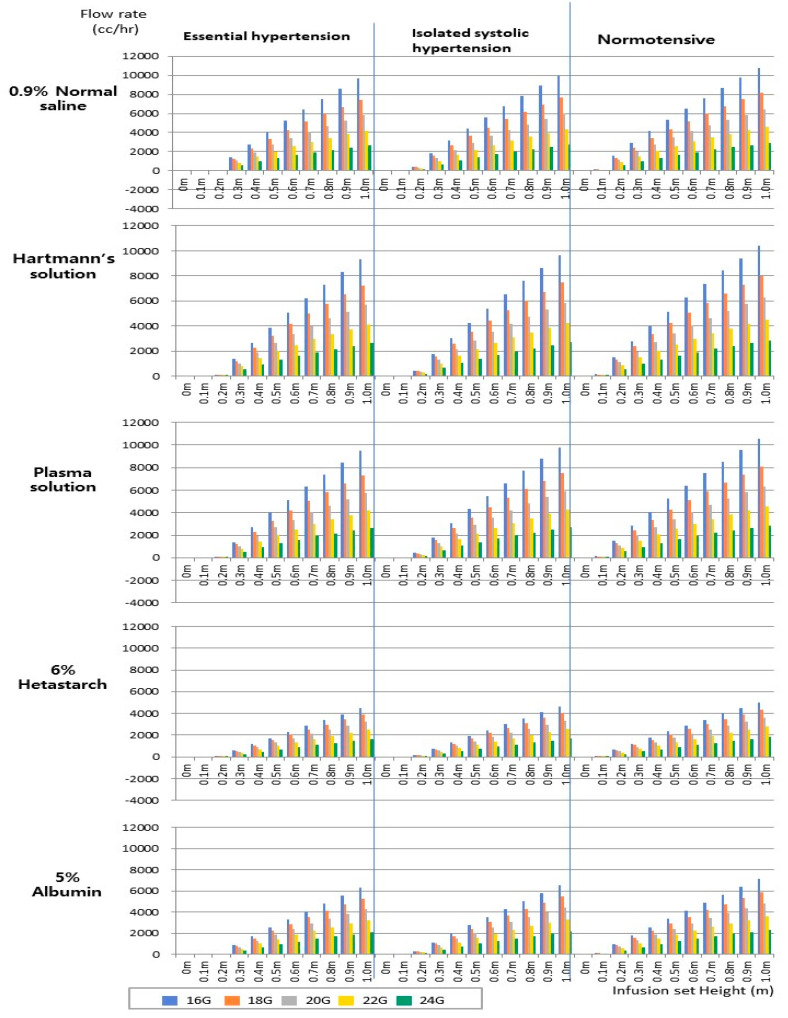
The results of this study demonstrate that infusion-set height, catheter size, fluid type, and blood pressure significantly affect flow rates. Under normotensive conditions, flow rates ranged from 58.2 to 10,743.18 cc/h, with the highest rates observed at a 1 m infusion-set height and larger catheters. Additionally, 6% hetastarch exhibited the lowest flow rates, while 0.9% normal saline showed the highest. Under hypertensive conditions, slightly higher infusion-set elevations were required for measurable flow rates, but they remained lower than those under normotensive conditions.
This study investigates the mechanics of peripheral venous fluid therapy and provides foundational data for future nursing research on fluid management.
本研究旨在确定液体高度、内导管直径和外周静脉压力对室温静脉输液的影响。
我们采用伯努利方程,并在体积分析中考虑了摩擦力。
本研究结果表明,输液器高度、导管尺寸、液体类型和血压显著影响流速。在血压正常的情况下,流速范围为58.2至10743.18毫升/小时,在输液器高度为1米且使用较大导管时观察到最高流速。此外,6%羟乙基淀粉的流速最低,而0.9%生理盐水的流速最高。在高血压情况下,需要稍高的输液器高度才能获得可测量的流速,但仍低于血压正常情况下的流速。
本研究探讨了外周静脉输液治疗的机制,并为未来液体管理的护理研究提供了基础数据。