Department of Anesthesiology and Pain Medicine, Korea University Anam Hospital, Seoul, Korea.
College of Medicine, Korea University, Seoul, Korea.
J Korean Med Sci. 2022 Mar 7;37(9):e71. doi: 10.3346/jkms.2022.37.e71.
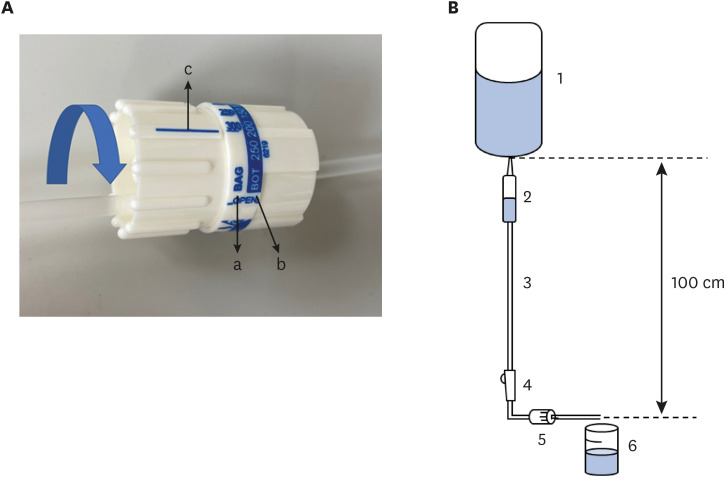
Intravenous infusion flow regulators (IIFRs) are widely used devices but it is unknown how much the difference between the IIFR scale and the actual flow rate depends on the viscosity of the intravenous (IV) fluid. This study evaluated the effects of viscosity on the flow rate of five IV fluids (0.9% normal saline, Hartmann's solution, plasma solution-A, 6% hetastarch, and 5% albumin) when using IIFRs. The viscosity of crystalloids was 1.07-1.12 mPa·s, and the viscosities of 6% hetastarch and 5% albumin were 2.59 times and 1.74 times that of normal saline, respectively. When the IIFR scales were preset to 20, 100, and 250 mL/hr, crystalloids were delivered at the preset flow rate within a difference of less than 10%, while 6% hetastarch was delivered at approximately 40% of the preset flow rates and 5% albumin was approximately 80% transmitted. When delivering colloids, IIFRs should be used with caution.
静脉输液流速调节器(IVFRs)是广泛使用的装置,但尚不清楚 IVFR 刻度与实际流速之间的差异在多大程度上取决于静脉(IV)液的粘度。本研究评估了粘度对五种 IV 液(0.9%生理盐水、哈特曼溶液、血浆溶液-A、6%贺斯淀粉和 5%白蛋白)在使用 IVFR 时的流速的影响。晶体的粘度为 1.07-1.12 mPa·s,6%贺斯淀粉和 5%白蛋白的粘度分别是生理盐水的 2.59 倍和 1.74 倍。当将 IIFR 刻度预设为 20、100 和 250 mL/hr 时,晶体在预设流速下的输送误差小于 10%,而 6%贺斯淀粉的预设流速约为 40%,5%白蛋白的预设流速约为 80%。在输送胶体时,应谨慎使用 IVFRs。