Gawronski Krzysztof, Hussein Nadia, Rzepecki Piotr
Department of Hematology, Military Institute of Medicine-National Research Institute, Szaserow Street 128, 04-141 Warsaw, Poland.
J Clin Med. 2024 Nov 26;13(23):7146. doi: 10.3390/jcm13237146.
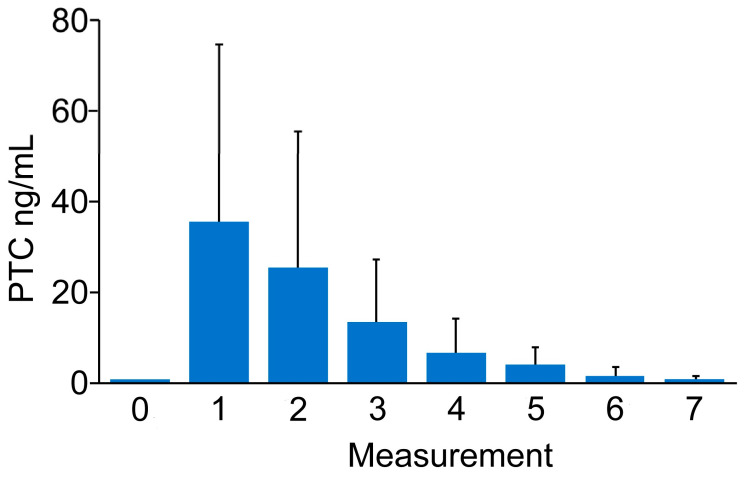
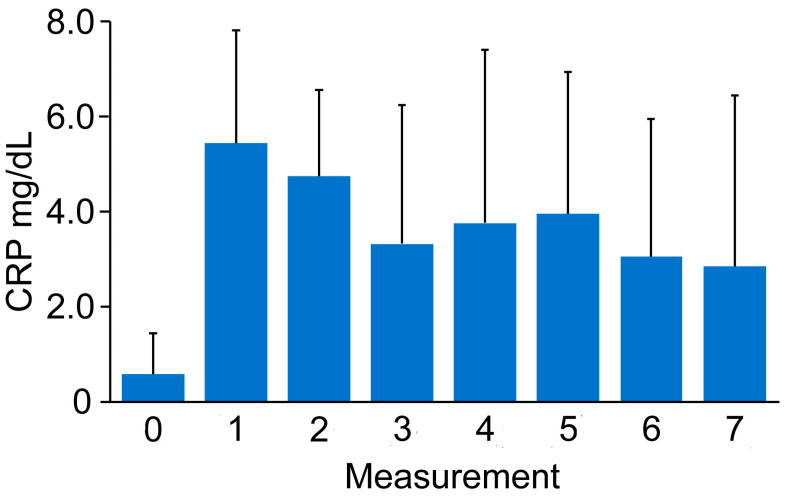
: The purpose of this study was to analyze the behaviors of inflammatory markers, such as procalcitonin and C-reactive protein (CRP), during treatment with obinotuzumab (an anti-CD20 antibody). : Our non-randomized observational study prospectively evaluated a cohort of 22 adult patients with lymphoproliferative neoplasms, chronic lymphocytic leukemia (CLL), and follicular lymphoma (FL) with indications for obinotuzumab therapy. : All patients had their blood drawn to determine blood counts, CRP, and procalcitonin, as well as body temperature measurements and blood cultures performed for bacterial infections on day 0 before administration of the anti-CD20 antibody. Subsequently, on days 1 to 7 after administration, blood was drawn daily at a fixed time of 8:00 a.m. for blood counts and CRP and PCT values, and blood cultures were performed. In addition, on days 1 to 7, body temperature was measured at fixed times (i.e., 8:00 a.m. and 8:00 p.m.). In all of these patients, significant increases in inflammatory markers, such as CRP and procalcitonin, were observed shortly after drug infusion. There was a statistically significant change in the serum PCT concentration ( < 0.0001), which significantly increased on days 1 to 4 compared to the initial measurement 0. : The increases in inflammatory markers shortly after obinotuzumab (anti-CD20 antibody) administration can be significantly high but are most often not related to the onset of infection and do not lead to any ill consequences in the treatment of lymphoproliferative disease.
本研究的目的是分析在使用奥滨尤妥珠单抗(一种抗CD20抗体)治疗期间炎症标志物(如降钙素原和C反应蛋白(CRP))的行为。我们的非随机观察性研究前瞻性评估了一组22例有奥滨尤妥珠单抗治疗指征的成年淋巴增殖性肿瘤、慢性淋巴细胞白血病(CLL)和滤泡性淋巴瘤(FL)患者。所有患者在给予抗CD20抗体前的第0天进行采血以测定血细胞计数、CRP和降钙素原,以及测量体温并进行细菌感染的血培养。随后,在给药后的第1至7天,每天上午8:00固定时间采血测定血细胞计数、CRP和PCT值,并进行血培养。此外,在第1至7天,在固定时间(即上午8:00和晚上8:00)测量体温。在所有这些患者中,在药物输注后不久观察到CRP和降钙素原等炎症标志物显著增加。血清PCT浓度有统计学显著变化(<0.0001),与初始测量值相比,在第1至4天显著升高。奥滨尤妥珠单抗(抗CD20抗体)给药后不久炎症标志物的增加可能会显著升高,但最常见的是与感染的发生无关,并且在淋巴增殖性疾病的治疗中不会导致任何不良后果。