• 文献检索
  • 文档翻译
  • 深度研究
  • 学术资讯
  • Suppr Zotero 插件Zotero 插件
  • 邀请有礼
  • 套餐&价格
  • 历史记录
应用&插件
Suppr Zotero 插件Zotero 插件浏览器插件Mac 客户端Windows 客户端微信小程序
定价
高级版会员购买积分包购买API积分包
服务
文献检索文档翻译深度研究API 文档MCP 服务
关于我们
关于 Suppr公司介绍联系我们用户协议隐私条款
关注我们

Suppr 超能文献

核心技术专利:CN118964589B侵权必究
粤ICP备2023148730 号-1Suppr @ 2026

文献检索

告别复杂PubMed语法,用中文像聊天一样搜索,搜遍4000万医学文献。AI智能推荐,让科研检索更轻松。

立即免费搜索

文件翻译

保留排版,准确专业,支持PDF/Word/PPT等文件格式,支持 12+语言互译。

免费翻译文档

深度研究

AI帮你快速写综述,25分钟生成高质量综述,智能提取关键信息,辅助科研写作。

立即免费体验

一种基于多姿态下肢康复机器人的线性康复运动规划方法

A Linear Rehabilitative Motion Planning Method with a Multi-Posture Lower-Limb Rehabilitation Robot.

作者信息

Wang Xincheng, Lin Musong, Sang Lingfeng, Wang Hongbo, Feng Yongfei, Niu Jianye, Yu Hongfei, Cheng Bo

机构信息

Hebei Provincial Key Laboratory of Parallel Robot and Mechatronic System, Yanshan University, Qinhuangdao 066000, China.

School of Mechanical Engineering, Yanshan University, Qinhuangdao 066000, China.

出版信息

Sensors (Basel). 2024 Nov 25;24(23):7506. doi: 10.3390/s24237506.

DOI:10.3390/s24237506
PMID:39686042
原文链接:https://pmc.ncbi.nlm.nih.gov/articles/PMC11644415/
Abstract

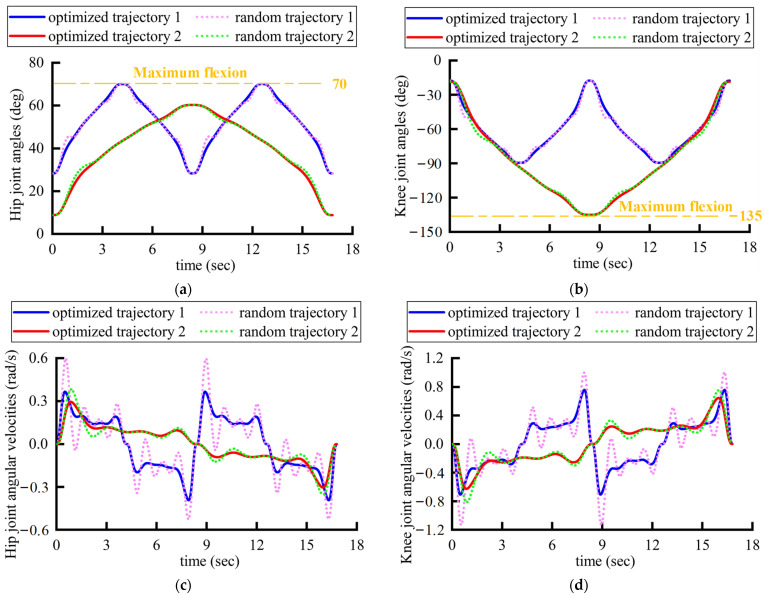
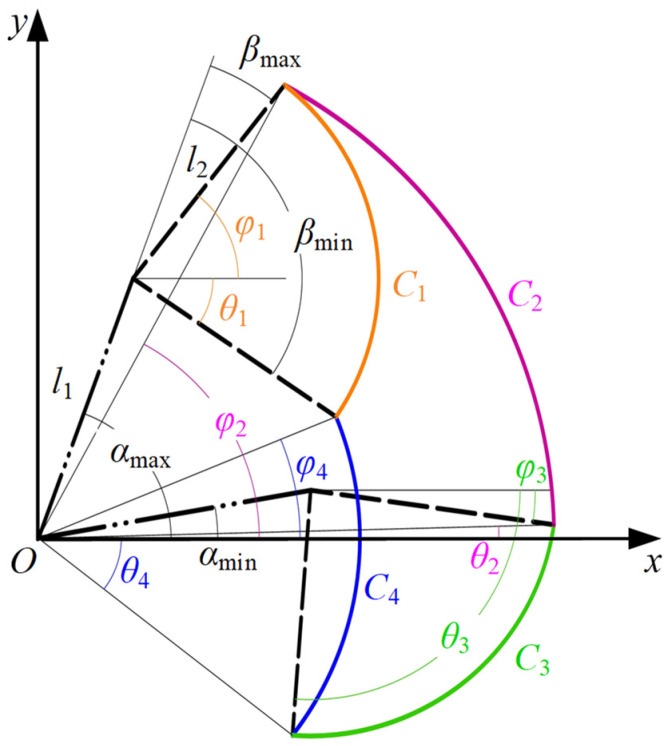
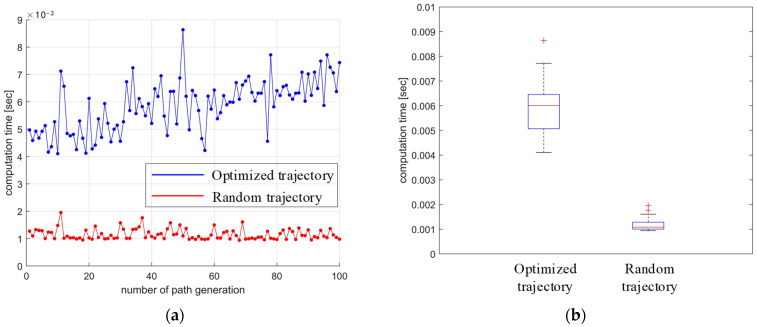
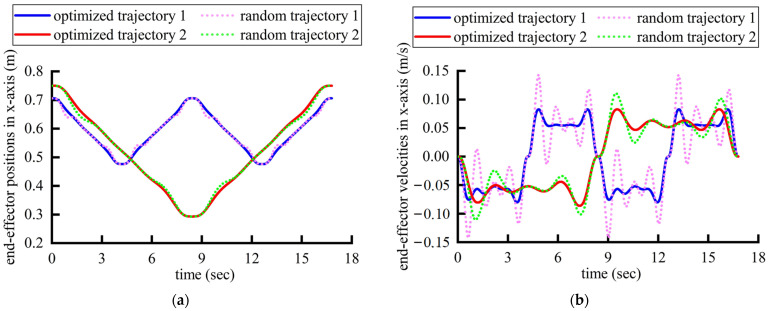
In rehabilitation, physicians plan lower-limb exercises via linear guidance. Ensuring efficacy and safety, they design patient-specific paths, carefully plotting smooth trajectories to minimize jerks. Replicating their precision in robotics is a major challenge. This study introduces a linear rehabilitation motion planning method designed for physicians to use a multi-posture lower-limb rehabilitation robot, encompassing both path and trajectory planning. By subdividing the lower limb's action space into four distinct training sections and classifying this space, we articulate the correlation between linear trajectories and key joint rehabilitation metrics. Building upon this foundation, a rehabilitative path generation system is developed, anchored in joint rehabilitation indicators. Subsequently, high-order polynomial curves are employed to mimic the smooth continuity of traditional rehabilitation trajectories and joint motions. Furthermore, trajectory planning is refined through the resolution of a constrained quadratic optimization problem, aiming to minimize the abrupt jerks in the trajectory. The optimized trajectories derived from our experiments are compared with randomly generated trajectories, demonstrating the suitability of trajectory optimization for real-time rehabilitation trajectory planning. Additionally, we compare trajectories generated based on the two groups of joint rehabilitation indicators, indicating that the proposed path generation system effectively assists clinicians in executing efficient and precise robot-assisted rehabilitation path planning.

摘要

在康复治疗中,医生通过线性引导来规划下肢运动。为确保疗效和安全性,他们设计针对患者的运动路径,精心绘制平滑轨迹以尽量减少抖动。在机器人技术中复制这种精度是一项重大挑战。本研究介绍了一种线性康复运动规划方法,旨在让医生能够使用多姿态下肢康复机器人,该方法涵盖路径规划和轨迹规划。通过将下肢的动作空间细分为四个不同的训练部分并对该空间进行分类,我们明确了线性轨迹与关键关节康复指标之间的关联。在此基础上,开发了一个基于关节康复指标的康复路径生成系统。随后,采用高阶多项式曲线来模拟传统康复轨迹和关节运动的平滑连续性。此外,通过解决一个约束二次优化问题来优化轨迹规划,旨在尽量减少轨迹中的突然抖动。将我们实验得出的优化轨迹与随机生成的轨迹进行比较,证明了轨迹优化适用于实时康复轨迹规划。此外,我们比较了基于两组关节康复指标生成的轨迹,表明所提出的路径生成系统有效地协助临床医生执行高效且精确的机器人辅助康复路径规划。
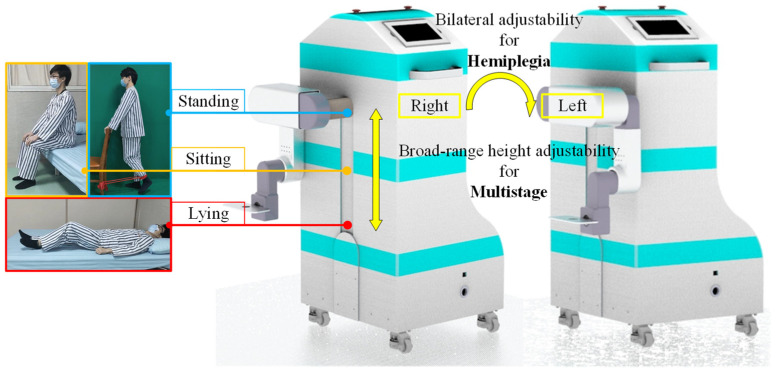
https://cdn.ncbi.nlm.nih.gov/pmc/blobs/7bd3/11644415/cb6a7e1f4ed9/sensors-24-07506-g018a.jpg
https://cdn.ncbi.nlm.nih.gov/pmc/blobs/7bd3/11644415/c415788c03a4/sensors-24-07506-g001.jpg
https://cdn.ncbi.nlm.nih.gov/pmc/blobs/7bd3/11644415/8f97360e52b5/sensors-24-07506-g002.jpg
https://cdn.ncbi.nlm.nih.gov/pmc/blobs/7bd3/11644415/713934a73647/sensors-24-07506-g003.jpg
https://cdn.ncbi.nlm.nih.gov/pmc/blobs/7bd3/11644415/dbe5e4d60968/sensors-24-07506-g004.jpg
https://cdn.ncbi.nlm.nih.gov/pmc/blobs/7bd3/11644415/2630faa1a639/sensors-24-07506-g005.jpg
https://cdn.ncbi.nlm.nih.gov/pmc/blobs/7bd3/11644415/c5fd93cc60d3/sensors-24-07506-g006.jpg
https://cdn.ncbi.nlm.nih.gov/pmc/blobs/7bd3/11644415/3061cb64d470/sensors-24-07506-g007.jpg
https://cdn.ncbi.nlm.nih.gov/pmc/blobs/7bd3/11644415/c6bbfa3b1d90/sensors-24-07506-g008.jpg
https://cdn.ncbi.nlm.nih.gov/pmc/blobs/7bd3/11644415/221f27144e74/sensors-24-07506-g009.jpg
https://cdn.ncbi.nlm.nih.gov/pmc/blobs/7bd3/11644415/1ba6bd5f39ed/sensors-24-07506-g010.jpg
https://cdn.ncbi.nlm.nih.gov/pmc/blobs/7bd3/11644415/808985d6ec24/sensors-24-07506-g011.jpg
https://cdn.ncbi.nlm.nih.gov/pmc/blobs/7bd3/11644415/9fd3514ad2fd/sensors-24-07506-g012.jpg
https://cdn.ncbi.nlm.nih.gov/pmc/blobs/7bd3/11644415/c36254296f3f/sensors-24-07506-g013.jpg
https://cdn.ncbi.nlm.nih.gov/pmc/blobs/7bd3/11644415/977bf8d98f05/sensors-24-07506-g014.jpg
https://cdn.ncbi.nlm.nih.gov/pmc/blobs/7bd3/11644415/f5e0687f75e8/sensors-24-07506-g015.jpg
https://cdn.ncbi.nlm.nih.gov/pmc/blobs/7bd3/11644415/18777bd77ed4/sensors-24-07506-g016.jpg
https://cdn.ncbi.nlm.nih.gov/pmc/blobs/7bd3/11644415/b0ab54e82c2a/sensors-24-07506-g017a.jpg
https://cdn.ncbi.nlm.nih.gov/pmc/blobs/7bd3/11644415/cb6a7e1f4ed9/sensors-24-07506-g018a.jpg
https://cdn.ncbi.nlm.nih.gov/pmc/blobs/7bd3/11644415/c415788c03a4/sensors-24-07506-g001.jpg
https://cdn.ncbi.nlm.nih.gov/pmc/blobs/7bd3/11644415/8f97360e52b5/sensors-24-07506-g002.jpg
https://cdn.ncbi.nlm.nih.gov/pmc/blobs/7bd3/11644415/713934a73647/sensors-24-07506-g003.jpg
https://cdn.ncbi.nlm.nih.gov/pmc/blobs/7bd3/11644415/dbe5e4d60968/sensors-24-07506-g004.jpg
https://cdn.ncbi.nlm.nih.gov/pmc/blobs/7bd3/11644415/2630faa1a639/sensors-24-07506-g005.jpg
https://cdn.ncbi.nlm.nih.gov/pmc/blobs/7bd3/11644415/c5fd93cc60d3/sensors-24-07506-g006.jpg
https://cdn.ncbi.nlm.nih.gov/pmc/blobs/7bd3/11644415/3061cb64d470/sensors-24-07506-g007.jpg
https://cdn.ncbi.nlm.nih.gov/pmc/blobs/7bd3/11644415/c6bbfa3b1d90/sensors-24-07506-g008.jpg
https://cdn.ncbi.nlm.nih.gov/pmc/blobs/7bd3/11644415/221f27144e74/sensors-24-07506-g009.jpg
https://cdn.ncbi.nlm.nih.gov/pmc/blobs/7bd3/11644415/1ba6bd5f39ed/sensors-24-07506-g010.jpg
https://cdn.ncbi.nlm.nih.gov/pmc/blobs/7bd3/11644415/808985d6ec24/sensors-24-07506-g011.jpg
https://cdn.ncbi.nlm.nih.gov/pmc/blobs/7bd3/11644415/9fd3514ad2fd/sensors-24-07506-g012.jpg
https://cdn.ncbi.nlm.nih.gov/pmc/blobs/7bd3/11644415/c36254296f3f/sensors-24-07506-g013.jpg
https://cdn.ncbi.nlm.nih.gov/pmc/blobs/7bd3/11644415/977bf8d98f05/sensors-24-07506-g014.jpg
https://cdn.ncbi.nlm.nih.gov/pmc/blobs/7bd3/11644415/f5e0687f75e8/sensors-24-07506-g015.jpg
https://cdn.ncbi.nlm.nih.gov/pmc/blobs/7bd3/11644415/18777bd77ed4/sensors-24-07506-g016.jpg
https://cdn.ncbi.nlm.nih.gov/pmc/blobs/7bd3/11644415/b0ab54e82c2a/sensors-24-07506-g017a.jpg
https://cdn.ncbi.nlm.nih.gov/pmc/blobs/7bd3/11644415/cb6a7e1f4ed9/sensors-24-07506-g018a.jpg

相似文献

1
A Linear Rehabilitative Motion Planning Method with a Multi-Posture Lower-Limb Rehabilitation Robot.一种基于多姿态下肢康复机器人的线性康复运动规划方法
Sensors (Basel). 2024 Nov 25;24(23):7506. doi: 10.3390/s24237506.
2
Research on the Motion Control Strategy of a Lower-Limb Exoskeleton Rehabilitation Robot Using the Twin Delayed Deep Deterministic Policy Gradient Algorithm.基于双延迟深度确定性策略梯度算法的下肢外骨骼康复机器人运动控制策略研究。
Sensors (Basel). 2024 Sep 17;24(18):6014. doi: 10.3390/s24186014.
3
Creating Better Collision-Free Trajectory for Robot Motion Planning by Linearly Constrained Quadratic Programming.通过线性约束二次规划为机器人运动规划创建更好的无碰撞轨迹
Front Neurorobot. 2021 Aug 9;15:724116. doi: 10.3389/fnbot.2021.724116. eCollection 2021.
4
An Active Control Method for a Lower Limb Rehabilitation Robot with Human Motion Intention Recognition.一种具有人体运动意图识别功能的下肢康复机器人的主动控制方法
Sensors (Basel). 2025 Jan 24;25(3):713. doi: 10.3390/s25030713.
5
Patient's Healthy-Limb Motion Characteristic-Based Assist-As-Needed Control Strategy for Upper-Limb Rehabilitation Robots.基于患者健肢运动特征的辅助按需控制策略在上肢康复机器人中的应用。
Sensors (Basel). 2024 Mar 25;24(7):2082. doi: 10.3390/s24072082.
6
Investigation of Trajectory Tracking Control in Hip Joints of Lower-Limb Exoskeletons Using SSA-Fuzzy PID Optimization.基于麻雀搜索算法-模糊PID优化的下肢外骨骼髋关节轨迹跟踪控制研究
Sensors (Basel). 2025 Feb 22;25(5):1335. doi: 10.3390/s25051335.
7
A Multistage Hemiplegic Lower-Limb Rehabilitation Robot: Design and Gait Trajectory Planning.多阶段偏瘫下肢康复机器人:设计与步态轨迹规划。
Sensors (Basel). 2024 Apr 5;24(7):2310. doi: 10.3390/s24072310.
8
Kinematic Redundancy Analysis during Goal-Directed Motion for Trajectory Planning of an Upper-Limb Exoskeleton Robot.用于上肢外骨骼机器人轨迹规划的目标导向运动中的运动学冗余分析
Annu Int Conf IEEE Eng Med Biol Soc. 2019 Jul;2019:5251-5255. doi: 10.1109/EMBC.2019.8857716.
9
[Study on the center-driven multiple degrees of freedom upper limb rehabilitation training robot].[中心驱动多自由度上肢康复训练机器人的研究]
Sheng Wu Yi Xue Gong Cheng Xue Za Zhi. 2018 Jun 25;35(3):452-459. doi: 10.7507/1001-5515.201703052.
10
Trajectory Deformation-Based Multi-Modal Adaptive Compliance Control for a Wearable Lower Limb Rehabilitation Robot.基于轨迹变形的可穿戴下肢康复机器人多模态自适应顺应性控制
IEEE Trans Neural Syst Rehabil Eng. 2024;32:314-324. doi: 10.1109/TNSRE.2023.3348332. Epub 2024 Jan 15.

本文引用的文献

1
A Multistage Hemiplegic Lower-Limb Rehabilitation Robot: Design and Gait Trajectory Planning.多阶段偏瘫下肢康复机器人:设计与步态轨迹规划。
Sensors (Basel). 2024 Apr 5;24(7):2310. doi: 10.3390/s24072310.
2
Stiff Knee Gait Disorders as Neuromechanical Consequences of Spastic Hemiplegia in Chronic Stroke.僵硬膝关节步态障碍是慢性脑卒中痉挛性偏瘫的神经机械后果。
Toxins (Basel). 2023 Mar 7;15(3):204. doi: 10.3390/toxins15030204.
3
Effectiveness of Stretching in Post-Stroke Spasticity and Range of Motion: Systematic Review and Meta-Analysis.
拉伸对中风后痉挛和关节活动范围的有效性:系统评价与荟萃分析
J Pers Med. 2021 Oct 24;11(11):1074. doi: 10.3390/jpm11111074.
4
Effects of limited knee flexion movement in intra-limb gait coordination.肢体内步态协调中膝关节弯曲运动受限的影响。
J Biomech. 2021 Nov 9;128:110712. doi: 10.1016/j.jbiomech.2021.110712. Epub 2021 Aug 27.
5
Using the Flexor Reflex in a Chronic Stroke Patient for Gait Improvement: A Case Report.在一名慢性中风患者中利用屈肌反射改善步态:病例报告
Front Neurol. 2021 Jun 18;12:691214. doi: 10.3389/fneur.2021.691214. eCollection 2021.
6
Relationships Between Stepping-Reaction Movement Patterns and Clinical Measures of Balance, Motor Impairment, and Step Characteristics After Stroke.脑卒中后步态反应运动模式与平衡、运动障碍和步态特征的临床测量指标之间的关系。
Phys Ther. 2021 May 4;101(5). doi: 10.1093/ptj/pzab069.
7
[Robot therapy with the H2 exoskeleton for gait rehabilitation in patients with incomplete spinal cord injry. A clinical experience].[使用H2外骨骼机器人疗法对不完全性脊髓损伤患者进行步态康复。临床经验]
Rehabilitacion (Madr). 2020 Apr-Jun;54(2):87-95. doi: 10.1016/j.rh.2019.10.004. Epub 2020 Mar 31.
8
Associations between lower-limb muscle activation and knee flexion in post-stroke individuals: A study on the stance-to-swing phases of gait.中风后个体下肢肌肉激活与膝关节屈曲之间的关联:一项关于步态站立期到摆动期的研究。
PLoS One. 2017 Sep 8;12(9):e0183865. doi: 10.1371/journal.pone.0183865. eCollection 2017.
9
Gait training with Hybrid Assistive Limb enhances the gait functions in subacute stroke patients: A pilot study.使用混合辅助肢体进行步态训练可增强亚急性中风患者的步态功能:一项初步研究。
NeuroRehabilitation. 2017;40(1):87-97. doi: 10.3233/NRE-161393.
10
The combined effects of guidance force, bodyweight support and gait speed on muscle activity during able-bodied walking in the Lokomat.在Lokomat中进行健全人步行时,引导力、体重支持和步速对肌肉活动的综合影响。
Clin Biomech (Bristol). 2016 Jul;36:65-73. doi: 10.1016/j.clinbiomech.2016.04.013. Epub 2016 Apr 27.