Amdemicael Beemnet, Yang Kun, Chronister Briana N C, Mackey Caroline, Tu Xin, Gahagan Sheila, Martinez Danilo, Checkoway Harvey, Jacobs David R, Suarez-Torres Jose, Hong Suzi, Suarez-Lopez Jose R
School of Medicine, University of California, San Diego, 9500 Gilman Drive #0832, La Jolla, CA, 92093-0832, USA.
Herbert Wertheim School of Public Health and Human Longevity Science, University of California, San Diego, 9500 Gilman Drive #0725, La Jolla, CA, 92024-0725, USA.
Brain Behav Immun Health. 2024 Nov 23;43:100912. doi: 10.1016/j.bbih.2024.100912. eCollection 2025 Feb.
Systemic inflammation has been associated with lower neurobehavioral performance in diverse populations, yet the evidence in adolescents remains lacking. Cytokines can alter neural network activity to induce neurocognitive changes. This work seeks to investigate the association between inflammation and neurobehavior in adolescents living in a rural region of Ecuador.
We examined 535 adolescents in rural communities of Ecuador (ESPINA study), 508 of which had neurobehavioral assessments (NEPSY-II) and circulating plasma levels of inflammatory markers (CRP, IL-6, TNF-⍺, sICAM-1, sVCAM-1, SAA, and sCD14). Associations between inflammatory biomarker concentrations and neurobehavioral scores were examined using adjusted bivariate semi-parametric models with generalized estimating equations. A partial least squares regression approach was used to create composite variables from multiple inflammation biomarkers and model their association with cognitive outcomes.
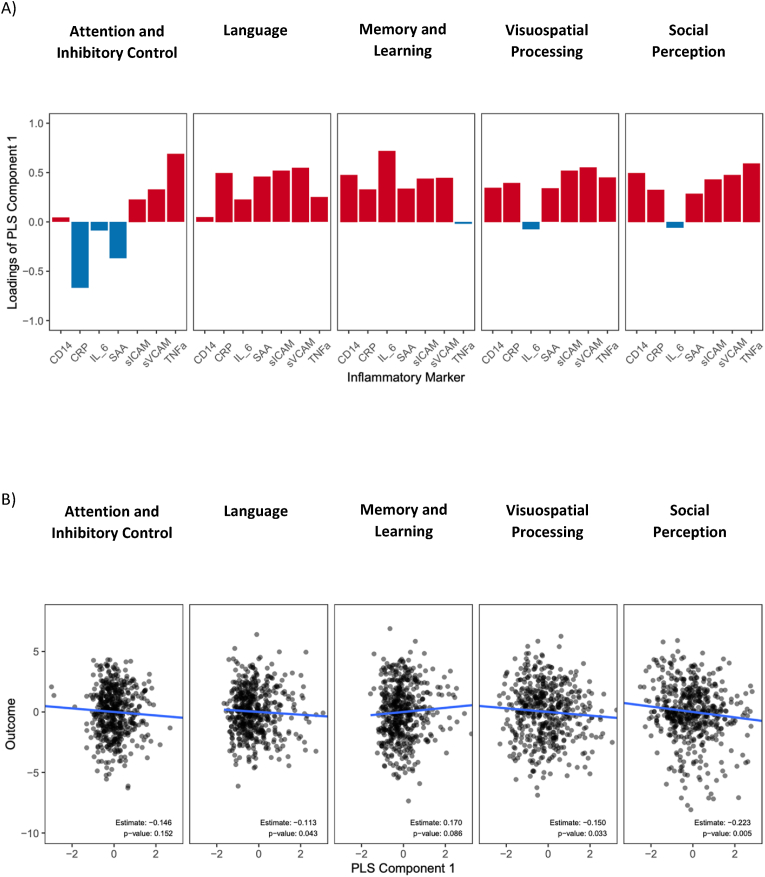
Higher sCD14 and TNF-α concentrations were significantly associated with lower social perception scores, by -0.465 units (95% CI: -0.80, -0.13) and -0.418 units (-0.72, -0.12) for every 50% increase in inflammatory marker concentration, respectively. Similarly, every 50% increase in the inflammation summary score was associated with a significantly lower Social Perception score by -0.112 units (-0.19, -0.03). A greater inflammatory composite variable from seven markers was associated with lower scores in language (β = -0.11, p = 0.043), visuospatial processing (β = -0.15, p = 0.086), and social perception (β = -0.22, p = 0.005) domains.
Higher levels of inflammation were associated with lower neurobehavioral performance in adolescents, especially with social perception. In addition, using a robust analytic method to examine an association between a composite inflammatory variable integrating seven markers led to additional findings, including the domains of language and visuospatial processing. A longitudinal follow-up of such investigations could unveil potential changes in inflammation-neurobehavior performance links through developmental stages and intervention opportunities.
全身炎症与不同人群较低的神经行为表现有关,但青少年中的证据仍然缺乏。细胞因子可改变神经网络活动以诱导神经认知变化。这项研究旨在调查厄瓜多尔农村地区青少年炎症与神经行为之间的关联。
我们对厄瓜多尔农村社区的535名青少年进行了检查(ESPINA研究),其中508名进行了神经行为评估(NEPSY-II)并检测了循环血浆中炎症标志物(CRP、IL-6、TNF-α、sICAM-1、sVCAM-1、SAA和sCD14)的水平。使用带有广义估计方程的调整后双变量半参数模型检查炎症生物标志物浓度与神经行为评分之间的关联。采用偏最小二乘回归方法从多个炎症生物标志物创建复合变量,并对其与认知结果的关联进行建模。
炎症标志物浓度每增加50%,较高的sCD14和TNF-α浓度分别与较低的社会感知评分显著相关,降低0.465分(95%置信区间:-0.80,-0.13)和0.418分(-0.72,-0.12)。同样,炎症综合评分每增加50%,社会感知评分显著降低0.112分(-0.19,-0.03)。来自七个标志物的更大炎症复合变量与语言(β = -0.11,p = 0.043)、视觉空间处理(β = -0.15,p = 0.086)和社会感知(β = -0.22,p = 0.005)领域的较低评分相关。
较高水平的炎症与青少年较低的神经行为表现有关,尤其是与社会感知有关。此外,使用稳健的分析方法检查整合七个标志物的复合炎症变量之间的关联产生了额外的发现,包括语言和视觉空间处理领域。对此类研究进行纵向随访可以揭示炎症与神经行为表现之间在发育阶段和干预机会方面的潜在变化。