Horan Louise, Patton Joseph, McAloon Conor G, García-Muñoz Ángel, Regan Áine, Mee John F, Valldecabres Ainhoa
Animal and Grassland Research and Innovation Centre, Teagasc Moorepark, Fermoy, Co. Cork, Ireland.
School of Veterinary Medicine, University College Dublin, Belfield, Dublin, Ireland.
PLoS One. 2024 Dec 17;19(12):e0314987. doi: 10.1371/journal.pone.0314987. eCollection 2024.
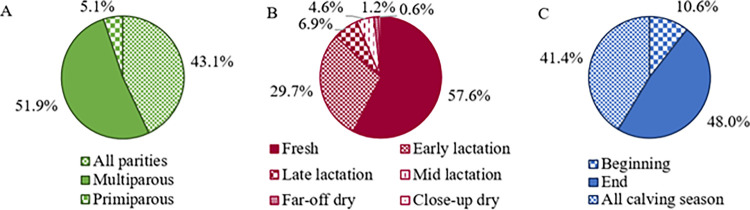
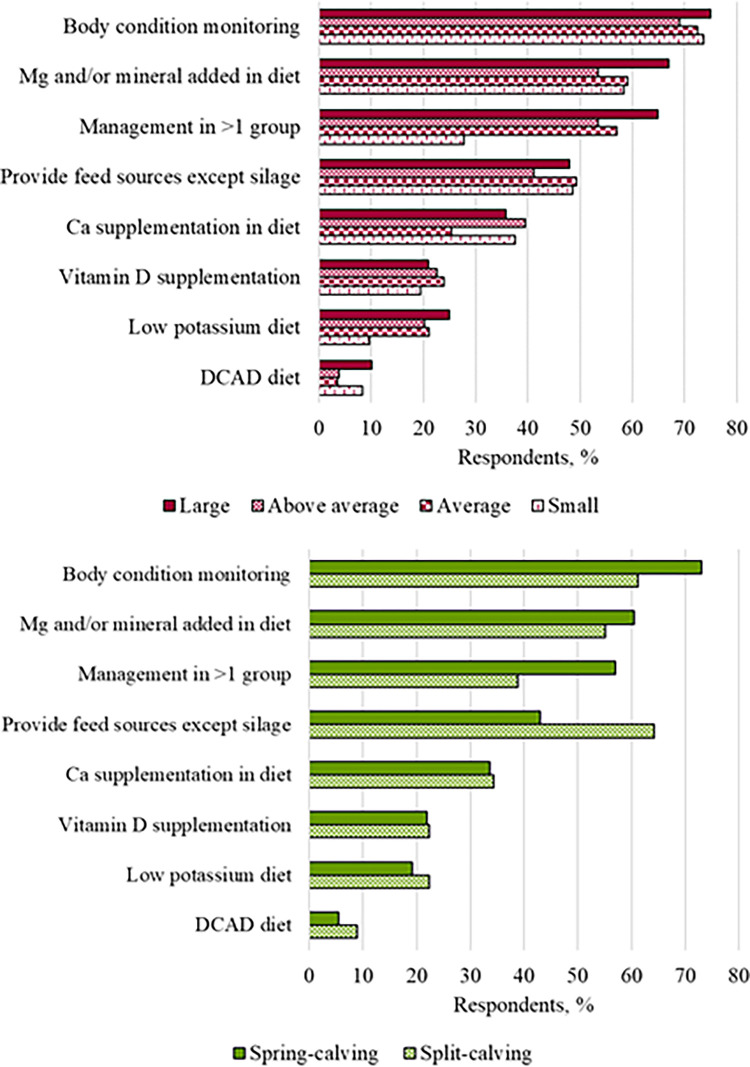
Seasonal-calving pasture-based systems characterize Irish dairy production. During the dry period, cows are housed and offered predominantly grass silage, providing unique transition cow management opportunities. This study aimed to describe transition period disease incidence and management strategies reported by farmers, and to evaluate their associations with herd size and calving pattern to inform and guide research activities and national advisory. An online survey distributed amongst 3,899 Teagasc Technical Dairy Advisory clients yielded 525 responses suitable for analysis. Results are presented for all respondents, by herd size and by the two most common calving systems (spring- [84.3%; 439/521] and split-calving [12.9%; 67/521]). Disease incidence was reportedly highest in cows within their first 3 weeks postpartum (58%; 299/519), in cows calving at the end of the calving season (48%; 245/510) and in multiparous cows (52%; 266/513). Respondents reported treating >3% of their herd for milk fever (23%; 120/521) and retained placenta (13%; 68/518), and <1% of their herd for grass tetany (82.6%; 419/507) and ketosis (72.7%; 368/506). Regarding management, dry cow body condition monitoring (73%; 365/497), dry cow mineral supplementation (61%; 304/497), and Ca supplementation at calving (61%; 314/487) were most commonly reported. Other milk fever prevention strategies supported by research in other production systems were not commonly reported (low K [20%; 101/497] and negative dietary cation-anion difference diet [6%; 31/497]). The odds of reporting keeping records of antibiotic treatment for milk fever were higher (OR = 3.20) for farmers from small compared to large herds. In conclusion, responses to our survey suggest that milk fever is a transition cow health concern in Irish dairy farms. Efforts should be devoted to enhance farmers' uptake of existing research-supported prophylactic strategies for milk fever and to optimize commonly reported management strategies in the Irish dairy production context.
季节性产犊的草地养殖系统是爱尔兰奶牛养殖的特点。在干奶期,奶牛被圈养,主要饲喂青贮牧草,这提供了独特的围产母牛管理机会。本研究旨在描述农民报告的围产期疾病发病率和管理策略,并评估它们与牛群规模和产犊模式的关联,以为研究活动和国家咨询提供信息并给予指导。在3899名Teagasc技术奶牛咨询客户中进行的一项在线调查获得了525份适合分析的回复。结果按所有受访者、牛群规模以及两种最常见的产犊系统(春季产犊[84.3%;439/521]和分批产犊[12.9%;67/521])呈现。据报告,产后前3周的奶牛疾病发病率最高(58%;299/519),产犊季节末期产犊的奶牛发病率最高(48%;245/510),经产母牛发病率最高(52%;266/513)。受访者报告称,有超过3%的牛群因产乳热(23%;120/521)和胎衣不下(13%;68/518)接受治疗,而因青草搐搦(82.6%;419/507)和酮病(72.7%;368/506)接受治疗的牛群不到1%。关于管理方面,最常报告的是干奶牛体况监测(73%;365/497)、干奶牛矿物质补充(61%;304/497)以及产犊时补钙(61%;314/487)。其他生产系统研究支持的其他预防产乳热的策略报告较少(低钾[20%;101/497]和负性日粮阴阳离子差日粮[6%;31/497])。与大牛群的农民相比,小牛群的农民报告记录产乳热抗生素治疗情况的几率更高(OR = 3.2)。总之,我们调查的回复表明,产乳热是爱尔兰奶牛场围产母牛的健康问题。应致力于提高农民对现有研究支持的产乳热预防策略的采用率,并在爱尔兰奶牛生产背景下优化常见的管理策略。